



Gol-NTR

Based on 1 Customer Validation
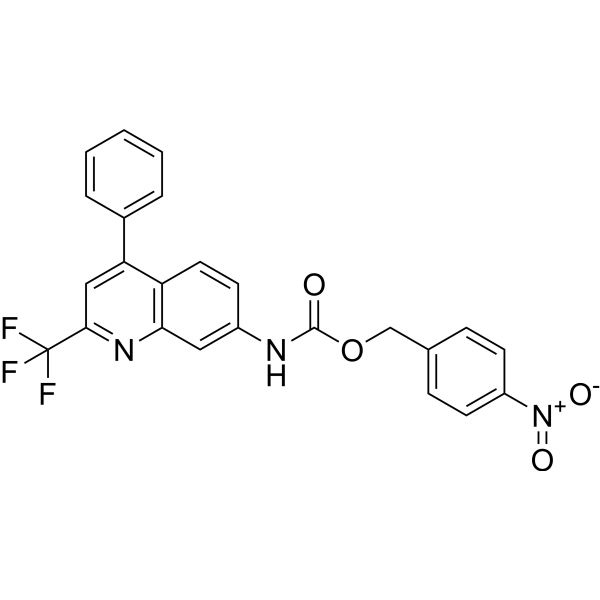
Gol-NTR is a Golgi-targetable probe with high selectivity and sensitivity. Gol-NTR is Nitroreductase (NTR)-activated and has visualization acute lung injury (ALI) and repair function. Gol-NTR has a low detection limit of 54.8 ng/mL. Gol-NTR can be used for the research for monitoring and assessing research response of sepsis-induced ALI.
商品は「研究用試薬」です。人や動物の医療用・臨床診断用・食品用の製品ではありません。
研究用途以外に使用した場合、当社は一切の責任を負いかねます。
- 純度 : 99.44%
- CAS 番号: 2968461-58-5
- 分子式: C24H16F3N3O4
- 分子量:467.40
-
保管条件:
4°C, sealed storage, away from moisture and light
* In solvent : -80°C, 6 months; -20°C, 1 month (sealed storage, away from moisture and light)

To place orders, for customer services and technical support, please contact: MedChemExpress USA
Tel: 609-228-6898 E-mail: [email protected] [email protected]


-
 生物活性
生物活性
-
化学情報
- プロトコル
- 純度とドキュメンテーション
- 参考文献
-
 Help & FAQs




生物活性
製品説明
体外実験
Guide (Following is our recommended protocol. This protocol only provides a guideline, and should be modified according to your specific needs).
Fluorescent labeling of NTR by Gol-NTR[1]
(1) Prepare 1.0 mM Gol-NTR stock solution with DMSO solution.
(2) Dilute the stock solution with DMSO solution to prepare 5.0 μM Gol-NTR working solution.
(3) Mix 5.0 μM Gol-NTR with 50 μM NADH in PBS buffer (10 mM, pH 7.4) containing 5% DMSO, and then add appropriate NTR.
(4) After incubation at 37°C for 30 min, the spectra was recorded at 405 nm (slit width: dex/dem=5/5 nm).
Fluorescence labeling of NTR in A549 cells by Gol-NTR[1]
(1) A549 cells were cultured at different oxygen concentrations (1%, 5%, 10%, 15% and 20% O2) for 8 h.
(2) A549 cells were washed with phosphate buffered saline (PBS).
(3) A549 cells were treated with 5.0 μM Gol-NTR for 1 h.
(4) Fluorescence images of A549 cells were observed using confocal fluorescence imaging.
MedChemExpress (MCE) has not independently confirmed the accuracy of these methods. They are for reference only. Further protocols information, click here.
体内実験
(1) C57BL/6 male mice (6-8 weeks old, weight 20-22 g) were pre injected with 300 μL DMOG (25 mg/mL), after 24 h, intraperitoneal injection of 300 μL LPS (10 mg/kg) for 6 h.
(2) Mice were killed by cervical vertebra dislocation and lung organs were collected.
(3) After washing with PBS, incubate with 50 μM Gol-NTR in PBS for 1 h.
(4) After washing with PBS, fluorescence imaging was performed on a small animal imaging system (excitation wavelength of 420 nm and emission wavelength of 510 nm).
MedChemExpress (MCE) has not independently confirmed the accuracy of these methods. They are for reference only.
Emission (Em)
730
Excitation (Ex)
680


化学情報
-
CAS 番号 2968461-58-5
-
性状 Solid
-
分子量 467.40
-
分子式 C24H16F3N3O4
-
Color White to off-white
-
SMILES
FC(F)(C1=NC(C=C(NC(OCC2=CC=C([N+]([O-])=O)C=C2)=O)C=C3)=C3C(C4=CC=CC=C4)=C1)F
-
輸送条件
Room temperature in continental US; may vary elsewhere.
-
保管条件
4°C, sealed storage, away from moisture and light
* In solvent : -80°C, 6 months; -20°C, 1 month (sealed storage, away from moisture and light)

プロトコル
-
LPS-Induced Endotoxemia/Systemic Inflammation
Lipopolysaccharide (LPS)-induced endotoxemia is a widely used in vivo model of acute systemic inflammation in which LPS, a Gram-negative bacterial endotoxin, activates innate immune signaling primarily through TLR4, leading to rapid and transient induction of pro-inflammatory cytokines such as TNF-α, IL-6, and IL-1β in circulation and tissues. This cytokine surge is commonly used as a measurable readout of systemic inflammatory activation and immune dysregulation, and is typically assessed within hours after intraperitoneal LPS administration in mouse models of endotoxemia. The model captures key features of systemic inflammatory response syndrome, including cytokine release, immune cell activation, and downstream tissue responses, and has been used to evaluate anti-inflammatory interventions such as cytokine modulation, lipid mediators, and immune cell-targeting therapies.
-
Inhalation Toxicity Study
Inhalation toxicity studies expose rodents to a controlled aerosol, vapor, gas, or smoke atmosphere and assess respiratory and systemic toxicity using exposure-atmosphere characterization, clinical observations, body and organ weights, bronchoalveolar lavage fluid, histopathology, blood chemistry, hematology, and, when included, molecular endpoints such as transcriptomics, proteomics, lipidomics, or tissue burden analysis. The primary biological readouts are airway irritation, pulmonary inflammation, cytotoxicity, altered surfactant or lipid homeostasis, impaired particle clearance, and tissue remodeling, reflected by BALF cell differentials, BALF protein, LDH, phosphatase activities, cytokines, lung weight, microscopic respiratory-tract lesions, and retained lung burden.


純度とドキュメンテーション
-
データシート (271 KB)
-
SDS (251 KB)
- English - EN (251 KB)
- Français - FR (251 KB)
- Deutsch - DE (251 KB)
- Norwegian - NO (251 KB)
- Español - ES (251 KB)
- Swedish - SV (251 KB)
- Italian - IT (251 KB)
- Korean - KR (251 KB)
- Portuguese - PT (251 KB)
-
取扱説明書 (2659 KB)
参考文献

Calculators
濃度 (開始) × 体積 (開始) = 濃度 (終了) × 体積 (終了)


Gol-NTR 関連分類
HY-151537 関連分類
 Powered by Bioz