



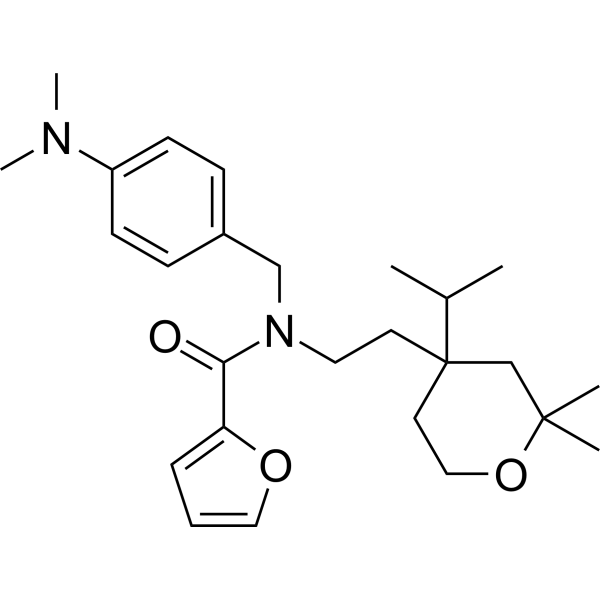
JGB-1-155
JGB-1-155 is a nicotinamide phosphoribosyltransferase (NAMPT) activator and also a reactive oxygen species (ROS) inhibitor. JGB-1-155 binds to NAMPT, thereby enhancing its catalytic activity and increasing intracellular NAD+ levels. JGB-1-155 alleviates the elevation of ROS levels induced by various types of damage. JGB-1-155 can be used in research related to neurodegenerative diseases.
商品は「研究用試薬」です。人や動物の医療用・臨床診断用・食品用の製品ではありません。
研究用途以外に使用した場合、当社は一切の責任を負いかねます。
- CAS 番号: 3011930-28-9
- 分子式: C26H38N2O3
- 分子量:426.59
-
保管条件:
Please store the product under the recommended conditions in the Certificate of Analysis.

To place orders, for customer services and technical support, please contact: MedChemExpress USA
Tel: 609-228-6898 E-mail: [email protected] [email protected]


-
 生物活性
生物活性
-
化学情報
- プロトコル
- 純度とドキュメンテーション
- 参考文献
-
 Help & FAQs




生物活性
製品説明
IC50 & Target
EC50: NAMPT (3.29 μM)
体外実験
JGB-1-155 (3-40 μM) increases NAD+ levels in human THP-1 monocytes in a concentration-dependent manner by directly activating NAMPT[1].
JGB-1-155 activates purified NAMPT enzyme with an EC50 of 3.88 μM[2].
JGB-1-155 (1.25-40 μM) attenuates glutamate-induced mitochondrial ROS in mouse HT-22 hippocampal neuron cells in a concentration-dependent manner[1].
JGB-1-155 (1.25-20 μM; overnight pre-incubation; overnight insult incubation) reduces ROS levels in HT-22 cells exposed to VK3, glutamate, TNFα or hyperconfluent conditions in a dose-dependent manner[2].
MedChemExpress (MCE) has not independently confirmed the accuracy of these methods. They are for reference only.


化学情報
-
CAS 番号 3011930-28-9
-
分子量 426.59
-
分子式 C26H38N2O3
-
SMILES
O=C(N(CCC1(C(C)C)CCOC(C)(C1)C)CC2=CC=C(N(C)C)C=C2)C3=CC=CO3
-
輸送条件
Room temperature in continental US; may vary elsewhere.
-
保管条件
Please store the product under the recommended conditions in the Certificate of Analysis.


純度とドキュメンテーション
参考文献

Calculators
濃度 (開始) × 体積 (開始) = 濃度 (終了) × 体積 (終了)


JGB-1-155 関連分類
HY-163280 関連分類
 Powered by Bioz