



NPD-2975

Based on 1 Customer Validation
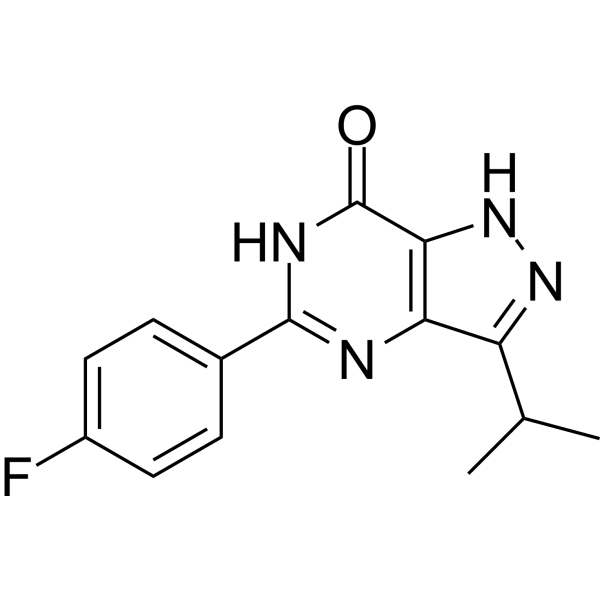
NPD-2975 (compound 30) is an orally active antitrypanosomal agent, against Human African Trypanosomiasis (HAT). NPD-2975 has low toxicity potential against human MRC-5 lung fibroblasts, and acute mouse model of T. b. brucei infection. NPD-2975 shows acceptable metabolic stability, inhibits T. b. brucei with IC500 of 70 nM in vitro. NPD-2975 also inhibits CYP enzymes resulted in IC50 values of 0.16 and 0.42 μM against CYP1A2 and CYP2C19, respectively.
商品は「研究用試薬」です。人や動物の医療用・臨床診断用・食品用の製品ではありません。
研究用途以外に使用した場合、当社は一切の責任を負いかねます。
- 純度 : 98.40%
- CAS 番号: 3032452-65-3
- 分子式: C14H13FN4O
- 分子量:272.28
-
保管条件:Powder -20°C, 3 years ; In solvent -80°C, 6 months , -20°C, 1 month

To place orders, for customer services and technical support, please contact: MedChemExpress USA
Tel: 609-228-6898 E-mail: [email protected] [email protected]


-
 生物活性
生物活性
-
化学情報
- プロトコル
- 純度とドキュメンテーション
- 参考文献
-
 Help & FAQs


Parasite アイソフォーム固有の製品をすべて表示
More

生物活性
製品説明
IC50 & Target
IC50: 70 nM (Trypanosoma brucei), 0.16 μM (CYP1A2), 0.42 μM (CYP2C19)[1]
体内実験
Pharmacokinetic Analysis of NPD-2975 in Mouse Model[1]
| Route | Dose (mg/kg) | Tmax (h) | Cmax (μM) | T1/2 (h) | AUC0-6 h (ng·h/mL) | Cl (mL/min) |
| PO | 50 | 1 | 5.25 | 3.46 | 6064.75 | 58.5 |
| IP | 10 | 13.18 | 1.06 | 3928.37 | 171 |
MedChemExpress (MCE) has not independently confirmed the accuracy of these methods. They are for reference only.


化学情報
-
CAS 番号 3032452-65-3
-
性状 Solid
-
分子量 272.28
-
分子式 C14H13FN4O
-
Color White to off-white
-
SMILES
O=C1C(NN=C2C(C)C)=C2N=C(C3=CC=C(F)C=C3)N1
-
輸送条件
Room temperature in continental US; may vary elsewhere.
-
保管条件
Powder -20°C 3 years In solvent -80°C 6 months -20°C 1 month

プロトコル
-
Research Protocol for Infectious Diseases
Infectious-disease experiments test how pathogens interact with host barriers, innate immune receptors, inflammatory signaling, pathogen replication, and tissue injury; pattern-recognition receptors such as TLRs, RIG-I-like receptors, NOD-like receptors, and inflammasomes detect microbial molecules and activate NF-κB, interferon, and cytokine responses. The central hypothesis is that infection severity reflects the balance between pathogen burden and host response: protective inflammation restricts pathogen growth, whereas excessive or mislocalized inflammation contributes to tissue damage and disease phenotype. Unresolved questions include which host pathways are protective versus pathogenic, why some infection models fail to translate to human disease, and which combined readouts best predict clinically relevant infection outcomes.
-
Cell Cytotoxicity Assay
Cytotoxicity assays are usually based on the assessment of cell membrane damage, which can also be indirectly detected by measuring cell viability. Detection methods include MTT assay, CKK-8 assay, LDH assay and ATP assay, etc.
-
How to Choose the Right Model Animal
Choosing the right model animal is a validity-driven decision in which the species, strain, sex, age, genetic background, disease-induction method, outcome measures, and welfare burden must match the scientific question rather than laboratory tradition or convenience. A model should be selected by judging face validity, construct validity, and predictive validity: whether it resembles the human phenotype, whether it reproduces relevant mechanisms, and whether results are likely to predict human biology or treatment response. Animal studies often fail to translate because of species differences, weak disease resemblance, poor experimental design, inadequate reporting, publication bias, and underuse of randomization, blinding, and sample-size justification. Unresolved questions include how to rank competing models objectively, how much human-disease complexity must be reproduced for a given objective, and when non-animal systems such as organoids, ex vivo tissue, or computational models


純度とドキュメンテーション
-
データシート (272 KB)
-
SDS (251 KB)
- English - EN (251 KB)
- Français - FR (251 KB)
- Deutsch - DE (251 KB)
- Norwegian - NO (251 KB)
- Español - ES (251 KB)
- Swedish - SV (251 KB)
- Italian - IT (251 KB)
- Korean - KR (251 KB)
- Portuguese - PT (251 KB)
-
取扱説明書 (2659 KB)
参考文献

Calculators
濃度 (開始) × 体積 (開始) = 濃度 (終了) × 体積 (終了)


NPD-2975 関連分類
HY-155732 関連分類
 Powered by Bioz