



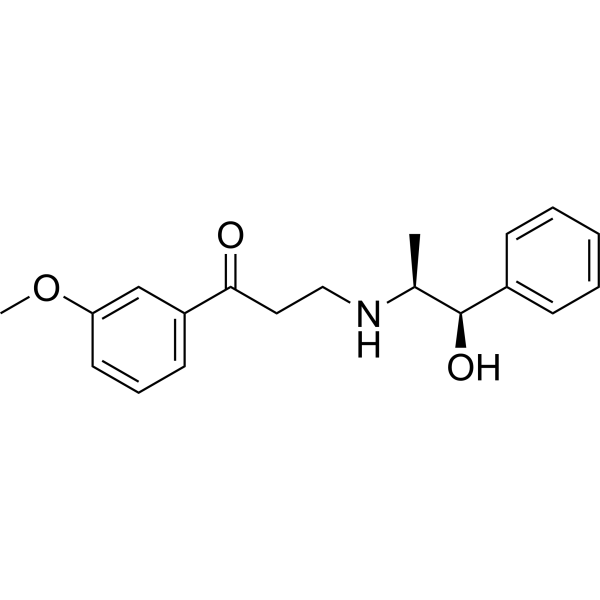
Oxyfedrine
Oxyfedrine, a vasodilator, is an orally active β-adrenoreceptor agonist. Oxyfedrine decreases the tonicity of coronary vessels. Oxyfedrine can be used in the research of cardiovascular disease.
商品は「研究用試薬」です。人や動物の医療用・臨床診断用・食品用の製品ではありません。
研究用途以外に使用した場合、当社は一切の責任を負いかねます。
- CAS 番号: 15687-41-9
- 分子式: C19H23NO3
- 分子量:313.39
-
保管条件:
Please store the product under the recommended conditions in the Certificate of Analysis.

To place orders, for customer services and technical support, please contact: MedChemExpress USA
Tel: 609-228-6898 E-mail: [email protected] [email protected]


-
 生物活性
生物活性
-
化学情報
- プロトコル
- 純度とドキュメンテーション
- 参考文献
-
 Help & FAQs


Adrenergic Receptor アイソフォーム固有の製品をすべて表示
More

生物活性
製品説明
IC50 & Target
[1]|
β-adrenoceptor |
体外実験
Oxyfedrine (50 μM, 48 h) suppresses aldehyde dehydrogenase (ALDH) activity in HCT116 and HSC-4 cells[1].
Oxyfedrine (50 μM, 48 h) acts as a sensitizer for GSH-depleting agents, and induces cell death in HCT116 and HSC-4 cells when with the drug combinations[1].
Oxyfedrine (0-1 μg/mL) inhibits spontaneous myogenic activity in rat isolated portal vein[4].
MedChemExpress (MCE) has not independently confirmed the accuracy of these methods. They are for reference only.
体内実験
Oxyfedrine (10 mg/kg, i.p., HCT116 cell xenograft mice) suppresses tumor growth when combined with sulfasalazine (SSZ, 350 mg/kg, i.p.)[1].
Oxyfedrine (1 mg/kg, i.v.) decreases the arterial and venous blood high blood viscosity (HBV) in ice water stress rats[3].
MedChemExpress (MCE) has not independently confirmed the accuracy of these methods. They are for reference only.
-
Animal Model:Cats[2]
-
Dosage:14 mg/kg
-
Administration:Oral administration (p.o.), for 3-4 weeks.
-
Result:Decreased systolic and diastolic blood pressures, increased heart rate and cardiac output.


化学情報
-
CAS 番号 15687-41-9
-
分子量 313.39
-
分子式 C19H23NO3
-
SMILES
O=C(C1=CC=CC(OC)=C1)CCN[C@@H](C)[C@H](O)C2=CC=CC=C2
-
輸送条件
Room temperature in continental US; may vary elsewhere.
-
保管条件
Please store the product under the recommended conditions in the Certificate of Analysis.


純度とドキュメンテーション
参考文献
[1]. Otsuki Y, et al. Vasodilator oxyfedrine inhibits aldehyde metabolism and thereby sensitizes cancer cells to xCT-targeted therapy. Cancer Sci. 2020 Jan;111(1):127-136. [Content Brief]
[2]. Parratt JR. The haemodynamic effects of prolonged oral administration of oxyfedrine, a partial agonist at beta-adrenoceptors: comparison with propranolol. Br J Pharmacol. 1974 May;51(1):5-13. [Content Brief]
[3]. Yu J, et al. [Effects of oxyfedrine on high blood viscosity and myocardial necrosis induced by epinephrine and ice water stress in rats]. Zhongguo Yao Li Xue Bao. 1993 Jul;14(4):364-6. [Content Brief]
[4]. Mackenzie JE, et al. Effects of oxyfedrine on isolated portal vein and other smooth muscles. Br J Pharmacol. 1973 Apr;47(4):827-37. [Content Brief]

Calculators
濃度 (開始) × 体積 (開始) = 濃度 (終了) × 体積 (終了)


Oxyfedrine 関連分類
HY-112070 関連分類
 Powered by Bioz