



Poly(methyl methacrylate)

Based on 1 Customer Validation
Poly (methyl methacrylate) (Poly(methyl methacrylate), beads; PMMA) is an amorphous glassy acrylic thermoplastic polymer belonging to the acrylate family, synthesized from methyl methacrylate monomers. Poly (methyl methacrylate) drives biochemical processes including free volume expansion induced by inelastic deformation, yield stress and strain softening regulated by physical aging, acid hydrolysis to polymethacrylic acid, multi-stage combustion, oxygen-dependent thermal decomposition, primary amine-mediated polypentanimide formation, and grafting/crosslinking-based copolymer and composite formation. Poly (methyl methacrylate) exhibits histocompatibility, low toxicity, low inflammatory potential, and fracture resistance; it can form functional blends and composites for biomedical and dental applications; it also allows performance-enhancing chemical and mechanical modifications. Poly (methyl methacrylate) is applicable to studies related to cranial repair.
商品は「研究用試薬」です。人や動物の医療用・臨床診断用・食品用の製品ではありません。
研究用途以外に使用した場合、当社は一切の責任を負いかねます。
- CAS 番号: 9011-14-7
-
保管条件:
4°C, stored under nitrogen
* In solvent : -80°C, 6 months; -20°C, 1 month (stored under nitrogen)


To place orders, for customer services and technical support, please contact: MedChemExpress USA
Tel: 609-228-6898 E-mail: [email protected] [email protected]


-
 生物活性
生物活性
-
化学情報
- 純度とドキュメンテーション
- 参考文献
-
 Help & FAQs


-
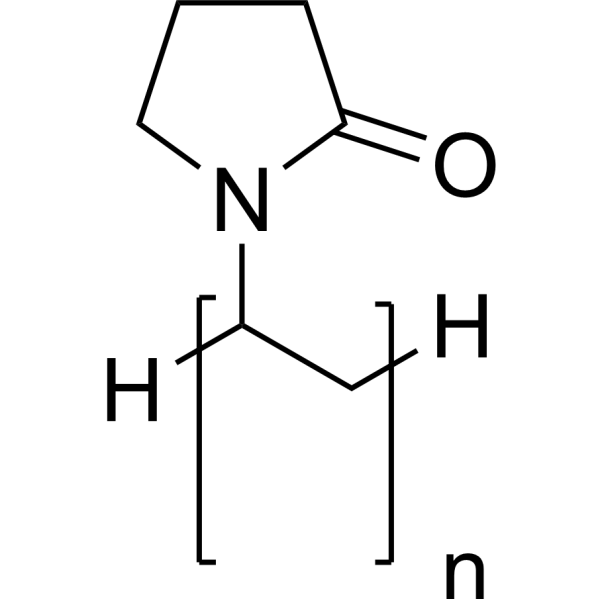
HY-B1620
Polyvinylpyrrolidone K30Disinfectant -

HY-B1620L
Polyvinylpyrrolidone, average Mw~40000Polyvinylpyrrolidone -

HY-B1620J
Polyvinylpyrrolidone, average Mw~10000Polyvinylpyrrolidone -

HY-B1620N
Polyvinylpyrrolidone, average Mw~360000Polyvinylpyrrolidone -

HY-B1620C
Polyvinylpyrrolidone K17Polymer -

HY-B1620B
Polyvinylpyrrolidone K15Polyvinylpyrrolidone -

HY-B1620H
Polyvinylpyrrolidone K90Disinfectant -

HY-B1620D
Polyvinylpyrrolidone K25Polyvinylpyrrolidone -

HY-B1620I
Polyvinylpyrrolidone K120Polyvinylpyrrolidone -

HY-B1620K
Polyvinylpyrrolidone, average Mw~29000Polyvinylpyrrolidone -

HY-B1620E
Polyvinylpyrrolidone K60Polyvinylpyrrolidone -
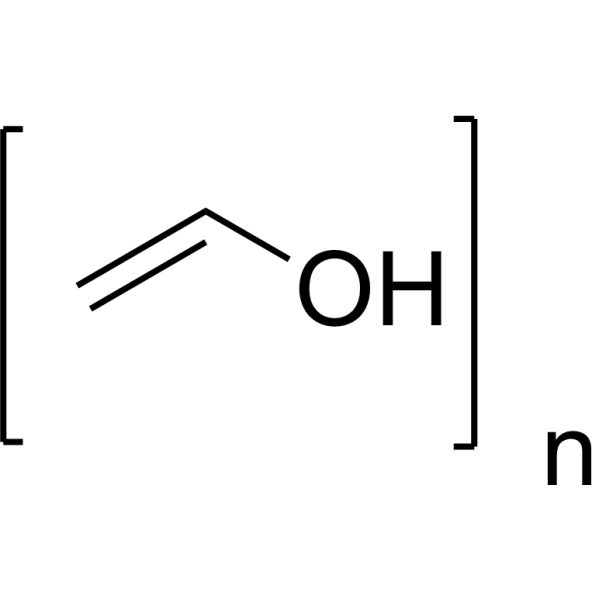
HY-Y0850E
Polyvinyl alcohol (Mw 30000-70000, 87-90% hydrolyzed)Dressing Meterial


生物活性
製品説明
体外実験
Poly (methyl methacrylate) can be synthesized into controlled living polymers via hours-long atom transfer radical polymerization; its hydrolysis performance is regulated by stereostructure; products from radical polymerization undergo thermal decomposition at 220 ℃, while products from anionic polymerization exhibit higher heat resistance, and the main thermal decomposition product of both types of materials is methyl methacrylate; in a toluene/methanol mixed solvent at 200 ℃, this polymer can react with primary amines to form polyglutarimide[2].
Poly (methyl methacrylate) can be used to prepare a nanocomposite system via in-situ polymerization with dispersed multi-walled carbon nanotubes. The volume conductivity of the material increases by up to 106 orders of magnitude, converting the insulating substrate into a semiconductor material[2].
Poly (methyl methacrylate) can be used to prepare gel polymer electrolytes suitable for lithium-ion batteries; its reduced graphene oxide composite fiber coating exhibits higher ammonia detection sensitivity than single-component coatings, and this system can be applied to ammonia sensing; modification of TiO2 photoanodes with composite NaGdF4:Eu down-conversion layers increases the photoelectric conversion efficiency of dye-sensitized solar cells by 4.5%; the silica composite system prepared via two-step modified polymerization shows 80.6% and 127.3% increases in tensile and flexural strength, respectively, compared with pure samples[2].
Poly (methyl methacrylate) exhibits better biocompatibility than cold-cured PMMA, with lower residual monomer elution and cytotoxicity; prolonging curing time and water soaking treatment can further reduce its cytotoxicity; it also possesses superior water-related physical properties, including low water absorption (0.69 mg/cm2), low water solubility (0.02 mg/cm2 in water) and low thermal conductivity[3].
Poly (methyl methacrylate) exhibits excellent mechanical properties, lower adhesion to Candida albicans, and comparable biocompatibility. It enhances mechanical properties such as Vickers hardness, flexural strength, and fracture toughness, making it more suitable for dental restoration applications[3].
Poly (methyl methacrylate) (following 24 h microbial incubation) exhibits significant antibacterial activity against oral pathogenic bacteria, while maintaining good biocompatibility with L929 cells[3].
MedChemExpress (MCE) has not independently confirmed the accuracy of these methods. They are for reference only. .
体内実験
Poly (methyl methacrylate) (PMMA) bone cements (implantation; 2-52 weeks) exhibit in vivo biocompatibility for up to 52 weeks after implantation into the knee joints of mice[2].
MedChemExpress (MCE) has not independently confirmed the accuracy of these methods. They are for reference only.
臨床実験
| NCT Number | Sponsor | Condition | Start Date |
Phase

|
|---|---|---|---|---|
| NCT01329991 | Plexxikon| | 2011-05 | PHASE1 |


化学情報
-
CAS 番号 9011-14-7
-
性状 Solid
-
Color White to off-white
-
SMILES
CC(C(OC)=O)=C.[x]
-
別名
Poly(methyl methacrylate), beads; PMMA
-
輸送条件
Room temperature in continental US; may vary elsewhere.
-
保管条件
4°C, stored under nitrogen
* In solvent : -80°C, 6 months; -20°C, 1 month (stored under nitrogen)


純度とドキュメンテーション
-
データシート (274 KB)
-
SDS (394 KB)
- English - EN (394 KB)
- Français - FR (394 KB)
- Deutsch - DE (394 KB)
- Norwegian - NO (394 KB)
- Español - ES (394 KB)
- Swedish - SV (394 KB)
- Italian - IT (394 KB)
- Korean - KR (394 KB)
- Portuguese - PT (394 KB)
-
取扱説明書 (2659 KB)
参考文献

Calculators
濃度 (開始) × 体積 (開始) = 濃度 (終了) × 体積 (終了)


Poly(methyl methacrylate) 関連分類
HY-W391506 関連分類
 Powered by Bioz
Keywords
- Poly(methyl methacrylate)
- 9011-14-7
- Poly(methyl methacrylate), beads
- PMMA
- Biochemical Assay Reagents
- Drug Intermediate
- poly(methacrylic acid)
- lithium ion battery
- MWCNTs
- methyl methacrylate monomer
- poly(glutarimide)
- dye-sensitized solar cells
- ammonia gas
- L929 cells
- Candida albicans
- Atom Transfer Radical Polymerization
- Inhibitor
- inhibitor
- inhibit