



Tragacanth gum

Based on 1 Customer Validation
Tragacanth gum is an orally active anionic composite polysaccharide and multifunctional biomaterial. Tragacanth gum exhibits biocompatibility, mucoadhesion and renoprotective effects, and effectively promotes wound closure and tissue healing. Tragacanth gum can be isolated from Astragalus gummifer. Tragacanth gum acts as an emulsifier and drug delivery carrier, and is also widely used in fields such as 3D scaffolds, tissue engineering and green nanoparticle preparation. High doses of Tragacanth gum may induce reversible forestomach squamous epithelial hyperplasia in mice, but show no mutagenic or carcinogenic activity. Tragacanth gum is commonly used in studies related to diseases including systemic candidiasis, rheumatoid arthritis and osteosarcoma.
商品は「研究用試薬」です。人や動物の医療用・臨床診断用・食品用の製品ではありません。
研究用途以外に使用した場合、当社は一切の責任を負いかねます。
- CAS 番号: 9000-65-1
-
保管条件:Powder -20°C, 3 years , 4°C, 2 years ; In solvent -80°C, 6 months , -20°C, 1 month


To place orders, for customer services and technical support, please contact: MedChemExpress USA
Tel: 609-228-6898 E-mail: [email protected] [email protected]


-
 生物活性
生物活性
-
化学情報
-
溶剤 & 溶解度
- プロトコル
- 純度とドキュメンテーション
- 参考文献
-
 Help & FAQs


-
HY-W011094
Win 18446ALDH1a2 Inhibitor -
HY-W145520
AmylopectinBranched Glucan Ppolymer -

HY-N7075
InulinEndogenous Metabolite -

HY-N6664
Gum arabicComplex Branched Polysaccharide -
HY-139413
β-D-GlucanNon-digestible Polysaccharide -
HY-A0103
Xanthan gumhydrogel Modulator -

HY-107846
XylanActive Compound -
HY-119109
LaminaranImmunotherapy Agent -
HY-W145481
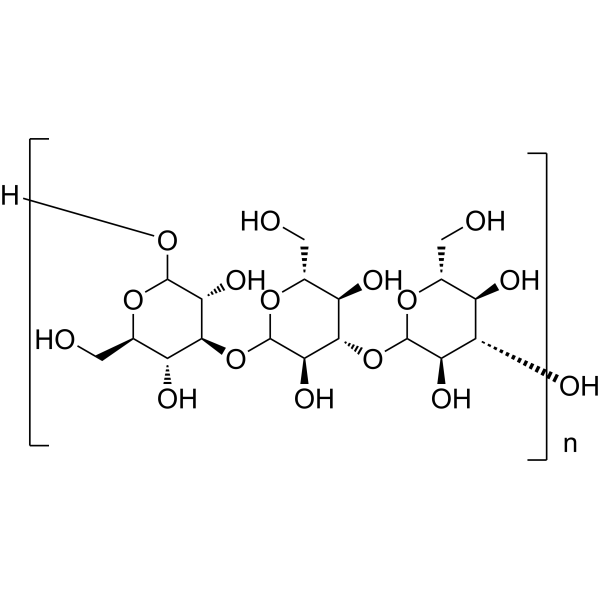
D-Galacto-D-mannan, 95%Biochemical Assay Reagent -

HY-W145481A
D-Galacto-D-mannanDectin-2 Agonist -

HY-W250120
Konjac glucomannan (Viscosity≥15000mPa.s)Biochemical Assay Reagents -

HY-W145665
AmyloseBiochemical Assay Reagent


生物活性
製品説明
体外実験
Iron-crosslinked deesterified Tragacanth gum gel microspheres support the adhesion of L929 fibroblasts and show no toxicity to HeLa, HepG2 and L929 cell lines[1].
Calcium alginate composite microspheres containing Tragacanth gum (25-50% w/w) enhance the viability, proliferation, osteogenic differentiation level, and expression of angiogenic markers of MG-63 osteoblasts compared with calcium alginate microspheres[1].
GPTMS-conjugated Tragacanth gum composite scaffolds support the proliferation and differentiation of MG-63 osteoblasts[1].
Bacterial cellulose/keratin electrospun nanofibers containing Tragacanth gum enhance the adhesion and proliferation capacities of L929 fibroblasts[2].
Calcium alginate microspheres containing Tragacanth gum (25-50 (w/v)) enhance the viability, proliferation and differentiation of encapsulated MG-63 osteocytes, and upregulate HIF-1α expression to strengthen pro-angiogenic activity[2].
Collagen hydrogels containing Tragacanth gum (25 mg/mL; 7-21 d) promote osteogenic differentiation of human adipose-derived mesenchymal stem cells by increasing ALP activity, calcium deposition, and the expression of osteogenesis-related genes[2].
Poly (vinyl alcohol)/tragacanth gum/Polycaprolactone hybrid nanofiber scaffolds support the growth and proliferation of NIH 3T3 fibroblasts[2].
Tragacanth gum exhibits antibacterial activity against Escherichia coli and Staphylococcus aureus, and shows no significant toxicity to human fibroblasts[2].
MedChemExpress (MCE) has not independently confirmed the accuracy of these methods. They are for reference only.
-
Cell Line:human adipose-derived mesenchymal stem cells (h-ASCs)
-
Concentration:25 mg/mL
-
Incubation Time:7, 14, 21 days
-
Result:Showed no cytotoxicity to h-ASCs.
Increased alkaline phosphatase (ALP) activity significantly at 7, 14, and 21 days compared to controls.
Increased calcium content and deposition significantly at 7, 14, and 21 days compared to controls.
Up-regulated expression of osteogenic-related genes (Runx2, collagen type 1, osteonectin, osteocalcin) significantly at 7, 14, and 21 days compared to controls.
体内実験
Oral AmpB-loaded TG-AA hydrogels effectively treat systemic candidiasis in male albino mice with no observed liver or kidney toxicity[1].
Topical tragacanth gum application (topical; single treatment period) achieves 90% closure of full-thickness dorsal wounds in male rats after 7 days[1].
Tragacanth gum (2:1 PCL/GT mass ratio, with 3% curcumin loading; implantation directly onto the wound site) enhances full-thickness diabetic skin wound healing in rats, improving wound closure and histological regenerative markers[2].
Tragacanth gum (0.625-5.0% dietary concentration; dietary; ad libitum daily; 13 weeks) causes only slight, biologically unimportant plasma GGT elevations and dose-related, male-specific, nonneoplastic squamous-cell hyperplasia of the forestomach, with no other meaningful toxic effects when administered orally to B6C3F1 mice for 13 weeks[3].
Tragacanth gum (5.0% dietary concentration; dietary; ad libitum daily; up to 48 weeks) induces only transient, reversible squamous-cell hyperplasia of the forestomach with no meaningful toxic or proliferative effects, and its overall oral toxicity is negligible when administered orally to male B6C3F1 mice for up to 48 weeks[3].
MedChemExpress (MCE) has not independently confirmed the accuracy of these methods. They are for reference only.
-
Animal Model:Rabbit[1]
-
Dosage:5 mg/kg
-
Administration:p.o.; single dose
-
Result:Achieved a maximum plasma concentration of 271.47 ng/mL (vs.
114.87 ng/mL for free AmpB solution).
Extended circulation time to reach peak concentration (4 hours vs.
2 hours for free drug).
-
Animal Model:Diabetic rats[2]
-
Dosage:2:1 PCL/GT mass ratio, with 3% curcumin loading
-
Administration:implantation directly onto the wound site
-
Result:Enhanced wound closure observed at 5, 10, and 15 days post-surgery compared to untreated controls.
Improved granulation tissue formation, epithelial regeneration, angiogenesis, and collagen deposition in treated wounds.


化学情報
-
CAS 番号 9000-65-1
-
性状 Solid
-
Color White to light yellow
-
SMILES
[Tragacanth gum]
-
輸送条件
Room temperature in continental US; may vary elsewhere.
-
保管条件
Powder -20°C 3 years 4°C 2 years In solvent -80°C 6 months -20°C 1 month


溶剤 & 溶解度
体外:
H2O : ≥ 20 mg/mL
* "≥" means soluble, but saturation unknown.


純度とドキュメンテーション
-
データシート (277 KB)
-
SDS (394 KB)
- English - EN (394 KB)
- Français - FR (394 KB)
- Deutsch - DE (394 KB)
- Norwegian - NO (394 KB)
- Español - ES (394 KB)
- Swedish - SV (394 KB)
- Italian - IT (394 KB)
- Korean - KR (394 KB)
- Portuguese - PT (394 KB)
-
取扱説明書 (2659 KB)
参考文献
[1]. Nazemi Z, et al. A review on tragacanth gum: A promising natural polysaccharide in drug delivery and cell therapy. Int J Biol Macromol. 2023;241:124343. [Content Brief]
[2]. Taghavizadeh Yazdi ME, et al. Gum Tragacanth (GT): A Versatile Biocompatible Material beyond Borders. Molecules. 2021;26(6):1510. Published 2021 Mar 10. [Content Brief]
[3]. Hagiwara A, et al. Oral toxicity study of tragacanth gum in B6C3F1 mice: development of squamous-cell hyperplasia in the forestomach and its reversibility. J Toxicol Environ Health. 1991;34(2):207-218. [Content Brief]

Calculators
濃度 (開始) × 体積 (開始) = 濃度 (終了) × 体積 (終了)


Tragacanth gum 関連分類
HY-W250121 関連分類
 Powered by Bioz