



Kisspeptin 13
Based on 1 publication(s) in Google Scholar
Kisspeptin 13 inhibits glucose-induced insulin secretion with an IC50 of 1.2 nM. Kisspeptin 13 activates the hypothalamic-pituitary-adrenal (HPA) axis, causes hyperthermia, motor behavior and anxiety in rats. Kisspeptin 13 interacts with α2-adrenergic and 5-HT2 serotonin receptors, exhibits antidepressant efficacy. Kisspeptin 13 is an activator for GPR54 and GnRH receptor, which enhances memory and can be used in Alzheimer's disease research.
For research use only. We do not sell to patients.
- CAS No.: 374675-18-0
- Formula: C78H107N21O18
- Molecular Weight:1626.81
-
Storage:
Please store the product under the recommended conditions in the Certificate of Analysis.

To place orders, for customer services and technical support, please contact: MedChemExpress USA
Tel: 609-228-6898 E-mail: [email protected] [email protected]


-
 Biological Activity
-
Chemical Information
- Protocols
- Purity & Documentation
- References
-
 Help & FAQs


Publications Citing Use of MedChemExpress (MCE) Kisspeptin 13
More

Biological Activity
Description
Cellular Effect
|
Cell Line

|
Type | Value | Description | References |
|---|---|---|---|---|
| HEK293 | EC50 |
22.8 nM
Compound: 13-mer, metastin-13
|
Activity at metastin receptor expressed in HEK293 cells by measuring calcium release
Activity at metastin receptor expressed in HEK293 cells by measuring calcium release
|
[PMID: 17266198] |
| HEK293 | EC50 |
33 nM
Compound: Y4A
|
Activity at metastin receptor expressed in HEK293 cells by measuring calcium release
Activity at metastin receptor expressed in HEK293 cells by measuring calcium release
|
[PMID: 17266198] |
In Vivo
MedChemExpress (MCE) has not independently confirmed the accuracy of these methods. They are for reference only.
-
Animal Model:Male Swiss mice with memory impairment induced by A-beta[1]
-
Dosage:2 μg/side
-
Administration:Intracerebroventricular administration; 2 μg/side; once
-
Result:Facilitated memory formation and prolonged memory retention through activation of the GPR54 and GnRH receptors, and suppressed memory-impairing effect of Aβ through activation of the GPR54.


Chemical Information
-
CAS No. 374675-18-0
-
Molecular Weight 1626.81
-
Formula C78H107N21O18
-
Sequence
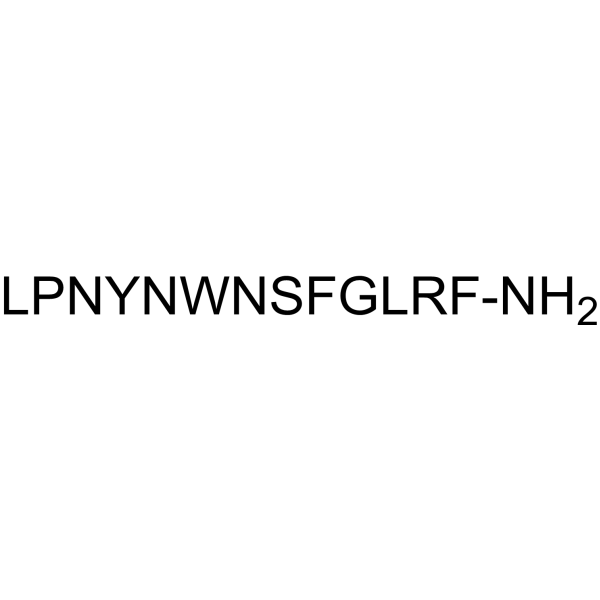
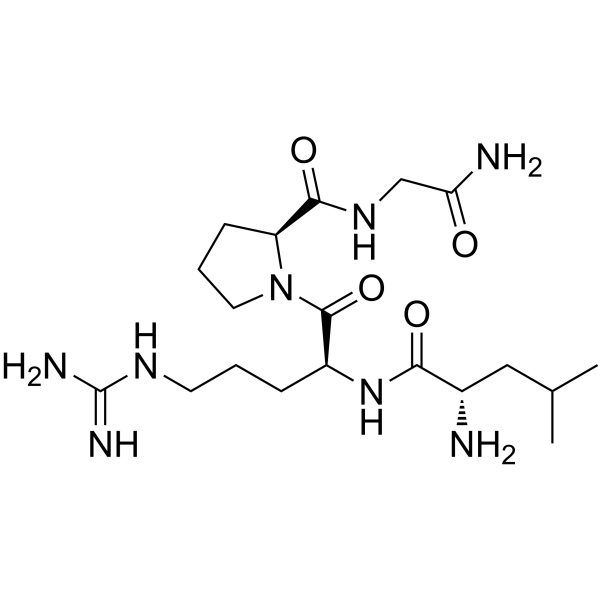
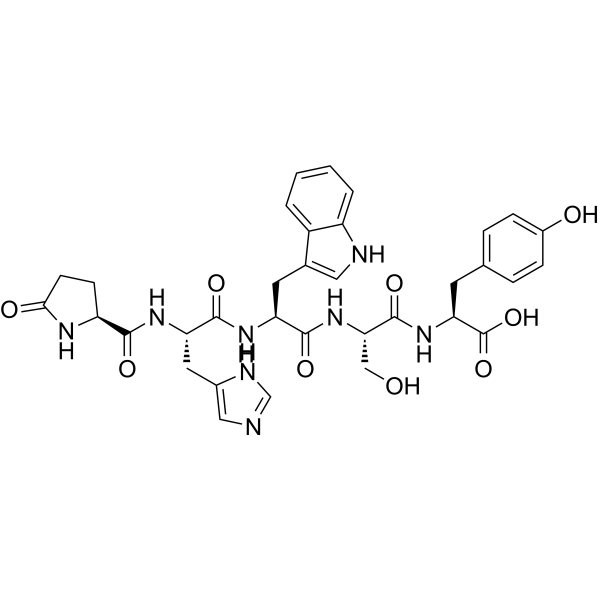
Leu-Pro-Asn-Tyr-Asn-Trp-Asn-Ser-Phe-Gly-Leu-Arg-Phe-NH2
-
Sequence Shortening
LPNYNWNSFGLRF-NH2
-
Shipping
Room temperature in continental US; may vary elsewhere.
-
Storage
Please store the product under the recommended conditions in the Certificate of Analysis.


Publications (1)
-
Journal Impact Factor
-
Most Recent

Protocols
-
Cell Cytotoxicity Assay
Cytotoxicity assays are usually based on the assessment of cell membrane damage, which can also be indirectly detected by measuring cell viability. Detection methods include MTT assay, CKK-8 assay, LDH assay and ATP assay, etc.
-
Research Protocol for Endocrine Diseases
Endocrine diseases often arise from disrupted hormone production, hormone signaling, or target-tissue responsiveness; for diabetes-focused endocrine disease models, insulin signaling regulates glucose uptake, hepatic glucose output, lipid metabolism, and β-cell compensation. Type 2 diabetes develops through interacting defects in insulin resistance, β-cell dysfunction, adipose inflammation, hepatic glucose overproduction, altered incretin signaling, and ectopic lipid metabolism. A major unresolved question is whether endocrine dysfunction is driven primarily by target-tissue insulin resistance, intrinsic β-cell failure, immune/inflammatory stress, or combined multi-organ failure that differs by disease stage.
-
Human Islet Cell Culture
The method of preserving islets in vitro, with purified reduced immunogenicity. The steps are islet isolation, islet cell purification, in vitro determination of islet function and islet cell culture.
-
Alzheimer’s Disease Modeling
Alzheimer’s Disease (AD) is a neurodegenerative disorder characterized by a progressive decline in cognitive functions and loss of specific types of neurons and synapses. Alzheimer's symptoms can be simulated in mice by injecting drugs (such as Aβ) or genetically modified.


Purity & Documentation
References
[1]. Jiang JH, et al. Kisspeptin-13 enhances memory and mitigates memory impairment induced by Aβ1-42 in mice novel object and object location recognition tasks. Neurobiol Learn Mem. 2015 Sep;123:187-95. [Content Brief]
[2]. Silvestre RA, et al., Kisspeptin-13 inhibits insulin secretion without affecting glucagon or somatostatin release: study in the perfused rat pancreas. J Endocrinol. 2008 Feb;196(2):283-90. [Content Brief]
[3]. Csabafi K, et al., Effects of kisspeptin-13 on the hypothalamic-pituitary-adrenal axis, thermoregulation, anxiety and locomotor activity in rats. Behav Brain Res. 2013 Mar 15;241:56-61. [Content Brief]
[4]. Tanaka M, et al., Neurotransmissions of antidepressant-like effects of kisspeptin-13. Regul Pept. 2013 Jan 10;180:1-4. [Content Brief]

Calculators
Concentration (start) × Volume (start) = Concentration (final) × Volume (final)


Kisspeptin 13 Related Classifications
HY-P3641 Related Classifications
 Powered by Bioz