



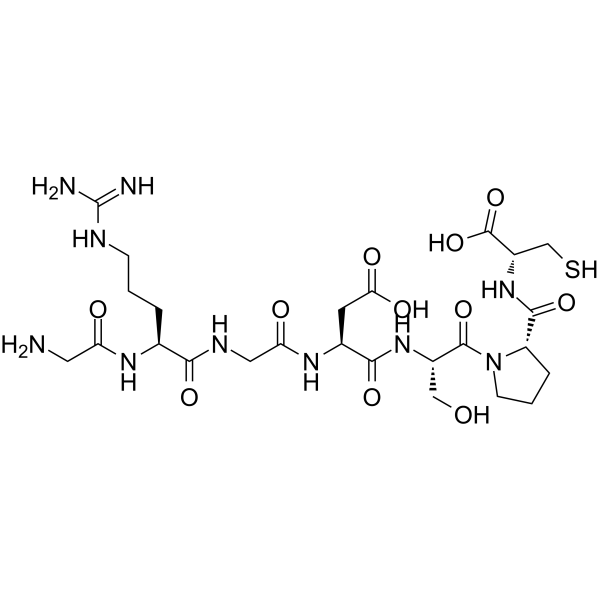
GRGDSPC

Based on 1 Customer Validation
GRGDSPC, a 7-amino acid peptide, is a thiolated cell adhesion peptide.
For research use only. We do not sell to patients.
- Purity : 98.09%
- CAS No.: 91575-26-7
- Formula: C25H42N10O11S
- Molecular Weight:690.73
-
Storage:
Sealed storage, away from moisture.
Powder -80°C, 2 years , -20°C, 1 year* In solvent : -80°C, 6 months; -20°C, 1 month (sealed storage, away from moisture)

To place orders, for customer services and technical support, please contact: MedChemExpress USA
Tel: 609-228-6898 E-mail: [email protected] [email protected]


-
 Biological Activity
-
Chemical Information
-
Solvent & Solubility
- Purity & Documentation
- References
-
 Help & FAQs




Biological Activity
Description
In Vitro
GRGDSPC is conjugated to acrylated dextran via thiol-acrylate reaction to regulate the interactions of human mesenchymal stem cells (hMSCs) with the photocrosslinkable hydrogels. To determine the conjugation kinetics and efficiency of GRGDSPC peptide to DEX-MAES16, various GRGDSPC concentrations (i.e., 5, 10 and 20 mg/1 g DEX-MAES16) are conjugated to the acrylated Dextran (DEX) macromer over time (0.25, 0.5, 1 and 3h) in PBS at pH 7.8 and the free thiol groups of unreacted peptides are quantified using Ellman’s assay. In addition, the reaction kinetics of the thiol-peptide to acrylated (DEX-MAES16) and methacrylated (DEX-HEMA16) macromers are compared. As early as 15 min conjugation, with 5, 10 and 20 mg of GRGDSPC peptide/1 g modified DEX, the peptide conjugation efficiencies with DEX-MAES are 105.40, 94.10 and 87.45%, respectively, while for the reaction with the DEX-HEMA they are 0.73, 15.78 and 18.42%, respectively. After 1h, the GRGDSPC conjugation with DEX-MAES is completed with the peptide concentration of 10 mg, but only 35.66% of the thiol groups of the peptide react with DEX-HEMA. The reaction kinetics are also monitored at 3 h of conjugation, and all of the 20 mg GRGDSPC peptide reacts with acrylated DEX compared to only 32.53% for the methacrylated DEX at this time point[1].
MedChemExpress (MCE) has not independently confirmed the accuracy of these methods. They are for reference only.


Chemical Information
-
CAS No. 91575-26-7
-
Appearance Solid
-
Molecular Weight 690.73
-
Formula C25H42N10O11S
-
Color White to off-white
-
Shipping
Room temperature in continental US; may vary elsewhere.
-
Storage
Sealed storage, away from moisture
Powder -80°C 2 years -20°C 1 year * In solvent : -80°C, 6 months; -20°C, 1 month (sealed storage, away from moisture)


Solvent & Solubility
In Vitro:
H2O : 25 mg/mL (36.19 mM; Need ultrasonic)
Please refer to the solubility information to select the appropriate solvent. Once prepared, please aliquot and store the solution to prevent product inactivation from repeated freeze-thaw cycles.
Storage method and period of stock solution: -80°C, 6 months; -20°C, 1 month (sealed storage, away from moisture). When stored at -80°C, please use it within 6 months. When stored at -20°C, please use it within 1 month.
* Note: If you choose water as the stock solution, please dilute it to the working solution, then filter and sterilize it with a 0.22 μm filter before use.
Please refer to the solubility information to select the appropriate solvent. Once prepared, please aliquot and store the solution to prevent product inactivation from repeated freeze-thaw cycles.
Storage method and period of stock solution: -80°C, 6 months; -20°C, 1 month (sealed storage, away from moisture). When stored at -80°C, please use it within 6 months. When stored at -20°C, please use it within 1 month.
* Note: If you choose water as the stock solution, please dilute it to the working solution, then filter and sterilize it with a 0.22 μm filter before use.
Concentration (start) × Volume (start) = Concentration (final) × Volume (final)


Purity & Documentation
-
Data Sheet (273 KB)
-
SDS (252 KB)
- English - EN (252 KB)
- Français - FR (252 KB)
- Deutsch - DE (252 KB)
- Norwegian - NO (252 KB)
- Español - ES (252 KB)
- Swedish - SV (252 KB)
- Italian - IT (252 KB)
- Korean - KR (252 KB)
- Portuguese - PT (252 KB)
-
Handling Instructions (2659 KB)
References


Complete Stock Solution Preparation Table
Please refer to the solubility information to select the appropriate solvent. Once prepared, please aliquot and store the solution to prevent product inactivation from repeated freeze-thaw cycles.
Storage method and period of stock solution: -80°C, 6 months; -20°C, 1 month (sealed storage, away from moisture). When stored at -80°C, please use it within 6 months. When stored at -20°C, please use it within 1 month.
| Optional Solvent | Concentration Solvent Mass | 1 mg | 5 mg | 10 mg | 25 mg |
|---|---|---|---|---|---|
| H2O | 1 mM | 1.4477 mL | 7.2387 mL | 14.4774 mL | 36.1936 mL |
| 5 mM | 0.2895 mL | 1.4477 mL | 2.8955 mL | 7.2387 mL | |
| 10 mM | 0.1448 mL | 0.7239 mL | 1.4477 mL | 3.6194 mL | |
| 15 mM | 0.0965 mL | 0.4826 mL | 0.9652 mL | 2.4129 mL | |
| 20 mM | 0.0724 mL | 0.3619 mL | 0.7239 mL | 1.8097 mL | |
| 25 mM | 0.0579 mL | 0.2895 mL | 0.5791 mL | 1.4477 mL | |
| 30 mM | 0.0483 mL | 0.2413 mL | 0.4826 mL | 1.2065 mL |
* Note: If you choose water as the stock solution, please dilute it to the working solution, then filter and sterilize it with a 0.22 μm filter before use.


GRGDSPC Related Classifications
HY-P1559 Related Classifications
 Powered by Bioz