



TDN345
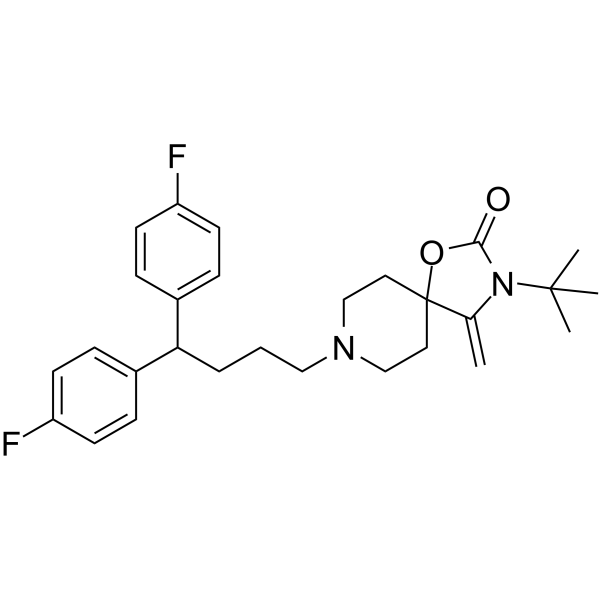
TDN345 is a Ca2+ antagonist, used for the treatment of vascular and senile dementia including Alzheimer's disease.
For research use only. We do not sell to patients.
- CAS No.: 134069-68-4
- Formula: C28H34F2N2O2
- Molecular Weight:468.58
-
Storage:
Please store the product under the recommended conditions in the Certificate of Analysis.

To place orders, for customer services and technical support, please contact: MedChemExpress USA
Tel: 609-228-6898 E-mail: [email protected] [email protected]


-
 Biological Activity
-
Chemical Information
- Protocols
- Purity & Documentation
- References
-
 Help & FAQs


All Calcium Channel Isoforms
More

Biological Activity
Description
In Vitro
TDN-345 (10 μM) significantly increases the intracellular NGF content in the time-course study. TDN-345 induces NGF synthesis/secretion at the concentrations of 0.1 μM; statistically significant at 1 μM. The ED50 is 0.88 μM[1].
MedChemExpress (MCE) has not independently confirmed the accuracy of these methods. They are for reference only.
In Vivo
MedChemExpress (MCE) has not independently confirmed the accuracy of these methods. They are for reference only.


Chemical Information
-
CAS No. 134069-68-4
-
Molecular Weight 468.58
-
Formula C28H34F2N2O2
-
SMILES
O=C(N1C(C)(C)C)OC2(CCN(CCCC(C3=CC=C(F)C=C3)C4=CC=C(F)C=C4)CC2)C1=C
-
Shipping
Room temperature in continental US; may vary elsewhere.
-
Storage
Please store the product under the recommended conditions in the Certificate of Analysis.


Purity & Documentation
References
[1]. Fukumoto H, et al. The novel compound TDN-345 induces synthesis/secretion of nerve growth factor in C6-10A glioma cells. Brain Res. 1997 Nov 7;774(1-2):87-93. [Content Brief]
[2]. Nakayama T, et al. Beneficial effects of TDN-345, a novel Ca2+ antagonist, on ischemic brain injury and cerebral glucose metabolism in experimental animal models with cerebrovascular lesions. Brain Res. 1997 Jul 11;762(1-2):203-10. [Content Brief]

Calculators
Concentration (start) × Volume (start) = Concentration (final) × Volume (final)


TDN345 Related Classifications
HY-101669 Related Classifications
 Powered by Bioz