



BAY-320
Based on 1 publication(s) in Google Scholar
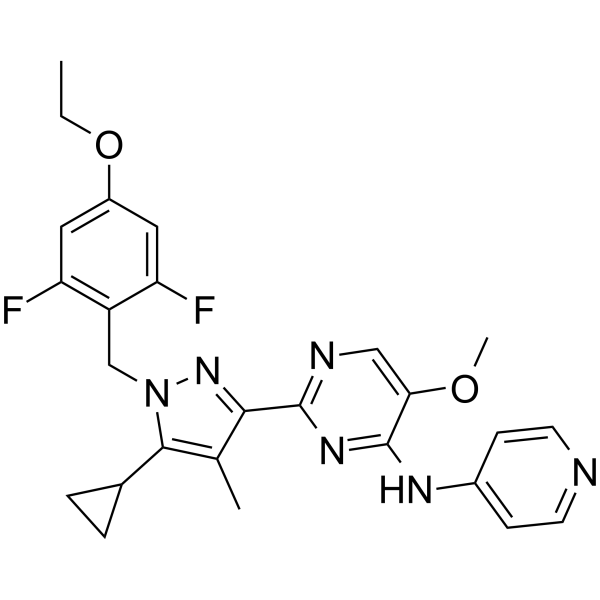
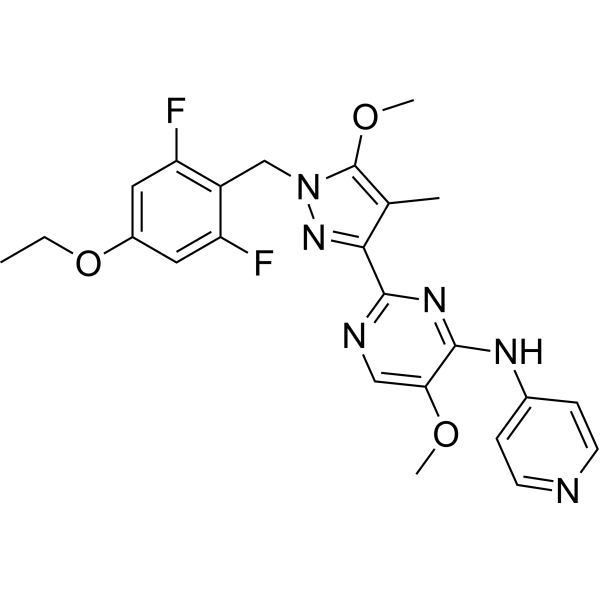
BAY-320 is a selective and ATP-competitive Bub1 inhibitor that inhibits the kinase activity of Bub1 with an IC50 of 680 nM. BAY-320 inhibits endogenous Bub1-mediated Sgo1 localization. BAY-320 affects cellular mitotic chromosome arrangement and spindle assembly. BAY-320 inhibits cell proliferation. BAY-320 can be used in the study of cancer such as ovarian cancer and cervical cancer.
연구목적의 판매만을 진행합니다. 환자를 대상으로 한 판매는 하지 않습니다.
- Purity : 99.74%
- CAS No.: 1445830-50-1
- 화학식: C26H26F2N6O2
- 분자량:492.52
-
보관:Powder -20°C, 3 years , 4°C, 2 years ; In solvent -80°C, 6 months , -20°C, 1 month

To place orders, for customer services and technical support, please contact: MedChemExpress USA
Tel: 609-228-6898 E-mail: [email protected] [email protected]


-
 Biological Activity
-
Chemical Information
-
용액&용해도
- Protocol
- 순도&문서
- References
-
 Help & FAQs


Publications Citing Use of MedChemExpress (MCE) BAY-320
More

Biological Activity
제품 설명
IC50 & Target
IC50: 680 nM (human Bub1, 2 mM ATP)[1]
In Vitro
BAY-320 (0.01-10 μM, 20 min) effectively inhibits the phosphorylation of Bub1 substrate H2ApT120 with an IC50 of 0.56 µM [1].
BAY-320 (10 μM-1 mM) inhibits Bub1 kinase activity with an IC50 of 0.56 μM[1].
BAY-320 (10 μM, 3 h) prevents the distribution of H2ApT120 along chromosome arms in tetracycline-induced cells and inhibits Bub1C fusion[1].
BAY-320 (10 μM, 3 d) significantly prolongs the time required for DLD-1 cells to complete mitosis[1].
BAY-320 (0-12.5 μM, 3 d) reduces colony formation in three cell lines: ovarian cancer cell lines (OVCAR-3), Kuramochi, and non-transformed RPE1 cell lines with a concentration of 10 μM[1].
BAY-320 (0.25-10 μM, 30 min) demonstrates inhibition of Bub1 through Bub1 autophosphorylation and phosphorylation of histone H2A and T120[2].
BAY-320 (3-10 μM, 14 h) achieves near-maximal inhibition of Bub1 and drastically reduces T120 phosphorylation in RPE1 and HeLa cells[2].
BAY-320 (3 μM, 48 h) provokes at most minor effects on mitotic progression, which is marked by a short delay of anaphase onset in HeLa cells[2].
BAY-320 (10 μM, 3 h) reduces the centromeric levels of Sgo1 and Sgo2 to ~20% of control values in RPE1 cells[2].
BAY-320 (3 μM, 10 h) partially displaces all CPC subunits examined from centromeres in HeLa cells[2].
BAY-320 (3 μM, 2 h) does not detectably affect the phosphorylation of the Haspin substrate histone H3 (T3) in HeLa S3 cells[2].
BAY-320 (3 μM, 24 h) lowers the percentage of HeLa cells maintaining a SAC arrest from 17% to 4% and 2% in response to Bub1 inhibition[2].
MedChemExpress (MCE) has not independently confirmed the accuracy of these methods. They are for reference only.
-
Cell Line:HeLa cells
-
Concentration:10 μM
-
Incubation Time:3 h
-
Result:Resulted in delocalization of Sgo1.
Almost completely abolished centromeric staining of H2ApT120.
-
Cell Line:OVCAR-3, Kuramochi, and RPE1 cells
-
Concentration:10 μM
-
Incubation Time:3 hd
-
Result:Reduced cell proliferation with proportion of cells not entering mitosis increasing from 20% without BAY-320 to 37% with BAY-320.
Resulted in fewer divisions of RPE1 and increased cell death in OVCAR-3 and Kuramochi cells.
- BrdU Incorporation Assay
- Somatic Cell Culture
- CFSE Dye Dilution Proliferation Assay
- Dye-dilution cell tracking and proliferation staining
- CCK-8/WST-8 Cell Proliferation Assay
- Protocol for Cell Cycle
- Cell Counting-Based Growth Curve Assay
- Colony Formation (Clonogenic) Assay
- Cell Viability Determination by MTT Colorimetric Assay
- Kinase activity and phosphorylation assays
- EdU Incorporation Assay (Click Chemistry-Based DNA Synthesis Measurement)
- Ki-67 Immunostaining Proliferation Assay
- PCNA Immunodetection Proliferation Assay
- Protocol for Cell Counting and Cell Density Analysis
- Protocol for Kinase activity and phosphorylation assays
- MTT Cell Proliferation Assay


Chemical Information
-
CAS No. 1445830-50-1
-
Appearance Solid
-
분자량 492.52
-
화학식 C26H26F2N6O2
-
Color White to off-white
-
SMILES
COC1=CN=C(C2=NN(CC3=C(F)C=C(OCC)C=C3F)C(C4CC4)=C2C)N=C1NC5=CC=NC=C5
-
선적
Room temperature in continental US; may vary elsewhere.
-
보관
Powder -20°C 3 years 4°C 2 years In solvent -80°C 6 months -20°C 1 month


Publications (1)
-
Journal Impact Factor
-
Most Recent


용액&용해도
In Vitro:
DMSO : 83.33 mg/mL (169.19 mM; Need ultrasonic; Hygroscopic DMSO has a significant impact on the solubility of product, please use newly opened DMSO)
Please refer to the solubility information to select the appropriate solvent. Once prepared, please aliquot and store the solution to prevent product inactivation from repeated freeze-thaw cycles.
Storage method and period of stock solution: -80°C, 6 months; -20°C, 1 month. When stored at -80°C, please use it within 6 months. When stored at -20°C, please use it within 1 month.
Please refer to the solubility information to select the appropriate solvent. Once prepared, please aliquot and store the solution to prevent product inactivation from repeated freeze-thaw cycles.
Storage method and period of stock solution: -80°C, 6 months; -20°C, 1 month. When stored at -80°C, please use it within 6 months. When stored at -20°C, please use it within 1 month.
Concentration (start) × Volume (start) = Concentration (final) × Volume (final)
In Vivo:
Select the appropriate dissolution method based on your experimental animal and administration route.
- For the following dissolution methods, please ensure to first prepare a clear stock solution using an In Vitro approach and then sequentially add co-solvents:
- To ensure reliable experimental results, the clarified stock solution can be appropriately stored based on storage conditions. As for the working solution for In Vivo experiments, it is recommended to prepare freshly and use it on the same day.
- The percentages shown for the solvents indicate their volumetric ratio in the final prepared solution. If precipitation or phase separation occurs during preparation, heat and/or sonication can be used to aid dissolution.
Add each solvent one by one: 10% DMSO 40% PEG300 5% Tween-80 45% Saline
Solubility: ≥ 2.08 mg/mL (4.22 mM); Clear solution
This protocol yields a clear solution of ≥ 2.08 mg/mL (saturation unknown).
Taking 1 mL working solution as an example, add 100 μL DMSO stock solution (20.8 mg/mL) to 400 μL PEG300, and mix evenly; then add 50 μL Tween-80 and mix evenly; then add 450 μL Saline to adjust the volume to 1 mL.
Preparation of Saline: Dissolve 0.9 g sodium chloride in ddH₂O and dilute to 100 mL to obtain a clear Saline solution.
In Vivo Dissolution Calculator
Please enter the basic information of animal experiments:
-
-
-
-
Recommended: Prepare an additional quantity of animals to account for potential losses during experiments.
Please enter your animal formula composition:
-
%DMSO +
Recommended: Keep the proportion of DMSO in working solution below 2% if your animal is weak.
-
%+
-
+%Tween-80 + +
-
%Saline +
The co-solvents required include: DMSO, . All of co-solvents are available by MedChemExpress (MCE). , Tween 80. All of co-solvents are available by MedChemExpress (MCE).
Working solution concentration: 0.22 mg/mL
Method for preparing stock solution: mg drug dissolved in μL DMSO. Stock solution concentration: mg/mL.
1. Take μL DMSO stock solution;
2. Add μL .
μL , mix evenly;
3. Then add μL Tween 80, mix evenly;
4. Then add μL
Please ensure that the stock solution in the first step is dissolved to a clear state, and add co-solvents in sequence. You can use ultrasonic heating (ultrasonic cleaner, recommended frequency 20-40 kHz), vortexing, etc. to assist dissolution.


순도&문서
-
Data Sheet (279 KB)
-
SDS (251 KB)
- English - EN (251 KB)
- Français - FR (251 KB)
- Deutsch - DE (251 KB)
- Norwegian - NO (251 KB)
- Español - ES (251 KB)
- Swedish - SV (251 KB)
- Italian - IT (251 KB)
- Korean - KR (251 KB)
- Portuguese - PT (251 KB)
-
Handling Instructions (2659 KB)
References
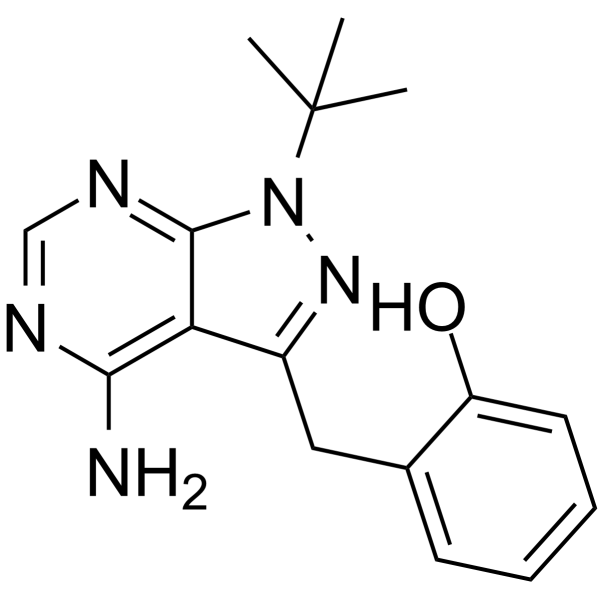
[1]. Amalina I, et al. Inhibitors of the Bub1 spindle assembly checkpoint kinase: synthesis of BAY-320 and comparison with 2OH-BNPP1. R Soc Open Sci. 2021 Dec 15;8(12):210854. [Content Brief]
[2]. Baron AP, et al. Probing the catalytic functions of Bub1 kinase using the small molecule inhibitors BAY-320 and BAY-524. Elife. 2016 Feb 17;5. pii: e12187. [Content Brief]


Complete Stock Solution Preparation Table
Please refer to the solubility information to select the appropriate solvent. Once prepared, please aliquot and store the solution to prevent product inactivation from repeated freeze-thaw cycles.
Storage method and period of stock solution: -80°C, 6 months; -20°C, 1 month. When stored at -80°C, please use it within 6 months. When stored at -20°C, please use it within 1 month.
| Optional Solvent | Concentration Solvent Mass | 1 mg | 5 mg | 10 mg | 25 mg |
|---|---|---|---|---|---|
| DMSO | 1 mM | 2.0304 mL | 10.1519 mL | 20.3037 mL | 50.7594 mL |
| 5 mM | 0.4061 mL | 2.0304 mL | 4.0607 mL | 10.1519 mL | |
| 10 mM | 0.2030 mL | 1.0152 mL | 2.0304 mL | 5.0759 mL | |
| 15 mM | 0.1354 mL | 0.6768 mL | 1.3536 mL | 3.3840 mL | |
| 20 mM | 0.1015 mL | 0.5076 mL | 1.0152 mL | 2.5380 mL | |
| 25 mM | 0.0812 mL | 0.4061 mL | 0.8121 mL | 2.0304 mL | |
| 30 mM | 0.0677 mL | 0.3384 mL | 0.6768 mL | 1.6920 mL | |
| 40 mM | 0.0508 mL | 0.2538 mL | 0.5076 mL | 1.2690 mL | |
| 50 mM | 0.0406 mL | 0.2030 mL | 0.4061 mL | 1.0152 mL | |
| 60 mM | 0.0338 mL | 0.1692 mL | 0.3384 mL | 0.8460 mL | |
| 80 mM | 0.0254 mL | 0.1269 mL | 0.2538 mL | 0.6345 mL | |
| 100 mM | 0.0203 mL | 0.1015 mL | 0.2030 mL | 0.5076 mL |


BAY-320 Related Classifications
HY-104000 Related Classifications
 Powered by Bioz