



TOK-8801
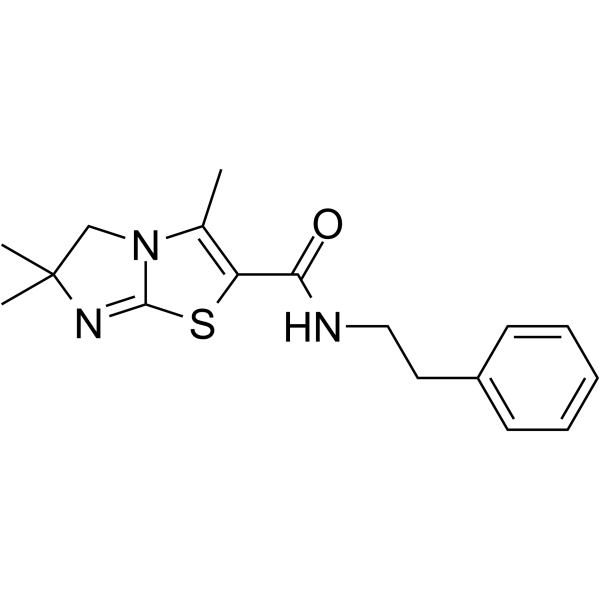
TOK-8801 is a synthesized dihydroimidazothiazole carboxamide and is under development as an immunomodulator.
연구목적의 판매만을 진행합니다. 환자를 대상으로 한 판매는 하지 않습니다.
- CAS No.: 105963-46-0
- 화학식: C17H21N3OS
- 분자량:315.43
-
보관:
Please store the product under the recommended conditions in the Certificate of Analysis.

To place orders, for customer services and technical support, please contact: MedChemExpress USA
Tel: 609-228-6898 E-mail: [email protected] [email protected]


-
 Biological Activity
-
Chemical Information
- 순도&문서
- References
-
 Help & FAQs




Biological Activity
제품 설명
In Vitro
TOK-8801 is a synthesized dihydroimidazothiazole carboxamide and is under development as an immunomodulator. TOK-8801 augments the in vitro anti-SRBC PFC response of murine splenocytes in a bell-shaped manner. The stimulatory effect of TOK-8801 is observed at concentrations of 2.5×10⁻⁷ to 2.5×10⁻⁵ M and is diminished at 10-4 M. The cell-viability is not altered during the culture with TOK-8801 at any doses used in this experiment (10-7 to 10-4 M). TOK-8801 enhances the 3H-TdR uptake of these responses in a bell-shaped manner, and effective concentrations of TOK-8801 are 10-7 to 10-5 M[1].
MedChemExpress (MCE) has not independently confirmed the accuracy of these methods. They are for reference only.
In Vivo
MedChemExpress (MCE) has not independently confirmed the accuracy of these methods. They are for reference only.


Chemical Information
-
CAS No. 105963-46-0
-
분자량 315.43
-
화학식 C17H21N3OS
-
SMILES
O=C(C1=C(C)N2C(S1)=NC(C)(C)C2)NCCC3=CC=CC=C3
-
선적
Room temperature in continental US; may vary elsewhere.
-
보관
Please store the product under the recommended conditions in the Certificate of Analysis.


순도&문서
References
[1]. Fujiwara M, et al. Immunomodulatory activity of the newly synthesized compound TOK-8801 (N-(2-phenylethyl)-3,6,6-trimethyl-5,6-dihydroimidazo[2,1-b]thiazole-2- carboxamide). Jpn J Pharmacol. 1989 Dec;51(4):549-54. [Content Brief]
[2]. Shibata K, et al. Immunomodulatory effect of a newly synthesized compound, TOK-8801 (N-(2-phenylethyl)-3,6,6-trimethyl-5,6-dihydroimidazo [2,1-b]thiazole-2-carboxamide) on antibody production in vivo and delayed-type hypersensitivity in mice. Int J Immunopharmacol. 1990;12(5):497-502. [Content Brief]

Calculators
Concentration (start) × Volume (start) = Concentration (final) × Volume (final)


TOK-8801 Related Classifications
HY-100162 Related Classifications
 Powered by Bioz