



Mal-Sulfo-DBCO
Based on 1 publication(s) in Google Scholar
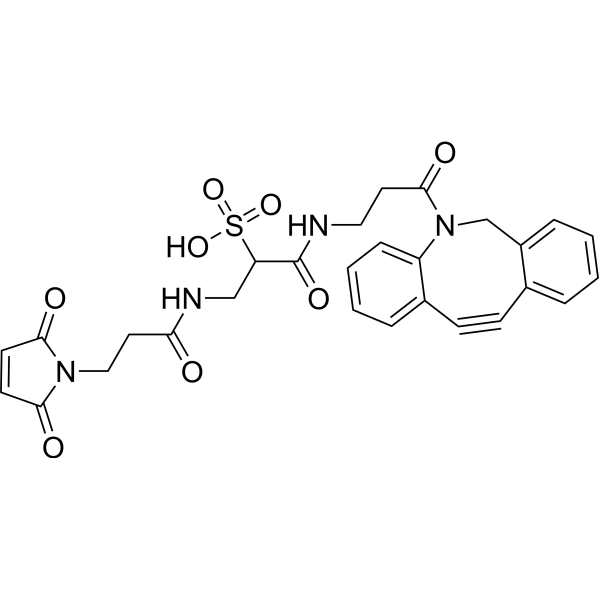
Mal-Sulfo-DBCO is a cleavable ADC linker used in the synthesis of antibody-drug conjugates (ADCs). Mal-Sulfo-DBCO is a click chemistry reagent, it contains a DBCO group that can undergo strain-promoted alkyne-azide cycloaddition (SPAAC) with molecules containing Azide groups.
연구목적의 판매만을 진행합니다. 환자를 대상으로 한 판매는 하지 않습니다.
- CAS No.: 2028281-86-7
- 화학식: C28H26N4O8S
- 분자량:578.59
-
보관:
Please store the product under the recommended conditions in the Certificate of Analysis.

To place orders, for customer services and technical support, please contact: MedChemExpress USA
Tel: 609-228-6898 E-mail: [email protected] [email protected]


-
 Biological Activity
-
Chemical Information
- Protocol
- 순도&문서
- References
-
 Help & FAQs


Publications Citing Use of MedChemExpress (MCE) Mal-Sulfo-DBCO
More

Biological Activity
제품 설명
IC50 & Target
|
Cleavable Linker |
In Vitro
ADCs are comprised of an antibody to which is attached an ADC cytotoxin through an ADC linker[1].
MedChemExpress (MCE) has not independently confirmed the accuracy of these methods. They are for reference only.


Chemical Information
-
CAS No. 2028281-86-7
-
분자량 578.59
-
화학식 C28H26N4O8S
-
SMILES
O=C(N1C2=CC=CC=C2C#CC3=CC=CC=C3C1)CCNC(C(S(=O)(O)=O)CNC(CCN(C4=O)C(C=C4)=O)=O)=O
-
선적
Room temperature in continental US; may vary elsewhere.
-
보관
Please store the product under the recommended conditions in the Certificate of Analysis.


Publications (1)
-
Journal Impact Factor
-
Most Recent
-
Acta Biomater
Engineered bioorthogonal cell delivery system for in situ antimicrobial peptide recruitment during systemic bacterial infection. [Abstract]2025 Apr 10:S1742-7061(25)00265-X. PMID: 40220946


순도&문서
References

Calculators
Concentration (start) × Volume (start) = Concentration (final) × Volume (final)


Mal-Sulfo-DBCO Related Classifications
HY-140306 Related Classifications
 Powered by Bioz