



Thiolutin
Based on 4 publication(s) in Google Scholar
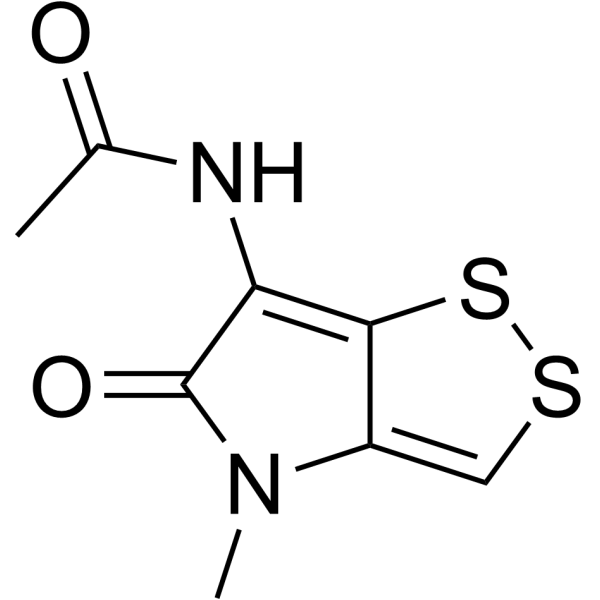
Thiolutin (Acetopyrrothin) is a sulfur-containing antibiotic, which is a potent inhibitor of bacterial and yeast RNA polymerases. Thiolutin can be produced by Streptomyces. Thiolutin inhibits AMSH (IC50 = 4 μM) and Rpn11 (IC50 = 0.53 μM). Thiolutin is a dual inhibitor of BRCC36 and the NLRP3 inflammasome, exhibiting anti-inflammatory effects. Thiolutin effectively suppresses the interaction between BRCC36 and HMGCR, leading to the inhibition of HCC growth. Thiolutin attenuates pyroptosis and NLRP3 inflammasome activation. Thiolutin markedly alleviates renal injury and inflammatory process in IgAN. Thiolutin is an anti-angiogenic compound which can ease Doxorubicin-induced cardiotoxicity (DOXIC)[1][2][3][4][5].
연구목적의 판매만을 진행합니다. 환자를 대상으로 한 판매는 하지 않습니다.
- Purity : 99.90%
- CAS No.: 87-11-6
- 화학식: C8H8N2O2S2
- 분자량:228.29
-
보관:Powder -20°C, 3 years , 4°C, 2 years ; In solvent -80°C, 6 months , -20°C, 1 month

To place orders, for customer services and technical support, please contact: MedChemExpress USA
Tel: 609-228-6898 E-mail: [email protected] [email protected]


-
 Biological Activity
-
Chemical Information
-
용액&용해도
- Protocol
- 순도&문서
- References
-
 Help & FAQs



Publications Citing Use of MedChemExpress (MCE) Thiolutin
More Customer Validation & Images

-
WB

-
RT-PCR

-
Cell Proliferation/Viability Assay

-
Apoptosis Analysis

-
IF

All Antibiotic Isoforms
MoreAll DNA/RNA Synthesis Isoforms
More

Biological Activity
제품 설명
IC50 & Target
|
RNA Polymerase |
In Vitro
Thiolutin (0.5-2 μM, 24 h) significantly inhibits the expression of BRCC36 and HMGCR proteins in a dose-dependent manner in HepG2 and Hep3B cells[1].
Thiolutin (0-24 h) attenuates the interaction between HMGCR and BRCC36 in HepG2 cells and reduces the half-life of the HMGCR protein while increasing its ubiquitination level in both HepG2 and Hep3B cells[1].
Thiolutin (0.1-10 μM, 48 h) inhibits the proliferation of HepG2 and Hep3B cells dose-dependently[1].
Thiolutin (0.25-0.5 μM, 14 days) elevates RSL3 (HY-100218A)-induced cell death and RSL3-triggered lipid peroxidation in HepG2 cells[1].
Thiolutin (25-250 nM) inhibits the LDH release induced by LPS (HY-D1056) and Nigericin (HY-127019)[1].
Thiolutin (0.5 μM, 14 days) reduces the colony-forming ability of HepG2 cancer cells in the presence of Lovastatin (HY-N0504) (5 μM)[1].
Thiolutin (50 μM, 0-120 min) induces global transcriptional stress in Neurospora[2].
Thiolutin (50 μM, 1-4 h) inhibits protein degradation by the proteasome in N.crassa and HeLa cells[2].
Thiolutin (0.001-100 μM) inhibits AMSH with an IC50 of 4 μM, which is higher than its inhibition of Rpn11 (IC50 = 0.53 μM), and this effect is reversible by Zn(cyclen)²⁺[2].
Thiolutin (10-50 nM, 30 min) attenuates pyroptosis and NLRP3 inflammasome activation in J774 A.1 murine monocyte-macrophage cells[3].
MedChemExpress (MCE) has not independently confirmed the accuracy of these methods. They are for reference only.
-
Cell Line:J774 A.1 murine monocyte-macrophage cells
-
Concentration:10, 25, 50 nM
-
Incubation Time:30 min
-
Result:Increased progressively with higher concentrations.
-
Cell Line:J774 A.1 murine monocyte-macrophage cells
-
Concentration:10, 25, 50 nM
-
Incubation Time:30 min
-
Result:Suppressed the levels of IL-1β and IL-18.
-
Cell Line:J774 A.1 murine monocyte-macrophage cells
-
Concentration:10, 25, 50 nM
-
Incubation Time:30 min
-
Result:Suppressed the levels of IL-1β and caspase-1.
In Vivo
Thiolutin (0.75 mg/kg, i.p., every 3 days for 18 days) significantly decreases the volume and weight of the tumor in the BALB/c or C57 mice subcutaneously injected with 0.1 mL of PBS containing SMMC7721, HepG2, or Heap1-6 cells[1].
Thiolutin (0.5-5 mg/kg, i.p., every 2 days for 4 weeks) alleviates kidney injury, attenuates renal inflammation and modulates the NLRP3 inflammasome pathway in IgAN mice without hepatotoxic effects[3].
Thiolutin (1 mg/kg, i.p., once daily for 4 weeks ) improves cardiac function, mitigates cardiac remodeling urged by Doxorubicin (DOX) and restrains the NLRP3 inflammasome activation in DOX‑challenged mice[4].
MedChemExpress (MCE) has not independently confirmed the accuracy of these methods. They are for reference only.
-
Animal Model:BALB/c or C57 mice (5 weeks) were subcutaneously injected with 0.1 mL of PBS containing SMMC7721, HepG2, or Heap1-6 cells[1]
-
Dosage:0.75 mg/kg
-
Administration:i.p. every 3 days for 18 days
-
Result:Decreased the volume and weight of the tumor.
-
Animal Model:IgAN model mice (8 weeks male BALB/c)[3]
-
Dosage:0.5, 2.5, 5 mg/kg
-
Administration:i.p. every 2 days for 4 weeks
-
Result:Decreased Serum BUN S-cr levels, Serum IgA levels and ACR in urine, which were markedly elevated in the IgAN-positive group.
Diminished the glomerular hypercellularity and matrix expansion.
Ameliorated mesangial proliferation and extracellular matrix expansion.
Reduced the level of IFN-γ, TNF-α and IL-6.
Showed no necrosis or injury in both the liver and heart sections of mice.
Downregulated the mRNA expression levels of NLRP3, IL-1β, IL-18, and caspase-1
-
Animal Model:DOX‑challenged Male C57BL/6 mice(8-10 weeks)[4]
-
Dosage:1 mg/kg
-
Administration:i.p. once daily for 4 weeks
-
Result:Ameliorated the changes of LVEF and LVFS as well as LVESD and LVEDD.
Increased the survival rate to 80%.
Decreased the levels of cTnT, CRP, and BNP.
Ameliorated the larger heart size.
Ameliorated DOX-induced pathological changes in cardiomyocytes, including misalignment, inflammatory cell infiltration, widened intercellular gaps, and abnormal morphology/size.
Decreased the protein levels of NLRP3, C-caspase-1/Pro-c-caspase, and GSDMD-N/GSDMD.


Chemical Information
-
CAS No. 87-11-6
-
Appearance Solid
-
분자량 228.29
-
화학식 C8H8N2O2S2
-
Color Light yellow to yellow
-
SMILES
CC(NC1=C2C(N(C)C1=O)=CSS2)=O
-
Synonyms
Acetopyrrothin
-
Structure Classification
-
Initial Source
Streptomyces
-
선적
Room temperature in continental US; may vary elsewhere.
-
보관
Powder -20°C 3 years 4°C 2 years In solvent -80°C 6 months -20°C 1 month


Publications (4)
-
Journal Impact Factor
-
Most Recent
-
ACS Environ Au
Machine Learning-Assisted Recognition of Environmental Sulfur-Containing Chemicals in Nontargeted Mass Spectrometry Analysis of Inadequate Mass Resolution. [Abstract]2025 Aug 5;5(6):573-582. PMID: 41277996 -
Anal Chem
Exposome-Scale Investigation of Cl-/Br-Containing Chemicals Using High-Resolution Mass Spectrometry, Multistage Machine Learning, and Cloud Computing. [Abstract]2025 Jun 3;97(21):11099-11109. PMID: 40401576 -
JOR Spine
Phosphorylated heat shock protein 27 improves the bone formation ability of osteoblasts and bone marrow stem cells from patients with adolescent idiopathic scoliosis. [Abstract]2023 Apr 20;6(3):e1256. PMID: 37780830
Thiolutin purchased from MedChemExpress. Usage Cited in: JOR Spine. 2023 Apr 20;6(3):e1256. [Abstract]
The protein levels of p‐HSP27 and HSP27 in AIS osteoblasts with/without Thiolutin (1 μM).
Thiolutin purchased from MedChemExpress. Usage Cited in: JOR Spine. 2023 Apr 20;6(3):e1256. [Abstract]
The mRNA levels of HSP27, ALPL, SPP1 in AIS osteoblasts with/without Thiolutin (1 μM).
-
J Toxicol Sci
2023;48(8):469-479. PMID: 37532580
Thiolutin purchased from MedChemExpress. Usage Cited in: J Toxicol Sci. 2023;48(8):469-479. [Abstract]
CCK-8 assay was employed to measure the toxicity of Thiolutin (THL) (0, 1, 10, 20, 40, 80, 160, 320 nM) to H9c2 cardiomyocytes.
Thiolutin purchased from MedChemExpress. Usage Cited in: J Toxicol Sci. 2023;48(8):469-479. [Abstract]
Cell apoptosis detected via flow cytometry treated with Thiolutin (THL).
Thiolutin purchased from MedChemExpress. Usage Cited in: J Toxicol Sci. 2023;48(8):469-479. [Abstract]
ROS accumulation detected via IF treated with Thiolutin (THL).


용액&용해도
In Vitro:
DMSO : 6.25 mg/mL (27.38 mM; ultrasonic and warming and heat to 60°C; Hygroscopic DMSO has a significant impact on the solubility of product, please use newly opened DMSO)
Please refer to the solubility information to select the appropriate solvent. Once prepared, please aliquot and store the solution to prevent product inactivation from repeated freeze-thaw cycles.
Storage method and period of stock solution: -80°C, 6 months; -20°C, 1 month. When stored at -80°C, please use it within 6 months. When stored at -20°C, please use it within 1 month.
Please refer to the solubility information to select the appropriate solvent. Once prepared, please aliquot and store the solution to prevent product inactivation from repeated freeze-thaw cycles.
Storage method and period of stock solution: -80°C, 6 months; -20°C, 1 month. When stored at -80°C, please use it within 6 months. When stored at -20°C, please use it within 1 month.
Concentration (start) × Volume (start) = Concentration (final) × Volume (final)


순도&문서
-
Data Sheet (290 KB)
-
SDS (480 KB)
- English - EN (480 KB)
- Français - FR (480 KB)
- Deutsch - DE (480 KB)
- Norwegian - NO (480 KB)
- Español - ES (480 KB)
- Swedish - SV (480 KB)
- Italian - IT (480 KB)
- Korean - KR (480 KB)
- Portuguese - PT (480 KB)
-
Handling Instructions (2659 KB)
References
[1]. Wang H, et al. BRCC36 Deubiquitinates HMGCR to Regulate the Interplay Between Ferroptosis and Pyroptosis. Adv Sci (Weinh). 2024 Mar;11(11):e2304263. [Content Brief]
[2]. Lauinger L, et al. Thiolutin is a zinc chelator that inhibits the Rpn11 and other JAMM metalloproteases. Nat Chem Biol. 2017 Jul;13(7):709-714. [Content Brief]
[3]. Zhang Y, et al. Thiolutin, a novel NLRP3 inflammasome inhibitor, mitigates IgA nephropathy in mice. Int Immunopharmacol. 2025 Apr 16;152:114440. [Content Brief]
[4]. Cai W, et al. Thiolutin Alleviates Cardiotoxic Effects of Doxorubicin by Suppressing NLRP3 Inflammasome in the Mouse Model. Cardiovasc Toxicol. 2025 Feb;25(2):182-192. [Content Brief]
[5]. Kebaara BW, Nielsen LE, Nickerson KW, Atkin AL. Determination of mRNA half-lives in Candida albicans using thiolutin as a transcription inhibitor. Genome. 2006 Aug;49(8):894-9. [Content Brief]


Complete Stock Solution Preparation Table
Please refer to the solubility information to select the appropriate solvent. Once prepared, please aliquot and store the solution to prevent product inactivation from repeated freeze-thaw cycles.
Storage method and period of stock solution: -80°C, 6 months; -20°C, 1 month. When stored at -80°C, please use it within 6 months. When stored at -20°C, please use it within 1 month.
| Optional Solvent | Concentration Solvent Mass | 1 mg | 5 mg | 10 mg | 25 mg |
|---|---|---|---|---|---|
| DMSO | 1 mM | 4.3804 mL | 21.9020 mL | 43.8039 mL | 109.5098 mL |
| 5 mM | 0.8761 mL | 4.3804 mL | 8.7608 mL | 21.9020 mL | |
| 10 mM | 0.4380 mL | 2.1902 mL | 4.3804 mL | 10.9510 mL | |
| 15 mM | 0.2920 mL | 1.4601 mL | 2.9203 mL | 7.3007 mL | |
| 20 mM | 0.2190 mL | 1.0951 mL | 2.1902 mL | 5.4755 mL | |
| 25 mM | 0.1752 mL | 0.8761 mL | 1.7522 mL | 4.3804 mL |


Thiolutin Related Classifications
HY-N6712 Related Classifications
 Powered by Bioz