
Kyoto probe 1
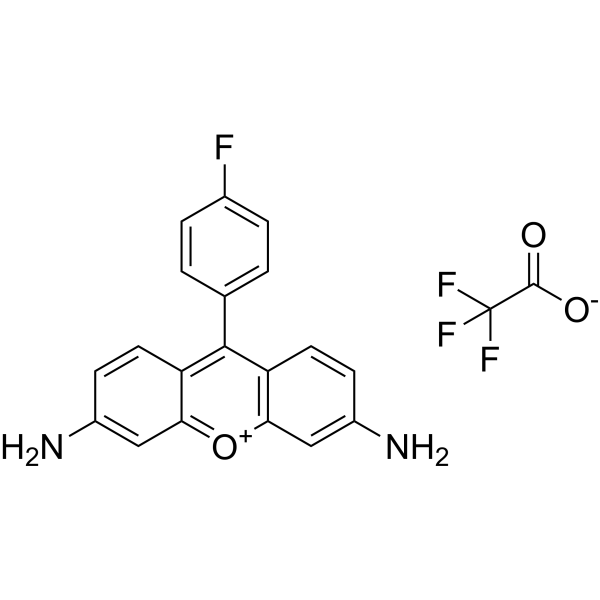
Kyoto probe 1 is a hiPSCs fluorescent probe. Kyoto probe 1 selectively labels human pluripotent stem cells. Kyoto probe 1 is primarily explained by the distinct expression patterns of ATP-binding cassette (ABC) transporters by hiPS cells and differentiated cells.
For research use only. We do not sell to patients.
- CAS No.: 2088021-81-0
- Formula: C21H14F4N2O3
- Molecular Weight:418.34
-
Storage:
Please store the product under the recommended conditions in the Certificate of Analysis.
Biological Activity
Description
Chemical Information
-
CAS No. 2088021-81-0
-
Molecular Weight 418.34
-
Formula C21H14F4N2O3
-
SMILES
FC1=CC=C(C2=C3C=CC(N)=CC3=[O+]C4=C2C=CC(N)=C4)C=C1.O=C([O-])C(F)(F)F
-
Shipping
Room temperature in continental US; may vary elsewhere.
-
Storage
Please store the product under the recommended conditions in the Certificate of Analysis.
Protocols
-
RNA extraction experimental
By lysing cells, releasing RNA, and removing impurities such as proteins and DNA, high-purity RNA products are finally obtained. The commonly used traditional method is the guanidine isothiocyanate/phenol/chloroform method (Trizol), which is suitable for a variety of animal materials including animal tissues, microorganisms, cultured cells, etc., and most plant materials.
-
hPSC maintenance and expansion
This protocol maintains and expands human pluripotent stem cells under feeder-free, chemically defined conditions using E8 medium and vitronectin-coated culture surfaces; the readout is sustained adherent colony growth with undifferentiated morphology and retained pluripotency-marker expression during serial passaging. E8-based hPSC culture relies on defined soluble factors and matrix-dependent adhesion rather than feeder cells; vitronectin supports hPSC attachment through integrin-mediated interactions, and EDTA passaging dissociates colonies as small aggregates without enzymatic digestion, centrifugation, or routine ROCK-inhibitor treatment.
-
CRISPR-Cas9 editing of human pluripotent stem cells
CRISPR-Cas9 editing of human pluripotent stem cells uses a guide RNA to direct Cas9 to a genomic target, where Cas9 creates a double-strand break that is repaired mainly by non-homologous end joining for knockout mutations or by homology-directed repair when a donor template is supplied for precise knock-in or sequence correction. The readout is generated by genotyping edited bulk populations or single-cell-derived clones, using PCR, sequencing, restriction-based assays, reporter fluorescence, or allele-specific analysis to distinguish unedited alleles, indels, precise donor-mediated edits, biallelic deletions, and unwanted on-target lesions.
Purity & Documentation
References
Calculators
Concentration (start) × Volume (start) = Concentration (final) × Volume (final)

