



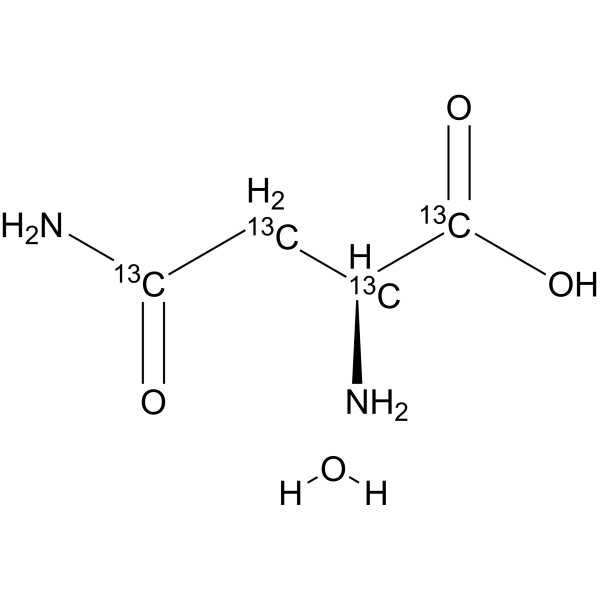
L-Asparagine-13C4 monohydrate

Based on 1 Customer Validation
L-Asparagine-13C4 monohydrate is the 13C-labeled L-Asparagine monohydrate (HY-W017443). L-Asparagine monohydrate is an essential amino acid for leukemic cells and a substrate for L-Asparaginase. L-Asparaginase is a potent anti-leukemic enzyme that promotes asparagine (Asn) and glutamine (Gln) depletion and inhibits protein biosynthesis in lymphoblasts. Removal of L-asparagine from plasma by L-Asparaginase results in inhibition of RNA and DNA synthesis and subsequent apoptosis. L-Asparaginase has cell-killing ability in vitro and in vivo, and selectively inhibits the growth of cancer cells with low asparagine synthetase (AASNS) expression. L-Asparagine monohydrate can be used as a biomarker and sensor for the study of childhood acute lymphoblastic leukemia.
For research use only. We do not sell to patients.
- Purity : 98.9%
- CAS No.: 286460-82-0
- Formula: 13C4H10N2O4
- Molecular Weight:154.10
-
Storage:Powder -20°C, 3 years , 4°C, 2 years ; In solvent -80°C, 6 months , -20°C, 1 month

To place orders, for customer services and technical support, please contact: MedChemExpress USA
Tel: 609-228-6898 E-mail: [email protected] [email protected]


-
 Biological Activity
-
Chemical Information
- Purity & Documentation
- References
-
 Help & FAQs




Biological Activity
Description
In Vitro
Stable heavy isotopes of hydrogen, carbon, and other elements have been incorporated into drug molecules, largely as tracers for quantitation during the drug development process. Deuteration has gained attention because of its potential to affect the pharmacokinetic and metabolic profiles of drugs[1].
MedChemExpress (MCE) has not independently confirmed the accuracy of these methods. They are for reference only.
Application
1. This compound can be used as a tracer
2. This compound can be used as an internal standard for quantitative analysis by NMR, GC-MS, or LC-MS.


Chemical Information
-
CAS No. 286460-82-0
-
Unlabeled CAS 70-47-3
-
Appearance Solid
-
Molecular Weight 154.10
-
Formula 13C4H10N2O4
-
Color White to off-white
-
SMILES
N[13C]([13CH2][13C@H](N)[13C](O)=O)=O.[H]O[H]
-
Synonyms
(-)-Asparagine-13C4 monohydrate; Asn-13C4 monohydrate; Asparamide-13C4 monohydrate
-
Shipping
Room temperature in continental US; may vary elsewhere.
-
Storage
Powder -20°C 3 years 4°C 2 years In solvent -80°C 6 months -20°C 1 month


Purity & Documentation
-
Data Sheet (270 KB)
-
SDS (254 KB)
- English - EN (254 KB)
- Français - FR (254 KB)
- Deutsch - DE (254 KB)
- Norwegian - NO (254 KB)
- Español - ES (254 KB)
- Swedish - SV (254 KB)
- Italian - IT (254 KB)
- Korean - KR (254 KB)
- Portuguese - PT (254 KB)
-
Handling Instructions (2659 KB)
References
[1]. Russak EM, et al. Impact of Deuterium Substitution on the Pharmacokinetics of Pharmaceuticals. Ann Pharmacother. 2019;53(2):211-236. [Content Brief]
[2]. Batool T, et al. A Comprehensive Review on L-Asparaginase and Its Applications. Appl Biochem Biotechnol. 2016 Mar;178(5):900-23. [Content Brief]
[3]. Asselin BL, et al. In vitro and in vivo killing of acute lymphoblastic leukemia cells by L-asparaginase. Cancer Res. 1989 Aug 1;49(15):4363-8. [Content Brief]
[4]. Horvath TD, et al. Assessment of l-Asparaginase Pharmacodynamics in Mouse Models of Cancer. Metabolites. 2019 Jan 9;9(1):10. [Content Brief]
[5]. Kravtzoff R, et al. Erythrocytes as carriers for L-asparaginase. Methodological and mouse in-vivo studies. J Pharm Pharmacol. 1990 Jul;42(7):473-6. [Content Brief]
[6]. Ilaria M Michelozzi, et al. Acute myeloid leukaemia niche regulates response to L-asparaginase. Br J Haematol. 2019 Aug;186(3):420-430. doi: 10.1111/bjh.15920. [Content Brief]

Calculators
Concentration (start) × Volume (start) = Concentration (final) × Volume (final)


L-Asparagine-13C4 monohydrate Related Classifications
HY-N0667S3 Related Classifications
 Powered by Bioz