



Epoxyeicosatrienoic Acids
- 1
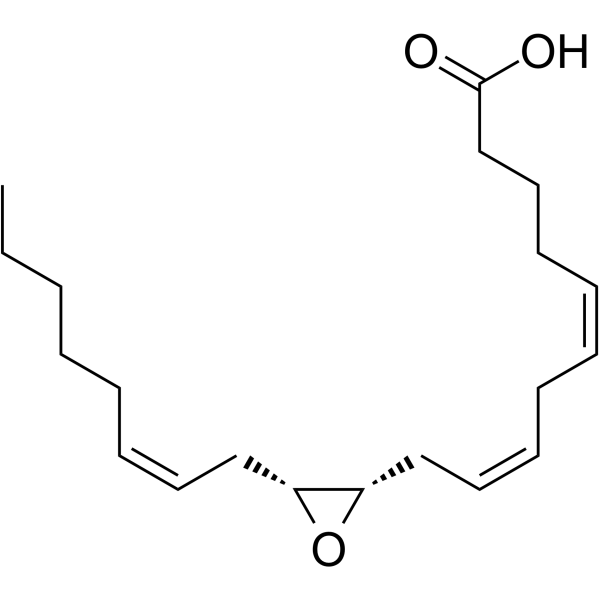
- Formula: C20H32O3
- Molecular Weight: 320.47
(±)11(12)-EET is a NLRP3 inflammasome inhibitor. (±)11(12)-EET can be used for the research of anti-inflammatory, angiogenic and cardioprotective.

- Formula: C20H32O3
- Molecular Weight: 320.47
5,6-Epoxyeicosatrienoic acid (5,6-EET; (±)5,6-EpETrE) is a fully racemic version of the enantiomeric forms biosynthesized from arachidonic acid by cytochrome P450 enzymes. In solution, 5,6-Epoxyeicosatrienoic acid degrades into 5,6-DiHET and 5,6-δ-lactone, which can be converted to 5,6-DiHET and quantified by GC-MS. In neuroendocrine cells, such as the anterior pituitary and pancreatic islets, 5,6-Epoxyeicosatrienoic acid has been implicated in the mobilization of calcium and hormone secretion. 5,6-Epoxyeicosatrienoic acid is an inhibitor of T-type voltage-gated calcium channels (Cav3) that inhibits isoforms Cav3.1, Cav3.2 (IC50=0.54 μM), and Cav3. and decreases nifedipine-resistant phenylephrine-induced vasoconstriction in isolated mouse mesenteric arteries via Cav3.2 blockade when used at a concentration of 3 μM. In addition, it is a substrate of COX-1 and COX-2.
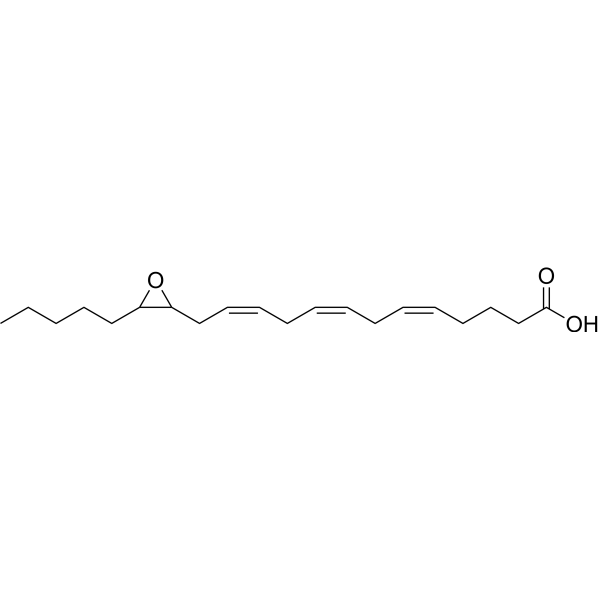
- Formula: C20H32O3
- Molecular Weight: 320.47
(±)14,15-Epoxyeicosatrienoic acid ((±)14(15)-EET) is the Cytochrome P450 metabolite of arachidonic acid. While CYP3A4 may be involved in breast cancer cell growth, (±)14,15-Epoxyeicosatrienoic acid may promote mitosis and anchorage-dependent cloning through STAT3 affected by CYP3A4. (±)14,15-Epoxyeicosatrienoic acid exhibits STAT3-dependent cell growth promotion and may also participate in the autocrine/paracrine pathway that drives cell growth.

- Formula: C20H32O3
- Molecular Weight: 320.47
14S(15R)-EET is an endogenous epoxytrienoic acid derivative that mainly exists in rat organs. By studying its metabolic process, it was found that its stereoselective hydration and formation of chiral diols were significantly affected by epoxidase. Different 14,15-EET enantiomers showed different regions and stereochemistry of hydration reactions, among which 14(R),15(S)-EET showed specific hydration for C15. These findings reveal the important role of epoxidase in the metabolism of endogenous EETs, and the differences in enzyme affinity and reaction rate for individual EET enantiomers may lead to their stereoselective metabolism.

- Formula: C20H32O4
- Molecular Weight: 336.47
15H-11,12-EETA is a nucleoside metabolite.

- Formula: C20H32O3
- Molecular Weight: 320.47
(±)8(9)-EET is one of the main metabolites produced by the metabolism of arachidonic acid (HY-109590) through the cytochrome P450 epoxide pathway. (±)8(9)-EET is an effective substrate for COX-1 and COX-2. (±)8(9)-EET activates PPARα in HEK293 cells and inhibits the activity of NF-κB induced by IL-1β in a PPARα-dependent and -independent manner. The (8S,9R)-isomer of (±)8(9)-EET ([(8S,9R)-EET]) causes vasoconstriction, thereby reducing renal plasma flow and glomerular filtration rate.

- Formula: C20H32O3
- Molecular Weight: 320.47
14R(15S)-EET (14R(15S)-EpETrE) is an oxylipin and a metabolite of Arachidonic acid (HY-109590).

- Formula: C20H32O3
- Molecular Weight: 320.47
8,9-Epoxyeicosatrienoic acid has an unique protective effect on glomeruli. 8,9-Epoxyeicosatrienoic acid blocks the increase in glomerular albumin permeability caused by circulating permeability factor (FSPF). 8,9-Epoxyeicosatrienoic acid can be used for the research of glomerular dysfunction.

- Formula: C20H32O3
- Molecular Weight: 320.47
8(S),9(R)-EET is an eicosanoid product of Arachidonic acid (AA; HY-109590) by cytochromes P450. 8(S),9(R)-EET dilates canine epicardial arterioles in a concentration-dependent manner with an EC50 value of 121 nM.

- Formula: C20H32O3
- Molecular Weight: 320.47
5R(6S)-EET is the metabolite of Arachidonic acid (HY-109590). 5R(6S)-EET activates the synthesis of endogenous prostaglandin (PGE2), which inhibits the Na+ absorption, increases the intracellular Ca2+, and promotes the depolarization of transmembrane voltage. 5R(6S)-EET exhibits stereoselectivity with less effectness than 5S(6R)-EET (HY-168382A).

- Formula: C20H32O3
- Molecular Weight: 320.47
8(9)-EET is one of the main metabolites produced by the metabolism of arachidonic acid (HY-109590) through the cytochrome P450 epoxide pathway. 8(9)-EET is an effective substrate for COX-1 and COX-2. 8(9)-EET activates PPARα in HEK293 cells and inhibits the activity of NF-κB induced by IL-1β in a PPARα-dependent and -independent manner. The (8S,9R)-isomer of 8(9)-EET ([(8S,9R)-EET]) causes vasoconstriction, thereby reducing renal plasma flow and glomerular filtration rate.

- Formula: C20H32O3
- Molecular Weight: 320.47
11R(12S)-EET is a cis-epoxytrienoic acid (EETs) derivative that is metabolized by cytoplasmic cyclooxygenases. Studies have shown that 14(R), 15(S)-, 11(S),12(R)-, and 8(S),9(R)-EETs are metabolized at significantly higher rates than their enantiomers. Enzyme-catalyzed hydration revealed that water addition was non-regioselective for the 11,12-EET enantiomers, whereas water addition occurred primarily at the C9 position for both enantiomers of 8,9-EET. These results suggest that the metabolic properties of 11R(12S)-EET and other EET enantiomers in enzyme-catalyzed processes are significantly affected by their stereostructures.

- Formula: C20H32O3
- Molecular Weight: 320.47
11S(12R)-EET is a dominant enantiomer of epoxytrienoic acid (EET) that is metabolized at a higher rate in rat organs. It shows enantiomeric-dependent reaction selectivity in hydration, especially in the case of 11,12-EET, where water addition is non-regioselective, while in 8,9-EET, water addition occurs mainly at the C9 position. In addition, 11S(12R)-EET generates diol products with specific stereochemistry through enzymatic hydration reactions, which are affected by the selective recognition of epoxidases, reaction conversion rates, and substrate binding parameters.
- 1



