



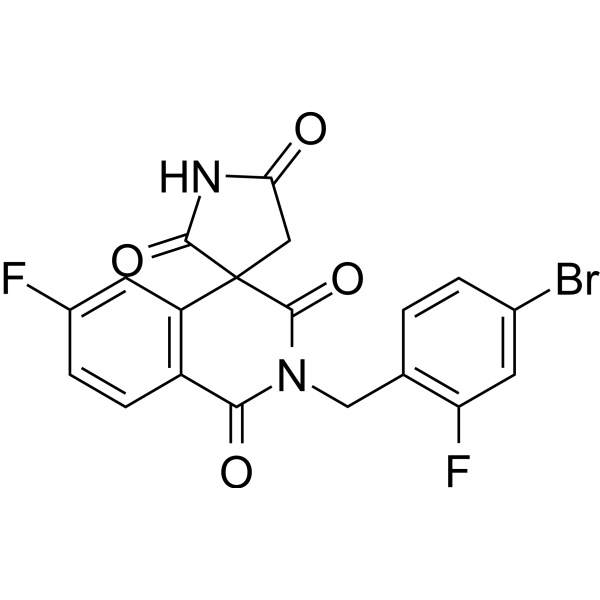
Minalrestat
Minalrestat (ARI-509) is a potent and orally active aldose reductase inhibitor. Minalrestat can be used in the research of diabetes.
For research use only. We do not sell to patients.
- CAS No.: 129688-50-2
- Formula: C19H11BrF2N2O4
- Molecular Weight:449.20
-
Storage:
Please store the product under the recommended conditions in the Certificate of Analysis.

To place orders, for customer services and technical support, please contact: MedChemExpress USA
Tel: 609-228-6898 E-mail: [email protected] [email protected]


-
 Biological Activity
-
Chemical Information
- Protocols
- Purity & Documentation
- References
-
 Help & FAQs




Biological Activity
Description
In Vitro
Minalrestat (100 μM) decreased intracellular sorbitol without affecting intracellular glucose in primary cultured rat mesangial cells[3].
Minalrestat (100 μM, 48 h) causes accumulation of PKC-α and -β2 in primary cultured rat mesangial cells[3].
MedChemExpress (MCE) has not independently confirmed the accuracy of these methods. They are for reference only.
-
Cell Line:Primary cultured rat mesangial cells
-
Concentration:100 μM
-
Incubation Time:48 h
-
Result:Increased accumulation of PKC-α and -β2.
In Vivo
Minalrestat (Oral gavage, 10 mg/kg) restores the reduced number of leukocytes adhered and migrated leukocytes in postcapillary venules in diabetic rats[2].
MedChemExpress (MCE) has not independently confirmed the accuracy of these methods. They are for reference only.
-
Animal Model:Alloxan (40 mg/kg i.v.)-induced diabetic rats[1]
-
Dosage:10 mg/kg/day
-
Administration:Oral gavage, for 30 days.
-
Result:Restored the decreased microvascular reactivity.


Chemical Information
-
CAS No. 129688-50-2
-
Molecular Weight 449.20
-
Formula C19H11BrF2N2O4
-
SMILES
O=C(N1CC2=C(C=C(Br)C=C2)F)C3(CC(NC3=O)=O)C4=C(C=CC(F)=C4)C1=O
-
Synonyms
ARI-509; WAY-ARI 509
-
Shipping
Room temperature in continental US; may vary elsewhere.
-
Storage
Please store the product under the recommended conditions in the Certificate of Analysis.


Purity & Documentation
References
[1]. Akamine EH, et al. Minalrestat, an aldose reductase inhibitor, corrects the impaired microvascular reactivity in diabetes. J Pharmacol Exp Ther. 2003 Mar;304(3):1236-42. [Content Brief]
[2]. Cruz JW, et al. Minalrestat and leukocyte migration in diabetes mellitus. Diabetes Metab Res Rev. 2003 May-Jun;19(3):223-31. [Content Brief]
[3]. Kapor-Drezgic J, et al. Effect of high glucose on mesangial cell protein kinase C-delta and -epsilon is polyol pathway-dependent. J Am Soc Nephrol. 1999 Jun;10(6):1193-203. [Content Brief]

Calculators
Concentration (start) × Volume (start) = Concentration (final) × Volume (final)


Minalrestat Related Classifications
HY-106877 Related Classifications
 Powered by Bioz