



Naphthalene-2,3-dicarboxaldehyde
Based on 1 publication(s) in Google Scholar
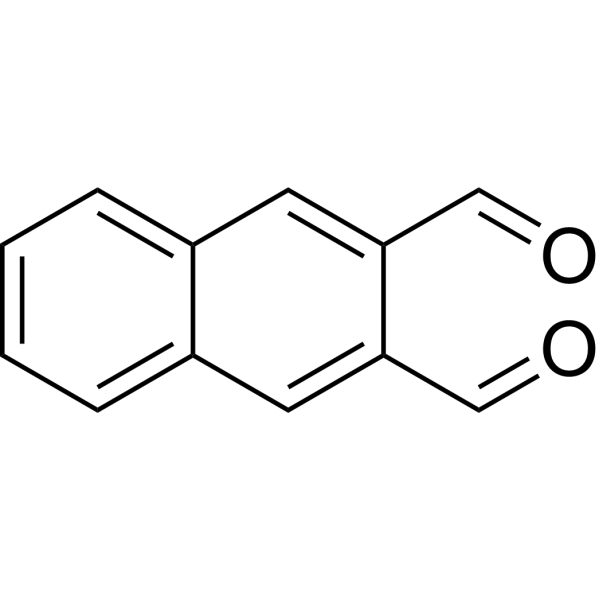
Naphthalene-2,3-dicarboxaldehyde (NDA) is an effective inhibitor of Candida albicans aspartate semialdehyde dehydrogenase (ASADH), with a Ki value of 45 μM. Naphthalene-2,3-dicarboxaldehyde targets ASADH in the aspartate biosynthetic pathway of Candida albicans. Naphthalene-2,3-dicarboxaldehyde reacts with primary amines to generate highly fluorescent and stable derivatives. Naphthalene-2,3-dicarboxaldehyde serves as a fungistatic agent and a fluorogenic derivatization reagent. Naphthalene-2,3-Dicarboxaldehyde can be used for the research of candidiasis.
For research use only. We do not sell to patients.
- Purity : 99.25%
- CAS No.: 7149-49-7
- Formula: C12H8O2
- Molecular Weight:184.19
-
Storage:
RT, stored under nitrogen.
In solvent -80°C, 1 year , -20°C, 6 months

To place orders, for customer services and technical support, please contact: MedChemExpress USA
Tel: 609-228-6898 E-mail: [email protected] [email protected]


-
 Biological Activity
-
Chemical Information
-
Solvent & Solubility
- Purity & Documentation
- References
-
 Help & FAQs


-
HY-101103
HP-β-CD -
HY-17006
Caspofungin diacetate -
HY-13679
Sodium 2-mercaptoethanesulfonate -
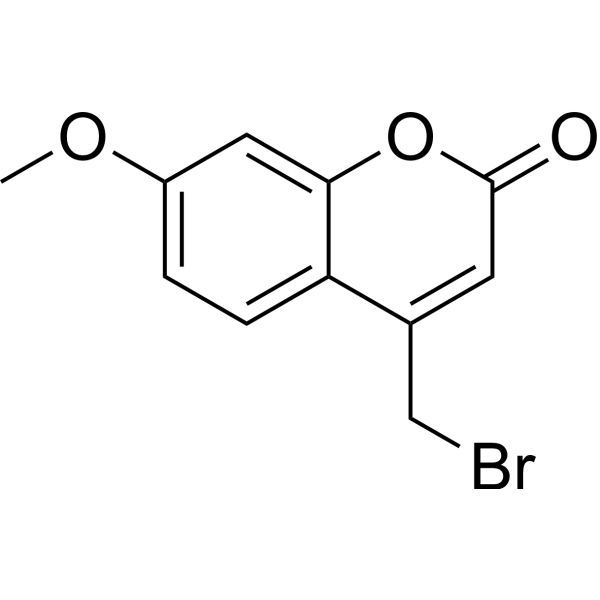
HY-D0036
Br-Mmc -
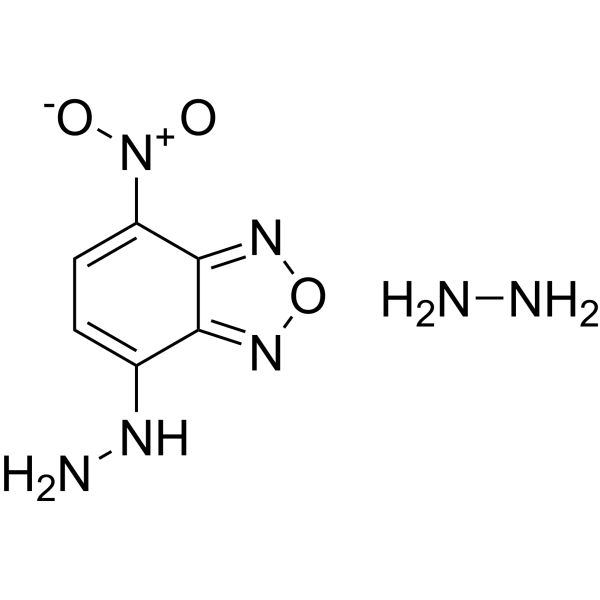
HY-W273413
4-Hydrazino-7-nitro-benzofurazan hydrazine adduct -
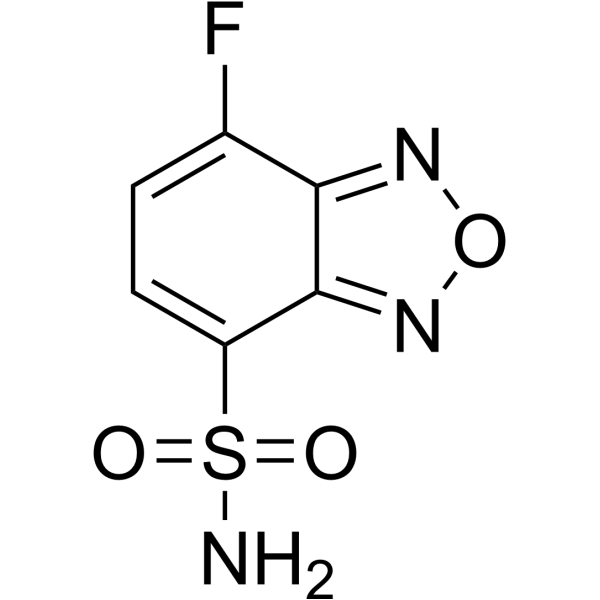
HY-D0102
4-(Aminosulfonyl)-7-fluoro-2,1,3-benzoxadiazole -

HY-W016288R
Naphthalene-2,3-dicarboxaldehyde (Standard) -
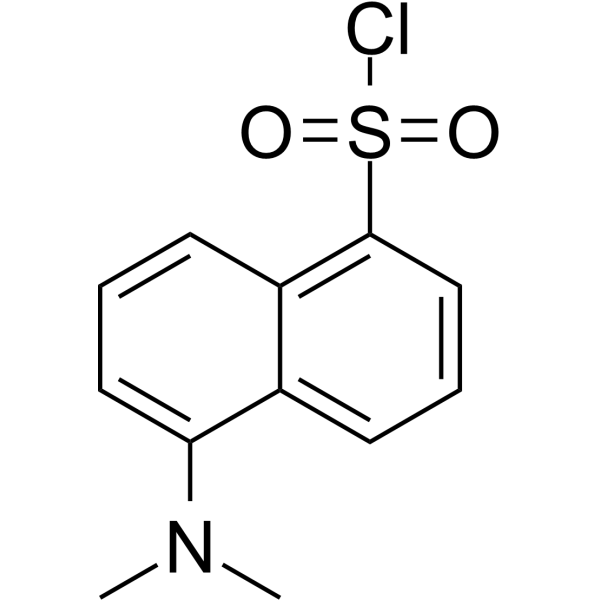
HY-D0017
Dansyl chloride -
HY-D0027
7-Amino-4-methylcoumarin -

HY-W012469
O-(4-Nitrobenzyl)hydroxylamine hydrochloride -

HY-W012669
Phthalaldehyde -
HY-101890
Dabsyl chloride
Publications Citing Use of MedChemExpress (MCE) Naphthalene-2,3-dicarboxaldehyde
More

Biological Activity
Description
In Vitro
Naphthalene-2,3-dicarboxaldehyde (2 mM; serial dilutions) inhibits purified Candida albicans aspartate semialdehyde dehydrogenase with a Ki of 45 μM[1].
Naphthalene-2,3-dicarboxaldehyde inhibits growth of Candida albicans CAF2-1 with an MIC of 12 μg/mL and an IC50 of 58.2 μM[1].
MedChemExpress (MCE) has not independently confirmed the accuracy of these methods. They are for reference only.


Chemical Information
-
CAS No. 7149-49-7
-
Appearance Solid
-
Molecular Weight 184.19
-
Formula C12H8O2
-
Color Off-white to pink
-
SMILES
O=CC1=CC2=CC=CC=C2C=C1C=O
-
Synonyms
2,3-Naphthalenedicarboxaldehyde; Naphthalene-2,3-dialdehyde
-
Shipping
Room temperature in continental US; may vary elsewhere.
-
Storage
RT, stored under nitrogen
In solvent -80°C 1 year -20°C 6 months


Publications (1)
-
Journal Impact Factor
-
Most Recent
-
Biomed Pharmacother
Targeted chemo-photodynamic therapy toward esophageal cancer by GSH-sensitive theranostic nanoplatform. [Abstract]2022 Sep:153:113506. PMID: 36076595


Solvent & Solubility
In Vitro:
DMSO : 100 mg/mL (542.92 mM; ultrasonic and warming and heat to 60°C; Hygroscopic DMSO has a significant impact on the solubility of product, please use newly opened DMSO)
Please refer to the solubility information to select the appropriate solvent. Once prepared, please aliquot and store the solution to prevent product inactivation from repeated freeze-thaw cycles.
Storage method and period of stock solution: -80°C, 1 year; -20°C, 6 months. When stored at -80°C, please use it within 1 year. When stored at -20°C, please use it within 6 months.
Please refer to the solubility information to select the appropriate solvent. Once prepared, please aliquot and store the solution to prevent product inactivation from repeated freeze-thaw cycles.
Storage method and period of stock solution: -80°C, 1 year; -20°C, 6 months. When stored at -80°C, please use it within 1 year. When stored at -20°C, please use it within 6 months.
Concentration (start) × Volume (start) = Concentration (final) × Volume (final)
In Vivo:
Select the appropriate dissolution method based on your experimental animal and administration route.
- For the following dissolution methods, please ensure to first prepare a clear stock solution using an In Vitro approach and then sequentially add co-solvents:
- To ensure reliable experimental results, the clarified stock solution can be appropriately stored based on storage conditions. As for the working solution for In Vivo experiments, it is recommended to prepare freshly and use it on the same day.
- The percentages shown for the solvents indicate their volumetric ratio in the final prepared solution. If precipitation or phase separation occurs during preparation, heat and/or sonication can be used to aid dissolution.
In Vivo Dissolution Calculator
Please enter the basic information of animal experiments:
-
-
-
-
Recommended: Prepare an additional quantity of animals to account for potential losses during experiments.
Please enter your animal formula composition:
-
%DMSO +
Recommended: Keep the proportion of DMSO in working solution below 2% if your animal is weak.
-
%+
-
+%Tween-80 + +
-
%Saline +
The co-solvents required include: DMSO, . All of co-solvents are available by MedChemExpress (MCE). , Tween 80. All of co-solvents are available by MedChemExpress (MCE).
Working solution concentration: 0.22 mg/mL
Method for preparing stock solution: mg drug dissolved in μL DMSO. Stock solution concentration: mg/mL.
1. Take μL DMSO stock solution;
2. Add μL .
μL , mix evenly;
3. Then add μL Tween 80, mix evenly;
4. Then add μL
Please ensure that the stock solution in the first step is dissolved to a clear state, and add co-solvents in sequence. You can use ultrasonic heating (ultrasonic cleaner, recommended frequency 20-40 kHz), vortexing, etc. to assist dissolution.


Purity & Documentation
-
Data Sheet (277 KB)
-
SDS (393 KB)
- English - EN (393 KB)
- Français - FR (393 KB)
- Deutsch - DE (393 KB)
- Norwegian - NO (393 KB)
- Español - ES (393 KB)
- Swedish - SV (393 KB)
- Italian - IT (393 KB)
- Korean - KR (393 KB)
- Portuguese - PT (393 KB)
-
Handling Instructions (2659 KB)
References
[1]. Dahal GP, et al. Aspartate semialdehyde dehydrogenase inhibition suppresses the growth of the pathogenic fungus Candida albicans. Drug Dev Res. 2020;81(6):736-744. [Content Brief]
[2]. Nerurkar MM, et al. Selective fluorogenic derivatization of a peptide nucleic acid trimer with naphthalene-2,3-dicarboxaldehyde. J Pharm Biomed Anal. 1997;15(7):945-950. [Content Brief]
[3]. Marra M, et al. High-performance liquid chromatographic assay of asymmetric dimethylarginine, symmetric dimethylarginine, and arginine in human plasma by derivatization with naphthalene-2,3-dicarboxaldehyde. Anal Biochem. 2003;318(1):13-17. [Content Brief]


Complete Stock Solution Preparation Table
Please refer to the solubility information to select the appropriate solvent. Once prepared, please aliquot and store the solution to prevent product inactivation from repeated freeze-thaw cycles.
Storage method and period of stock solution: -80°C, 1 year; -20°C, 6 months. When stored at -80°C, please use it within 1 year. When stored at -20°C, please use it within 6 months.
| Optional Solvent | Concentration Solvent Mass | 1 mg | 5 mg | 10 mg | 25 mg |
|---|---|---|---|---|---|
| DMSO | 1 mM | 5.4292 mL | 27.1459 mL | 54.2918 mL | 135.7294 mL |
| 5 mM | 1.0858 mL | 5.4292 mL | 10.8584 mL | 27.1459 mL | |
| 10 mM | 0.5429 mL | 2.7146 mL | 5.4292 mL | 13.5729 mL | |
| 15 mM | 0.3619 mL | 1.8097 mL | 3.6195 mL | 9.0486 mL | |
| 20 mM | 0.2715 mL | 1.3573 mL | 2.7146 mL | 6.7865 mL | |
| 25 mM | 0.2172 mL | 1.0858 mL | 2.1717 mL | 5.4292 mL | |
| 30 mM | 0.1810 mL | 0.9049 mL | 1.8097 mL | 4.5243 mL | |
| 40 mM | 0.1357 mL | 0.6786 mL | 1.3573 mL | 3.3932 mL | |
| 50 mM | 0.1086 mL | 0.5429 mL | 1.0858 mL | 2.7146 mL | |
| 60 mM | 0.0905 mL | 0.4524 mL | 0.9049 mL | 2.2622 mL | |
| 80 mM | 0.0679 mL | 0.3393 mL | 0.6786 mL | 1.6966 mL | |
| 100 mM | 0.0543 mL | 0.2715 mL | 0.5429 mL | 1.3573 mL |


Naphthalene-2,3-dicarboxaldehyde Related Classifications
HY-W016288 Related Classifications
 Powered by Bioz