



Neuropeptide S (Mouse) TFA
Neuropeptide S(Mouse) TFA is a potent endogenous neuropeptide S receptor (NPSR) agonist (EC50=3 nM). Neuropeptide S(Mouse) TFA induces mobilization of intracellular Ca2+. Neuropeptide S(Mouse) TFA increases locomotor activity and wakefulness in mice. Neuropeptide S(Mouse) TFA also reduces anxiety-like behavior in mice.
For research use only. We do not sell to patients.
- Formula: C93H156N34O27.xC2HF3O2
- Molecular Weight:2182.45 (free acid)
-
Storage:
Please store the product under the recommended conditions in the Certificate of Analysis.

To place orders, for customer services and technical support, please contact: MedChemExpress USA
Tel: 609-228-6898 E-mail: [email protected] [email protected]


-
 Biological Activity
-
Chemical Information
- Protocols
- Purity & Documentation
-
 Help & FAQs




Biological Activity
Description


Chemical Information
-
Molecular Weight 2182.45 (free acid)
-
Formula C93H156N34O27.xC2HF3O2
-
Sequence
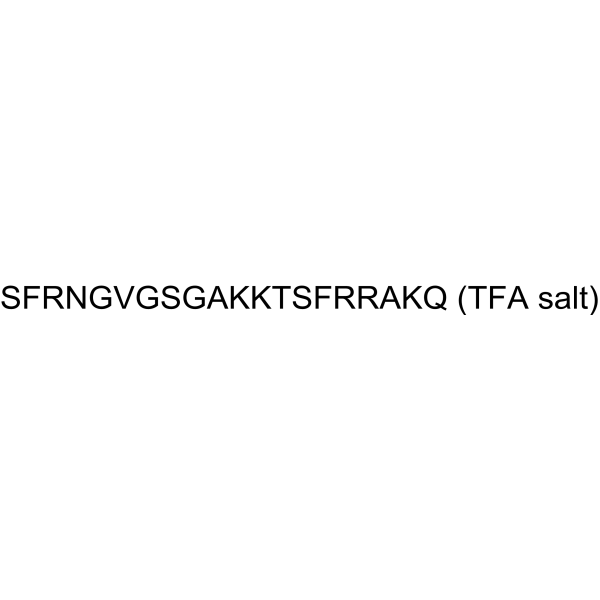
Ser-Phe-Arg-Asn-Gly-Val-Gly-Ser-Gly-Ala-Lys-Lys-Thr-Ser-Phe-Arg-Arg-Ala-Lys-Gln (TFA)
-
Sequence Shortening
SFRNGVGSGAKKTSFRRAKQ (TFA)
-
Shipping
Room temperature in continental US; may vary elsewhere.
-
Storage
Please store the product under the recommended conditions in the Certificate of Analysis.

Protocols
-
Protocol for Open Field Test (OF)
The Open Field Test is a rodent behavioral assay that measures spontaneous locomotion, exploratory behavior, and anxiety-like behavior when an animal is placed in a novel open arena. The main readouts are total distance traveled, movement time, velocity, center-zone entries, center-zone time, peripheral-zone time, and thigmotaxis. The assay is based on the conflict between exploration of a novel environment and avoidance of exposed open areas; higher center exploration is commonly interpreted as lower anxiety-like behavior, whereas increased wall-following or peripheral occupancy is interpreted as higher anxiety-like behavior.
-
Protocol for Elevated Plus Maze Test
The Elevated Plus Maze is a rodent anxiety-like behavior assay based on the conflict between spontaneous exploration and avoidance of open, elevated, exposed spaces. The apparatus contains two open arms and two closed arms arranged in a plus shape, and rodents normally spend more time in closed arms than open arms. The assay readout is generated by recording arm entries, time spent in open and closed arms, and related exploratory behaviors. Increased open-arm time or open-arm entries is commonly interpreted as reduced anxiety-like behavior, whereas reduced open-arm exploration is interpreted as increased anxiety-like behavior.
-
Ca2+ Staining Technique
Ca2+ staining is an experimental technique that utilizes specific fluorescent probes (such as Fluo-4 AM, Fura-2, etc.) to qualitatively or quantitatively detect dynamic changes in intracellular Ca2+ concentrations; this is achieved by monitoring the changes in fluorescent signals generated when these probes bind to free intracellular calcium ions. The underlying principle relies primarily on the presence of chelating groups within the probe's molecular structure that possess high affinity for calcium ions.


Purity & Documentation

Calculators
Concentration (start) × Volume (start) = Concentration (final) × Volume (final)


Neuropeptide S (Mouse) TFA Related Classifications
HY-P1437A Related Classifications
 Powered by Bioz