



Anticancer agent 50
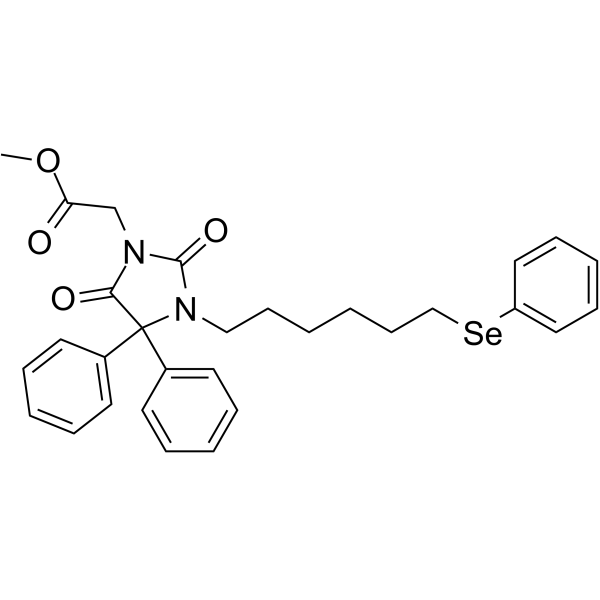
Anticancer agent 50 (compound 6) is a potent ABCB1 efflux pump modulator. Anticancer agent 50 shows cytotoxic effects and antiproliferative effects. Anticancer agent 50 decreases the expression of cyclin D1 and induces p53 expression. Anticancer agent 50 has the potential for the research of T-lymphoma.
For research use only. We do not sell to patients.
- CAS No.: 2487457-15-6
- Formula: C30H32N2O4Se
- Molecular Weight:563.55
-
Storage:
Please store the product under the recommended conditions in the Certificate of Analysis.

To place orders, for customer services and technical support, please contact: MedChemExpress USA
Tel: 609-228-6898 E-mail: [email protected] [email protected]


-
 Biological Activity
-
Chemical Information
- Protocols
- Purity & Documentation
- References
-
 Help & FAQs




Biological Activity
Description
In Vitro
Anticancer agent 50 (compound 6) (0-100 µM) shows cytotoxic effects with IC50s of 0.67, 0.90 µM for sensitive parental (PAR) and resistant (MDR) mouse T-lymphoma cells, respectively[1].
Anticancer agent 50 (0-100 µM) shows antiproliferative effects with IC50s of 3.84, 1.34 µM for sensitive parental (PAR) and resistant (MDR) mouse T-lymphoma cells, respectively[1].
Anticancer agent 50 (0.1, 0.5, 2 µM; 24 h) inhibits cell cycle progression through the reduction of the expression of cyclin D1 and inhibits cell proliferation by inducing p53 expression[1].
Anticancer agent 50 (0.1, 0.5, 2, 10 µM; 72 h) inhibits cell growth by 12% in SH-SY5Y cells[1].
MedChemExpress (MCE) has not independently confirmed the accuracy of these methods. They are for reference only.
-
Cell Line:JURKAT cells
-
Concentration:0.1, 0.5, 2 µM
-
Incubation Time:24 h
-
Result:Significantly reduced cyclin D1 expression and increased the level of p53.


Chemical Information
-
CAS No. 2487457-15-6
-
Molecular Weight 563.55
-
Formula C30H32N2O4Se
-
SMILES
COC(CN1C(N(C(C2=CC=CC=C2)(C1=O)C3=CC=CC=C3)CCCCCC[Se]C4=CC=CC=C4)=O)=O
-
Shipping
Room temperature in continental US; may vary elsewhere.
-
Storage
Please store the product under the recommended conditions in the Certificate of Analysis.


Purity & Documentation
References

Calculators
Concentration (start) × Volume (start) = Concentration (final) × Volume (final)


Anticancer agent 50 Related Classifications
HY-146389 Related Classifications
 Powered by Bioz