



Pep19-2.5
Based on 1 publication(s) in Google Scholar
Pep19-2.5 is an synthetic and antitoxin peptide, blocks the intracellular endotoxin signaling cascade. Pep19-2.5 inhibits signaling of lipopeptides (LP) and lipopolysaccharides (LPS) mediated by transmembrane and cytosolic pattern recognition receptors (PRRs). The signaling cascades lead to inflammation and cell pyroptosis.
Nos produits utilisent uniquement pour la recherche. Nous ne vendons pas aux patients.
- Pureté : 98.98%
- CAS No.: 1322711-38-5
- Formule: C135H187N37O22S
- Masse moléculaire:2712.23
-
Stockage:
Sealed storage, away from moisture.
Powder -80°C, 2 years , -20°C, 1 year* In solvent : -80°C, 6 months; -20°C, 1 month (sealed storage, away from moisture)

To place orders, for customer services and technical support, please contact: MedChemExpress USA
Tel: 609-228-6898 E-mail: [email protected] [email protected]


-
 Activité biologique
-
Chemical Information
- Protocole
- Pureté et documentation
- Références
-
 Help & FAQs


Publications Citing Use of MedChemExpress (MCE) Pep19-2.5
More

Activité biologique
Description
In Vivo
MedChemExpress (MCE) has not independently confirmed the accuracy of these methods. They are for reference only.
-
Animal Model:Sepsis model in male New Zealand rabbits (2-2.5 kg)[2]
-
Dosage:5 mg/kg, combinded with 15 mg/kg Ceftriaxone; total volume of 2 mL
-
Administration:Intravenous injection; extracted blood from the marginal ear vein at different time points post challenge (0, 2, 30, 90 and 180 min)
-
Result:Killed bacteria and eliminates bacteremia 30 min post challenge;
Inhibited Toll-like receptor 4 agonists in serum 90 min post challenge;
Reduced serum levels of pro-inflammatory cytokines (interleukin-6 and tumor necrosis factor α);
And reverted to hypothermia and gives rise to temperature values indistinguishable from basal levels 330 min post challenge.


Chemical Information
-
CAS No. 1322711-38-5
-
Appearance Solid
-
Masse moléculaire 2712.23
-
Formule C135H187N37O22S
-
Color White to off-white
-
Sequence Shortening
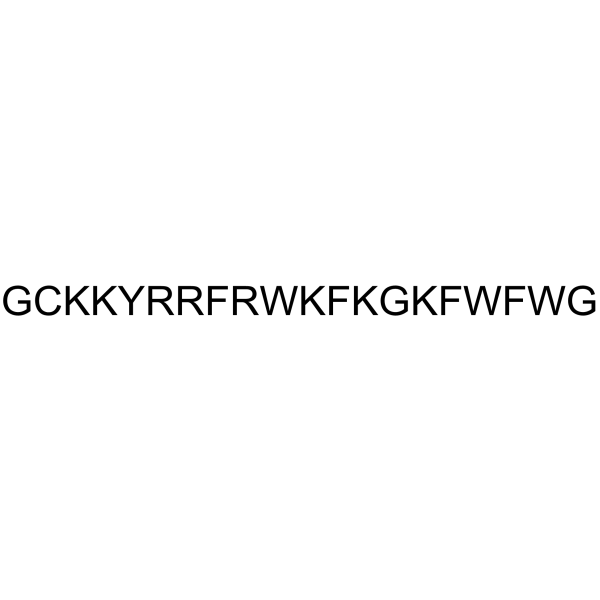
GCKKYRRFRWKFKGKFWFWG
-
Livraison
Room temperature in continental US; may vary elsewhere.
-
Stockage
Sealed storage, away from moisture
Powder -80°C 2 years -20°C 1 year * In solvent : -80°C, 6 months; -20°C, 1 month (sealed storage, away from moisture)


Publications (1)
-
Journal Impact Factor
-
Most Recent
-
Behav Brain Res
Serotonin mitigates depression in a rotenone-induced mouse Parkinson's disease model by inhibiting hippocampal neuronal pyroptosis and neuroinflammation. [Abstract]2025 Jul 26:490:115620. PMID: 40345554

Protocole
-
Research Protocol for Inflammation-related Diseases
The NLRP3 inflammasome is a cytosolic innate immune signaling platform that integrates priming signals and danger-signal activation to promote caspase-1 activation, maturation of IL-1β and IL-18, and gasdermin D-mediated pyroptotic cell death. The core experimental logic is to determine whether inflammatory disease phenotypes are driven by increased NLRP3 expression, ASC-containing inflammasome assembly, caspase-1 cleavage, GSDMD cleavage, and extracellular release of IL-1β/IL-18 rather than by nonspecific cell injury alone. The pathway is strongly linked to inflammation-related disease phenotypes because monosodium urate crystals activate NALP3/NLRP3 inflammasome signaling in gout-like crystal inflammation, cholesterol crystals activate NLRP3 inflammasomes in atherogenesis models, and DSS-induced intestinal inflammation has been reported to involve NLRP3 inflammasome activity. However, experimental colitis studies also show context-dependent protective effects of NLRP3 inflammasome co
-
Pyroptosis Solutions
Pyroptosis is a lytic inflammatory cell-death pathway executed by gasdermin pores, most classically through inflammasome-mediated activation of caspase-1, cleavage of gasdermin D, membrane pore formation, LDH release, and secretion of IL-1β and IL-18. The canonical pathway is commonly modeled by priming cells with an inflammatory signal such as LPS to induce pro-IL-1β and inflammasome components, followed by an activation signal such as ATP or nigericin to activate NLRP3, ASC speck formation, caspase-1 cleavage, GSDMD cleavage, cytokine release, and pyroptotic membrane rupture. The non-canonical pathway is triggered when cytosolic LPS activates mouse caspase-11 or human caspase-4/5, leading to GSDMD cleavage and pyroptosis, and this can secondarily activate NLRP3-dependent IL-1β release. Pyroptosis is linked to inflammatory injury, infection, cancer, liver disease, ocular disease, placental inflammation, and other disease phenotypes, but unresolved questions include which gasdermin fam


Pureté et documentation
-
Fiche technique (263 KB)
-
SDS (252 KB)
- English - EN (252 KB)
- Français - FR (252 KB)
- Deutsch - DE (252 KB)
- Norwegian - NO (252 KB)
- Español - ES (252 KB)
- Swedish - SV (252 KB)
- Italian - IT (252 KB)
- Korean - KR (252 KB)
- Portuguese - PT (252 KB)
-
Instruction de manipulation (2659 KB)
Références
[1]. Heinbockel L, et al. Inhibition of Lipopolysaccharide- and Lipoprotein-Induced Inflammation by Antitoxin Peptide Pep19-2.5. Front Immunol. 2018 Jul 26;9:1704. [Content Brief]
[2]. Bárcena-Varela S, et al. Coupling killing to neutralization: combined therapy with ceftriaxone/Pep19-2.5 counteracts sepsis in rabbits. Exp Mol Med. 2017 Jun 16;49(6):e345. [Content Brief]
[3]. Jannadi H, et al. Antimicrobial peptides Pep19-2.5 and Pep19-4LF inhibit Streptococcus mutans growth and biofilm formation. Microb Pathog. 2019 Aug;133:103546. [Content Brief]

Calculators
Concentration (start) × Volume (start) = Concentration (final) × Volume (final)


Pep19-2.5 Related Classifications
HY-P3496 Related Classifications
 Powered by Bioz