



Poloxamer 338 (F108)

Based on 1 Customer Validation
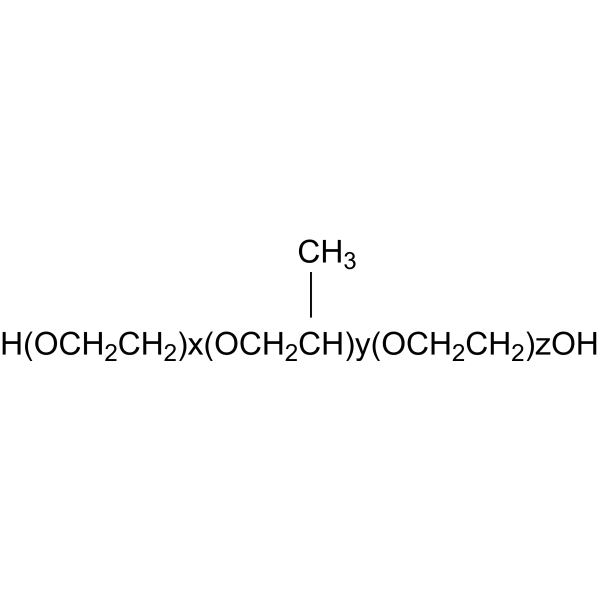
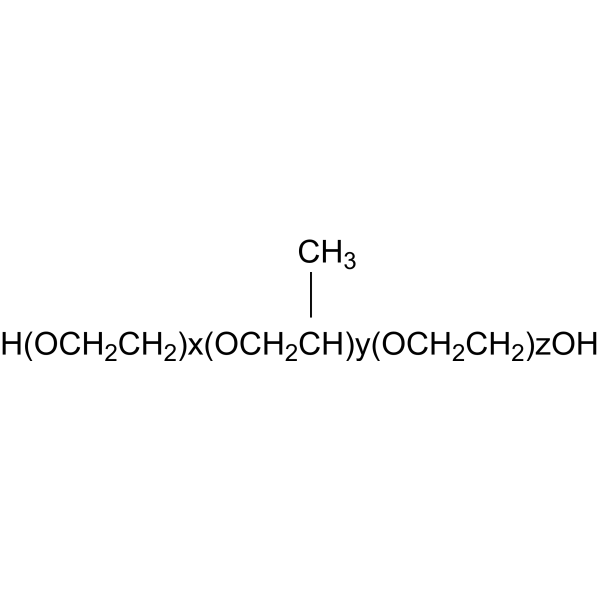
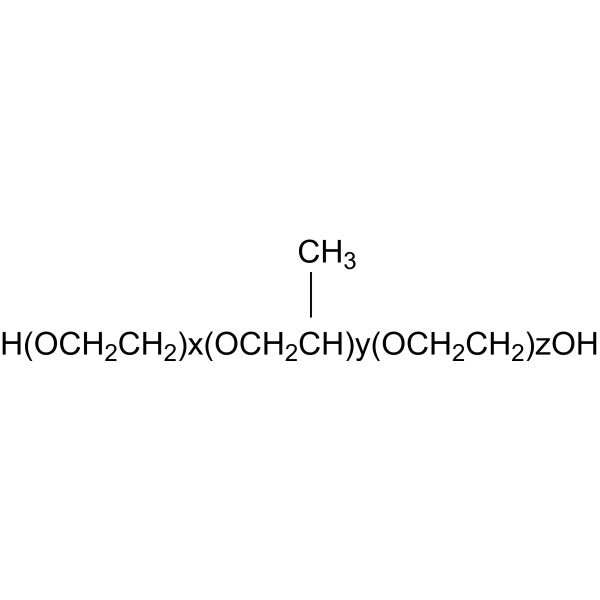
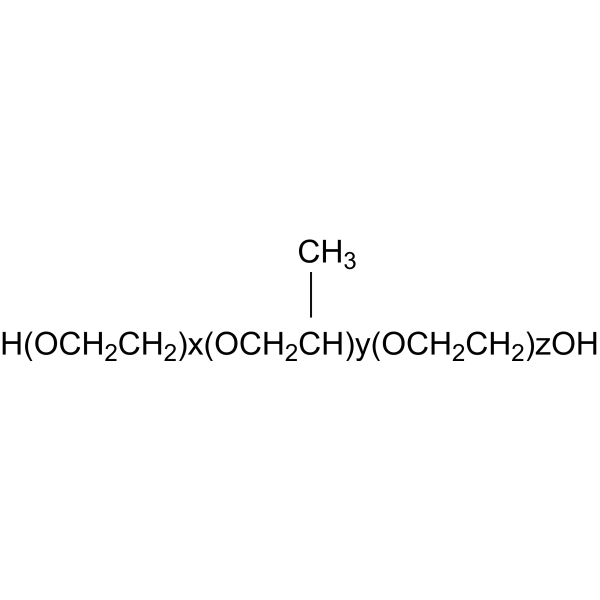
Poloxamer 338 F108 is block polymer of polyoxyethylene and polyoxypropylene with average molecular mass of 14600. Poloxamer 338 F108 reduces the aggregation of red blood cells, inhibits proliferation of human lymphocyte cell IIBR1. Poloxamer 338 F108 exhibits short-term and subchronic toxicity in rats.
For research use only. We do not sell to patients.
- CAS No.: 9003-11-6
- Molecular Weight:14600 (Average)
-
Storage:
Please store the product under the recommended conditions in the Certificate of Analysis.


To place orders, for customer services and technical support, please contact: MedChemExpress USA
Tel: 609-228-6898 E-mail: [email protected] [email protected]


-
 Biological Activity
-
Chemical Information
-
Solvent & Solubility
- Protocols
- Purity & Documentation
- References
-
 Help & FAQs


-
HY-D1005
Poloxamer 407 (F127)LPL Receptor Inhibitor -
HY-D1005A
Poloxamer 188Linear Copolymer -

HY-D1005A10
Poloxamer 184 (L64)Biochemical Assay Agent -
HY-D1005B
Poloxamer 237 (F87)Alcohol Substance -

HY-D1005A2
Poloxamer 105 (L35)Biochemical Assay Agent -

HY-D1005A8
Poloxamer 181 (L61)Biochemical Assay Agent -
HY-D1005H
Poloxamer 188 (F68)Nonionic Linear Copolymer -

HY-D1005A6
Poloxamer 124 (L44)Biochemical Assay Agent -
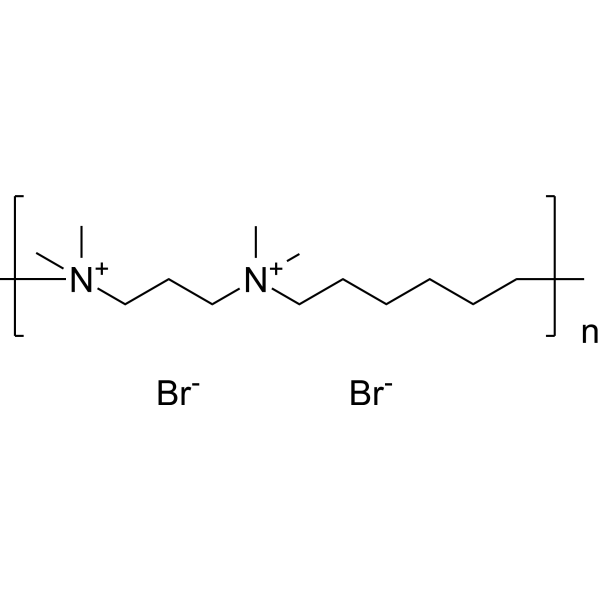
HY-112735
Hexadimethrine bromideCationic Polyelectrolyte -

HY-D1005A25
Poloxamer 403 (P123)Biochemical Assay Agent -

HY-D1005A23
Poloxamer 401 (L121)Biochemical Assay Agent -

HY-D1005K
Poloxamer L64Biochemical Assay Reagent


Biological Activity
Description
In Vitro
Poloxamer 338 F108 inhibits RPMI 8432 cell viability with a 30% inhibition rate at 0.2% concentration for 7 days.
MedChemExpress (MCE) has not independently confirmed the accuracy of these methods. They are for reference only. Further protocols information, click here.
In Vivo
MedChemExpress (MCE) has not independently confirmed the accuracy of these methods. They are for reference only.


Chemical Information
-
CAS No. 9003-11-6
-
Appearance Solid
-
Molecular Weight 14600 (Average)
-
Color White to off-white
-
SMILES
[Poloxamer 338 (F108)]
-
Synonyms
PEG-PPG-PEG, 14600 (Average)
-
Shipping
Room temperature in continental US; may vary elsewhere.
-
Storage
Please store the product under the recommended conditions in the Certificate of Analysis.


Solvent & Solubility
In Vitro:
H2O : 100 mg/mL (Need ultrasonic)

Protocols
-
Subchronic/Chronic Toxicity Study
A subchronic/chronic oral toxicity study detects systemic adverse effects caused by repeated administration of a test article, using mortality, clinical signs, body weight, food/water intake, ophthalmology, urinalysis, hematology, serum biochemistry, organ weights, gross necropsy, and histopathology as integrated readouts. The readout reflects dose-related physiological injury, target-organ pathology, reversibility after recovery, and derivation of NOAEL, LOAEL, or related point-of-departure values when the dataset supports them.
-
Repeated-Dose Oral Toxicity Study
A repeated-dose oral toxicity study evaluates systemic toxic effects after daily oral exposure to a test substance for a defined period, commonly 28 days, 6 weeks, 90 days, or 13 weeks in rodent studies. The readout is generated by integrating mortality, clinical signs, body-weight change, food and water intake, functional or behavioral observations, hematology, serum biochemistry, urinalysis, organ weights, necropsy, and histopathology to identify dose-related adverse effects, target organs, and the no-observed-adverse-effect level (NOAEL).
-
Cell Viability Determination by MTT Colorimetric Assay
The following protocol uses the MTT colorimetric assay as a classic literature-established method for assessing cell viability/metabolic activity in cultured mammalian cells. MTT[3-(4,5-dimethylthiazol-2-yl)-2,5-diphenyltetrazolium bromide] is reduced by metabolically active cells to a colored formazan product; the amount of formazan is quantified spectrophotometrically and provides an indirect measure of metabolically active viable cells. Importantly, MTT reduction reflects cellular oxidoreductase/metabolic activity rather than an absolute direct count of living cells, so changes in cellular metabolism can alter the signal independently of cell number.


Purity & Documentation
-
Data Sheet (266 KB)
-
SDS (251 KB)
- English - EN (251 KB)
- Français - FR (251 KB)
- Deutsch - DE (251 KB)
- Norwegian - NO (251 KB)
- Español - ES (251 KB)
- Swedish - SV (251 KB)
- Italian - IT (251 KB)
- Korean - KR (251 KB)
- Portuguese - PT (251 KB)
-
Handling Instructions (2659 KB)
References
[1]. Singh-Joy SD, et al., Safety assessment of poloxamers 101, 105, 108, 122, 123, 124, 181, 182, 183, 184, 185, 188, 212, 215, 217, 231, 234, 235, 237, 238, 282, 284, 288, 331, 333, 334, 335, 338, 401, 402, 403, and 407, poloxamer 105 benzoate, and poloxamer 182 dibenzoate as used in cosmetics. Int J Toxicol. 2008;27 Suppl 2:93-128. [Content Brief]
[2]. Mizrahi A. Pluronic polyols in human lymphocyte cell line cultures. J Clin Microbiol. 1975 Jul;2(1):11-3. [Content Brief]

Calculators
Concentration (start) × Volume (start) = Concentration (final) × Volume (final)


Poloxamer 338 (F108) Related Classifications
HY-D1005A22 Related Classifications
 Powered by Bioz