



Poly-D-lysine hydrobromide (MW ≥300000)
Poly-D-lysine hydrobromide (MW ≥300000) (PDLHB (MW ≥300000)) is a cationic polymer and cell adhesion promoter. Poly-D-lysine hydrobromide (MW ≥300000) serves as a substrate coating to support the adhesion and proliferation of rat dorsal root ganglion satellite glial cells in vitro. Poly-D-lysine hydrobromide (MW ≥300000) promotes the adhesion and immobilization of cells on plastic culture dishes. Poly-D-lysine hydrobromide is also known as a calcium-sensing receptor (CaSR) agonist peptide.
For research use only. We do not sell to patients.
- CAS No.: 27964-99-4
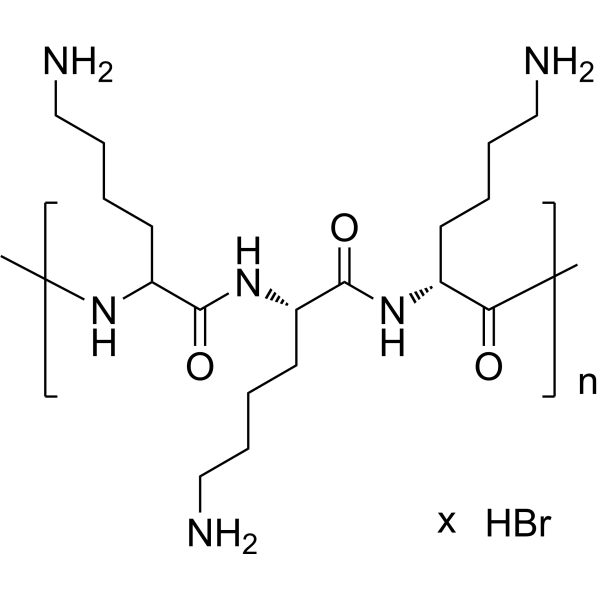
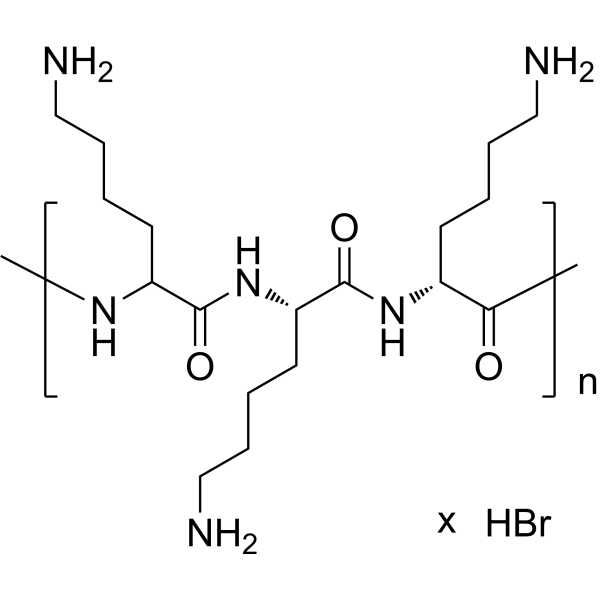
- Formula: (C6H14N2O2)n.xHBr
- Molecular Weight:≥300000
-
Storage:Powder -20°C, 3 years ; In solvent -80°C, 6 months , -20°C, 1 month


To place orders, for customer services and technical support, please contact: MedChemExpress USA
Tel: 609-228-6898 E-mail: [email protected] [email protected]


-
 Biological Activity
-
Chemical Information
- Protocols
- Purity & Documentation
- References
-
 Help & FAQs


-
HY-139201A
Poly-D-lysine hydrobromide (MW 70000-150000)CaSR Agonist -
HY-139201
Poly-D-lysine hydrobromide (MW 30000-70000)CaSR Agonist -

HY-139201B
Poly-D-lysine hydrobromide (MW 84000)CaSR Agonist -

HY-139201E
Poly-D-lysine hydrobromide (MW 150000-300000)CaSR Agonist Peptide -

HY-139201D
Poly-D-lysine hydrobromide (MW 4000-15000)Polymer Matrix -

HY-126437J
Poly-L-lysine solution (0.01%, sterile-filtered, MW 150000-300000)Biochemical Reagent -

HY-126437E
Poly-L-lysine hydrobromide (MW 15000-30000)Cell Culture Additive -

HY-126437H
Poly-L-lysine hydrobromide (MW 4000-15000)Cell Culture Additive -

HY-126437K
Poly-L-lysine solution (0.01%, sterile-filtered, MW 70000-150000)Biochemical Reagent -
HY-126437B
Poly-L-lysine hydrobromide (MW 70000-150000)Cell Attachment Factor -
HY-126437C
Poly-L-lysine hydrobromide (MW 150000-300000)Lysine Polymer -

HY-139201C
Poly-D-lysine hydrobromide (MW 1000-5000)Cationic Polypeptide Polymer


Biological Activity
Description
In Vitro
Poly-D-lysine hydrobromide (MW ≥300000) at 25 μg/mL (applied for ~10-21 days) serves as an effective substrate to support the adhesion and proliferation of primary satellite glial cells isolated from dorsal root ganglia of neonatal rats[1].
MedChemExpress (MCE) has not independently confirmed the accuracy of these methods. They are for reference only. Further protocols information, click here.


Chemical Information
-
CAS No. 27964-99-4
-
Appearance Solid
-
Molecular Weight ≥300000
-
Formula (C6H14N2O2)n.xHBr
-
Color White to off-white
-
SMILES
CNC(CCCCN)C(N[C@@H](CCCCN)C(N[C@H](CCCCN)C(C)=O)=O)=O.[x].Br.[n]
-
Synonyms
PDLHB (MW ≥300000)
-
Shipping
Room temperature in continental US; may vary elsewhere.
-
Storage
Powder -20°C 3 years In solvent -80°C 6 months -20°C 1 month

Protocols
-
Primary Dorsal Root Ganglion Sensory Neuron Culture
Primary dorsal root ganglion sensory neuron culture isolates DRG neuronal somata from rodent or human ganglia, dissociates tissue enzymatically and mechanically, and maintains post-mitotic sensory neurons in vitro for readouts such as neurite outgrowth, immunocytochemical marker expression, calcium imaging, electrophysiology, RNA/protein analysis, or neuropeptide release assays. The method reflects peripheral sensory neuron biology because DRG neurons are primary sensory neurons whose cell bodies reside in dorsal root ganglia and whose cultured dissociated cells can retain neuronal morphology, sensory-neuron marker expression, and stimulus-responsive properties depending on the downstream assay.
-
Cell Viability Determination by MTT Colorimetric Assay
The following protocol uses the MTT colorimetric assay as a classic literature-established method for assessing cell viability/metabolic activity in cultured mammalian cells. MTT[3-(4,5-dimethylthiazol-2-yl)-2,5-diphenyltetrazolium bromide] is reduced by metabolically active cells to a colored formazan product; the amount of formazan is quantified spectrophotometrically and provides an indirect measure of metabolically active viable cells. Importantly, MTT reduction reflects cellular oxidoreductase/metabolic activity rather than an absolute direct count of living cells, so changes in cellular metabolism can alter the signal independently of cell number.


Purity & Documentation
-
Data Sheet (269 KB)
-
SDS (252 KB)
- English - EN (252 KB)
- Français - FR (252 KB)
- Deutsch - DE (252 KB)
- Norwegian - NO (252 KB)
- Español - ES (252 KB)
- Swedish - SV (252 KB)
- Italian - IT (252 KB)
- Korean - KR (252 KB)
- Portuguese - PT (252 KB)
-
Handling Instructions (2659 KB)
References

Calculators
Concentration (start) × Volume (start) = Concentration (final) × Volume (final)


Poly-D-lysine hydrobromide (MW ≥300000) Related Classifications
HY-139201H Related Classifications
 Powered by Bioz