



Poly(styrenyl acetal trehalose)
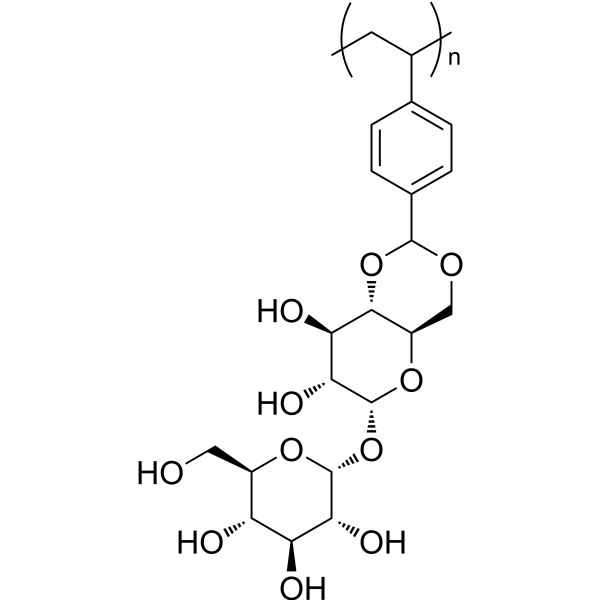
Poly(styrenyl acetal trehalose) (pSAT) is composed of trehalose side chains linked to a polystyrene backbone via acetals. Poly(styrenyl acetal trehalose) stabilizes a variety of proteins and enzymes against fluctuations in temperature, and does not trigger the innate immune response. Poly(styrenyl acetal trehalose) can be used in synthesis of protein-polymer conjugates for reduced renal clearance of the biomolecule.
For research use only. We do not sell to patients.
- Formula: C23H34O11
-
Storage:
Please store the product under the recommended conditions in the Certificate of Analysis.

To place orders, for customer services and technical support, please contact: MedChemExpress USA
Tel: 609-228-6898 E-mail: [email protected] [email protected]


-
 Biological Activity
-
Chemical Information
- Protocols
- Purity & Documentation
- References
-
 Help & FAQs




Biological Activity
Description
In Vivo
MedChemExpress (MCE) has not independently confirmed the accuracy of these methods. They are for reference only.
-
Animal Model:Female CD-1 mice (6 weeks, n = 6)[1]
-
Dosage:10 mg/kg
-
Administration:IV, single dosage
-
Result:Did not induce liver or kidney damage, and was safe in terms of acute toxicity.
-
Animal Model:Female CD-1 mice (6 weeks, n = 6)[1]
-
Dosage:1 mg/kg
-
Administration:IP, twice, at the 0 and 14 day
-
Result:Did not lead to IgG production.
Led to a slight increase in the IgM level for weeks 1 and 2 but dropped to the negative control level by week 3.
Did not induce the increase of pro-inflammatory cytokines.


Chemical Information
-
Formula C23H34O11
-
SMILES
O[C@@H]1[C@@H](O)[C@H](O)[C@@H](CO)O[C@@H]1O[C@H]2O[C@H]3[C@@H](OC(C4=CC=C(C(CC)C)C=C4)OC3)[C@H](O)[C@H]2O.[n]
-
Synonyms
pSAT
-
Shipping
Room temperature in continental US; may vary elsewhere.
-
Storage
Please store the product under the recommended conditions in the Certificate of Analysis.

Protocols
-
Protocol for Pharmacokinetic Study
Pharmacokinetic studies quantify how an organism handles a drug over time through absorption, distribution, metabolism, and excretion, and the core experimental readout is the concentration-time profile of parent drug and, when relevant, metabolites in biological matrices such as plasma, whole blood, urine, bile, or tissue. Pharmacokinetic analysis links dose, route, exposure, clearance, half-life, distribution, bioavailability, and systemic exposure to drug efficacy and toxicity hypotheses rather than measuring a signaling pathway directly. The literature links pharmacokinetics to drug-development phenotypes by showing that drug metabolism and pharmacokinetics influence compound progression, exposure-response interpretation, safety margins, dosing strategy, and failure risk during discovery and development. DMPK science contributes to compound optimization by integrating physicochemical properties, in vitro metabolism, transporter behavior, in vivo exposure, and pharmacodynamic contex


Purity & Documentation
References

Calculators
Concentration (start) × Volume (start) = Concentration (final) × Volume (final)


Poly(styrenyl acetal trehalose) Related Classifications
HY-150502 Related Classifications
 Powered by Bioz