



Potassium chloride, ≥99.99% trace metals basis

Based on 1 Customer Validation
Potassium chloride, ≥99.99% trace metals basis (Potassium chloride, suitable for the extraction and solubilization of proteins), is an inorganic salt used in the preparation of phosphate buffers. With very low metal impurity content, it is suitable for protein extraction and dissolution.
For research use only. We do not sell to patients.
- Purity : 98.8%
- CAS No.: 7447-40-7
- Formula: KCl
- Molecular Weight:74.55
-
Storage:
Store at room temperature, keep dry and cool.
In solvent -80°C, 1 year , -20°C, 6 months


To place orders, for customer services and technical support, please contact: MedChemExpress USA
Tel: 609-228-6898 E-mail: [email protected] [email protected]


-
 Biological Activity
-
Chemical Information
-
Solvent & Solubility
- Protocols
- Purity & Documentation
-
 Help & FAQs


-
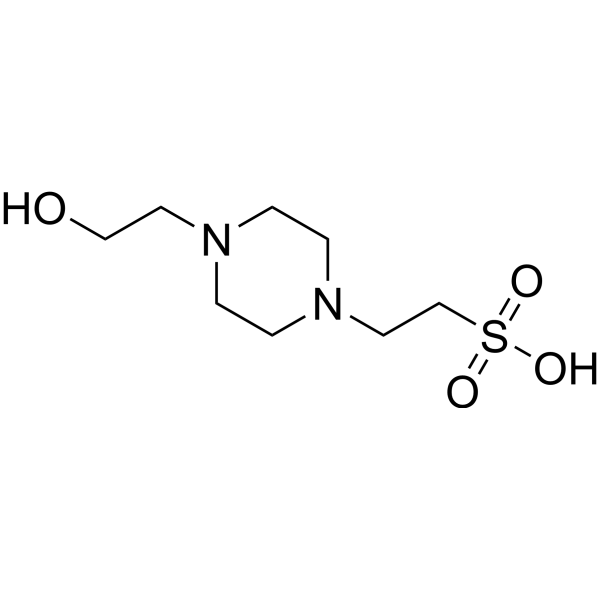
HY-D0857
HEPESZwitterionic Buffer -
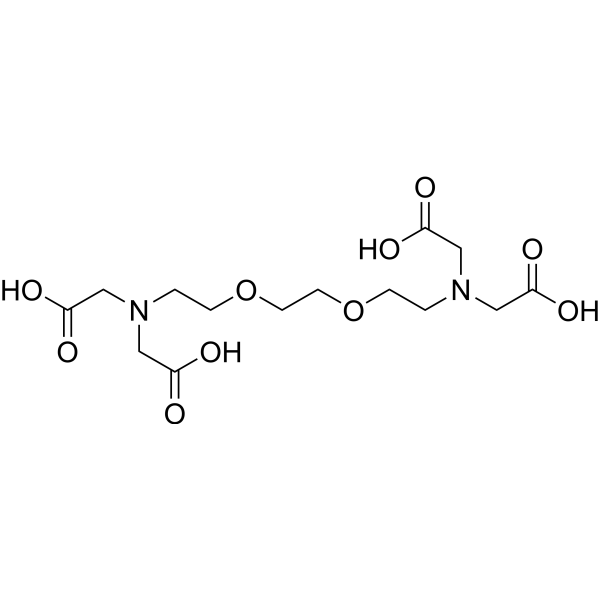
HY-D0861
EGTACalcium Ion Chelator -

HY-Y1267
Magnesium sulfateAnti-Inflammatory Agent -

HY-Y0537
Potassium chloride, AR, 99.5%Potassium Supplement -

HY-Y0537E
Potassium chloride, for cell cultureInorganic Salt -

HY-Y0537B
Potassium chloride, for molecular biologyPotassium Chloride -

HY-Y0537K
Potassium chloride, ACS, 99.0%Salt -

HY-Y0344D
Sodium chloride, for cell cultureBiochemical Assay Reagent -

HY-Y0344I
Sodium chloride, meets analytical specification of Ph. Eur. BP USP, ≤0.00002% AlBiochemical Reagent -

HY-Y0344J
Sodium chloride, for molecular biologyInorganic Salt -

HY-Y0537I
Potassium chloride, United States Pharmacopeia (USP) Reference StandardPotassium Chloride -

HY-Y0537J
Potassium chloride, meets analytical specification of Ph. Eur., BP, USP, FCC, E508, ≤0.0001% AlBiochemical Assay Reagent


Biological Activity
Description
Cellular Effect
|
Cell Line

|
Type | Value | Description | References |
|---|---|---|---|---|
| HEK293 | EC50 |
174 mM
Compound: 4873
|
Substrate uptake by the Sodium/Potassium/Calcium Exchanger 4 (NCKX4, SLC24A4) as assessed by Screen Questtrade mark Fluo-8 NW calcium assay kit in HEK-293 JumpIN-SLC24A4 cells (PubChem AID: 1794814)
Substrate uptake by the Sodium/Potassium/Calcium Exchanger 4 (NCKX4, SLC24A4) as assessed by Screen Questtrade mark Fluo-8 NW calcium assay kit in HEK-293 JumpIN-SLC24A4 cells (PubChem AID: 1794814)
|
10.5281/zenodo.7360317 |
| HEK293 | EC50 |
280 mM
Compound: 4873
|
Substrate uptake by the Sodium/Potassium/Calcium Exchanger 2 (NCKX2, SLC24A2) as assessed by Screen Questtrade mark Fluo-8 NW calcium assay kit in HEK-293 JumpIN-SLC24A2 cells (PubChem AID: 1794815)
Substrate uptake by the Sodium/Potassium/Calcium Exchanger 2 (NCKX2, SLC24A2) as assessed by Screen Questtrade mark Fluo-8 NW calcium assay kit in HEK-293 JumpIN-SLC24A2 cells (PubChem AID: 1794815)
|
10.5281/zenodo.7360329 |
In Vitro
Potassium chloride, ≥99.99% trace metals basis, is a phosphate buffer used for protein extraction and dissolution.
MedChemExpress (MCE) has not independently confirmed the accuracy of these methods. They are for reference only. Further protocols information, click here.
Clinical Trial
| NCT Number | Sponsor | Condition | Start Date |
Phase
|
|---|---|---|---|---|
| NCT01329991 | Plexxikon| | 2011-05 | PHASE1 |


Chemical Information
-
CAS No. 7447-40-7
-
Appearance Solid
-
Molecular Weight 74.55
-
Formula KCl
-
Color White to off-white
-
SMILES
[K]Cl
-
Synonyms
Potassium chloride, suitable for the extraction and solubilization of proteins
-
Shipping
Room temperature in continental US; may vary elsewhere.
-
Storage
Store at room temperature, keep dry and cool
In solvent -80°C 1 year -20°C 6 months


Solvent & Solubility
In Vitro:
H2O : 100 mg/mL (1341.38 mM; Need ultrasonic and warming)
Please refer to the solubility information to select the appropriate solvent. Once prepared, please aliquot and store the solution to prevent product inactivation from repeated freeze-thaw cycles.
Storage method and period of stock solution: -80°C, 1 year; -20°C, 6 months. When stored at -80°C, please use it within 1 year. When stored at -20°C, please use it within 6 months.
* Note: If you choose water as the stock solution, please dilute it to the working solution, then filter and sterilize it with a 0.22 μm filter before use.
Please refer to the solubility information to select the appropriate solvent. Once prepared, please aliquot and store the solution to prevent product inactivation from repeated freeze-thaw cycles.
Storage method and period of stock solution: -80°C, 1 year; -20°C, 6 months. When stored at -80°C, please use it within 1 year. When stored at -20°C, please use it within 6 months.
* Note: If you choose water as the stock solution, please dilute it to the working solution, then filter and sterilize it with a 0.22 μm filter before use.
Concentration (start) × Volume (start) = Concentration (final) × Volume (final)

Protocols
-
Membrane Protein Extraction Using Detergents and Chaotropes
Membrane protein extraction with detergents and chaotropes solubilizes lipid-bilayer-associated proteins by disrupting protein-lipid and protein-protein interactions while maintaining proteins in a soluble state for downstream electrophoresis, purification, or mass spectrometry. Chaotropes such as urea and thiourea improve solubilization of difficult proteins, while nonionic and zwitterionic detergents such as CHAPS, ASB-14, SB 3-10, MEGA-10, dodecyl maltoside, and Triton X-100 differ in extraction efficiency depending on sample type and membrane protein properties.
-
Protein Extraction
Protein extraction uses physical, chemical or biological methods, such as ultrasonic disruption, salting out, cell lysis, electrophoresis, etc., to destroy the cell membrane structure and to separate the proteins from different components according to their characteristics.
-
Detergent-Based Total Protein Extraction from Cultured Mammalian Cells (RIPA/NP-40/Triton Lysis)
Detergent-based total protein extraction lyses cultured mammalian cells by using amphipathic detergents to disrupt lipid membranes and solubilize proteins into aqueous lysate; RIPA combines non-ionic detergent with ionic detergents, whereas NP-40/Triton buffers are milder non-ionic lysis conditions. The readout is the recovered clarified protein lysate, which is commonly quantified by detergent-compatible protein assays and then used for downstream protein analysis such as SDS-PAGE and Western blotting.


Purity & Documentation
-
Data Sheet (251 KB)
-
SDS (396 KB)
- English - EN (396 KB)
- Français - FR (396 KB)
- Deutsch - DE (396 KB)
- Norwegian - NO (396 KB)
- Español - ES (396 KB)
- Swedish - SV (396 KB)
- Italian - IT (396 KB)
- Korean - KR (396 KB)
- Portuguese - PT (396 KB)
-
Handling Instructions (2659 KB)


Complete Stock Solution Preparation Table
Please refer to the solubility information to select the appropriate solvent. Once prepared, please aliquot and store the solution to prevent product inactivation from repeated freeze-thaw cycles.
Storage method and period of stock solution: -80°C, 1 year; -20°C, 6 months. When stored at -80°C, please use it within 1 year. When stored at -20°C, please use it within 6 months.
| Optional Solvent | Concentration Solvent Mass | 1 mg | 5 mg | 10 mg | 25 mg |
|---|---|---|---|---|---|
| H2O | 1 mM | 13.4138 mL | 67.0691 mL | 134.1382 mL | 335.3454 mL |
| 5 mM | 2.6828 mL | 13.4138 mL | 26.8276 mL | 67.0691 mL | |
| 10 mM | 1.3414 mL | 6.7069 mL | 13.4138 mL | 33.5345 mL | |
| 15 mM | 0.8943 mL | 4.4713 mL | 8.9425 mL | 22.3564 mL | |
| 20 mM | 0.6707 mL | 3.3535 mL | 6.7069 mL | 16.7673 mL | |
| 25 mM | 0.5366 mL | 2.6828 mL | 5.3655 mL | 13.4138 mL | |
| 30 mM | 0.4471 mL | 2.2356 mL | 4.4713 mL | 11.1782 mL | |
| 40 mM | 0.3353 mL | 1.6767 mL | 3.3535 mL | 8.3836 mL | |
| 50 mM | 0.2683 mL | 1.3414 mL | 2.6828 mL | 6.7069 mL | |
| 60 mM | 0.2236 mL | 1.1178 mL | 2.2356 mL | 5.5891 mL | |
| 80 mM | 0.1677 mL | 0.8384 mL | 1.6767 mL | 4.1918 mL | |
| 100 mM | 0.1341 mL | 0.6707 mL | 1.3414 mL | 3.3535 mL |
* Note: If you choose water as the stock solution, please dilute it to the working solution, then filter and sterilize it with a 0.22 μm filter before use.


Potassium chloride, ≥99.99% trace metals basis Related Classifications
HY-Y0537C Related Classifications
 Powered by Bioz