



PROTAC ATR degrader-1

Based on 1 Customer Validation
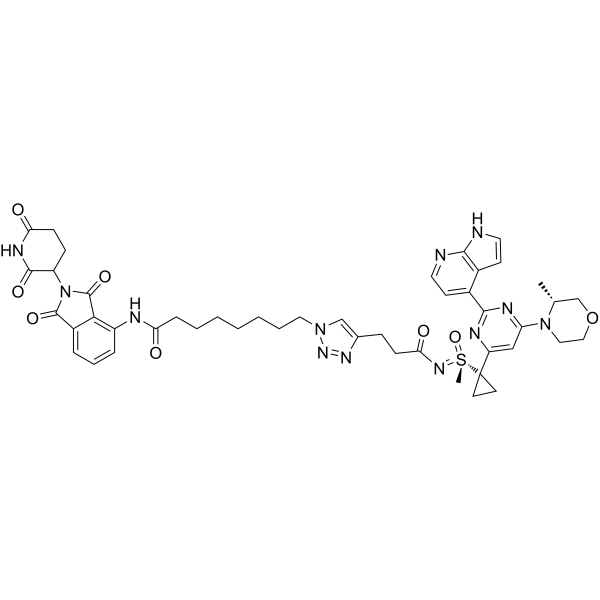
PROTAC ATR degrader-1 is a ATR PROTAC degrader. PROTAC ATR degrader-1 promotes ubiquitination and degradation of ATR. PROTAC ATR degrader-1 facilitates the progression of cells through the G2/M phase, thereby impairing DNA repair and inducing Apoptosis. PROTAC ATR degrader-1 exerts anticancer effects against colorectal cancer either alone or in combination with Cisplatin (HY-17394). PROTAC ATR degrader-1 can be used in research related to colorectal cancer.
(Pink: ATR Target protein ligand; Blue: Cereblon ligand (HY-10984); Black: linker (HY-W007700)).
For research use only. We do not sell to patients.
- Purity: 98.03%
- CAS No.: 2925916-30-7
- Formula: C46H52N12O8S
- Molecular Weight:933.05
-
Storage:Powder -20°C, 3 years , 4°C, 2 years ; In solvent -80°C, 6 months , -20°C, 1 month

To place orders, for customer services and technical support, please contact: MedChemExpress USA
Tel: 609-228-6898 E-mail: [email protected] [email protected]


-
 Biological Activity
-
Chemical Information
-
Solvent & Solubility
- Purity & Documentation
- References
-
 Help & FAQs




Biological Activity
Description
IC50 & Target
[1]|
ATR 0.53 μM (DC50) |
Cereblon |
Cellular Effect
|
Cell Line

|
Type | Value | Description | References |
|---|---|---|---|---|
| HCT-116 | IC50 |
5.1 μM
Compound: ZS-7
|
Antiproliferative activity against human HCT-116 cells expressing wildtype ATM incubated for 72 hrs by CCK8 assay
Antiproliferative activity against human HCT-116 cells expressing wildtype ATM incubated for 72 hrs by CCK8 assay
|
[PMID: 38325007] |
| LoVo | IC50 |
0.47 μM
Compound: ZS-7
|
Antiproliferative activity against ATM deficient human LoVo cells incubated for 72 hrs by CCK8 assay
Antiproliferative activity against ATM deficient human LoVo cells incubated for 72 hrs by CCK8 assay
|
[PMID: 38325007] |
In Vitro
PROTAC ATR degrader-1 (Compound ZS-7) (72 h) potently inhibits the proliferation of ATM-deficient LoVo cells with an IC50 of 0.47 μM and ATM-proficient HCT116 cells with an IC50 of 5.10 μM in vitro[1].
PROTAC ATR degrader-1 (0.16-10 μM; 72 h) induces concentration-dependent degradation of ATR in ATM-deficient LoVo cells with a DC50 of 0.53 μM and a maximum degradation rate of 84.3% after 72 h of treatment[1].
PROTAC ATR degrader-1 (0.16-10 μM; 72 h) potently inhibits ATR pathway signal transduction in ATM-deficient LoVo cells by reducing total ATR protein, phosphorylated ATRThr1989, and phosphorylated CHK1Ser345 levels in a concentration-dependent manner after 72 h of treatment, without degrading CHK1 protein[1].
PROTAC ATR degrader-1 (0.5-1 μM; 72 h) induces significant DNA damage in ATM-deficient LoVo cells, as evidenced by increased γH2AX foci formation after 72 h of treatment at 0.5 μM and 1 μM[1].
PROTAC ATR degrader-1 (0.5-1 μM; 48 h) induces apoptosis in ATM-deficient LoVo cells, with apoptotic rates of 23.91% and 45.62% after 48 h of treatment at 0.5 μM and 1 μM, respectively[1].
PROTAC ATR degrader-1 (0.5-1 μM; 72 h) alleviates G2/M arrest and promotes cell cycle progression through S phase in ATM-deficient LoVo cells in a concentration-dependent manner after 72 h of treatment[1].
MedChemExpress (MCE) has not independently confirmed the accuracy of these methods. They are for reference only.
-
Cell Line:ATM-deficient LoVo colorectal cancer cells
-
Concentration:0.16-10 μM
-
Incubation Time:72 h
-
Result:Induced concentration-dependent ATR degradation, with maximal degradation (84.3%) at 2.5 μM, and a slight hook effect observed at 5 and 10 μM.
Calculated the degradation half-maximal effective concentration (DC50) as 0.53 μM.\nInduced concentration-dependent reductions in total ATR protein, phosphorylated ATRThr1989, and phosphorylated CHK1Ser345 levels, but did not affect total CHK1 protein levels.
-
Cell Line:ATM-deficient LoVo colorectal cancer cells
-
Concentration:0.5-1 μM
-
Incubation Time:72 h
-
Result:Significantly increased γH2AX foci formation, with 31.1% of cells showing >5 foci at 0.5 μM and 57.2% of cells showing >5 foci at 1 μM, indicating accumulation of unrepaired DNA damage.
-
Cell Line:ATM-deficient LoVo colorectal cancer cells
-
Concentration:0.5-1 μM
-
Incubation Time:48 h
-
Result:Induced significant apoptosis, with apoptotic rates of 23.91% at 0.5 μM and 45.62% at 1 μM, comparable to the apoptosis rate induced by AZD6738 (1 μM, 42.00%).
Parmacokinetics
| Species | Dose | Route | T1/2 | Tmax | Cmax | AUC0-t | AUC0-∞ | MRT0-t | MRT0-∞ |
|---|---|---|---|---|---|---|---|---|---|
| Mice[1] | 25 mg/kg | i.p. | 4.75 h | 2.00 h | 1176 ng/mL | 4546 ng·h/mL | 4607 ng·h/mL | 4.21 h | 4.65 h |
In Vivo
MedChemExpress (MCE) has not independently confirmed the accuracy of these methods. They are for reference only.
-
Animal Model:BALB/c nude (6-8 weeks old)[1]
-
Dosage:12.5 mg/kg (single agent TGI; combination TGI); 25 mg/kg (single agent TGI)
-
Administration:i.p.; twice daily; 15 days (single agent 12.5 mg/kg, 25 mg/kg); i.p.; once daily; 15 days (combination with cisplatin 3 mg/kg i.p. on 3-day schedule)
-
Result:Achieved a tumor growth inhibition (TGI) of 39.5% at 12.5 mg/kg as a single agent.
Achieved a tumor growth inhibition (TGI) of 51.8% at 25 mg/kg as a single agent.
Increased γ-H2AX protein content in tumor tissues significantly.
Caused no significant body weight loss or organ toxicity in monotherapy groups.
Achieved a tumor growth inhibition (TGI) of 60.6% when 12.5 mg/kg was combined with cisplatin 3 mg/kg, which was more potent than the AZD6738 + cisplatin combination (TGI 52.7%).
Reduced ATR protein levels, ATRThr1989 phosphorylation, and CHK1Ser345 phosphorylation in tumor tissues dose-dependently, while leaving CHK1 expression unaffected.


Chemical Information
-
CAS No. 2925916-30-7
-
Appearance Solid
-
Molecular Weight 933.05
-
Formula C46H52N12O8S
-
Color Off-white to light yellow
-
SMILES
O=C(N1C2C(NC(CC2)=O)=O)C3=C(C=CC=C3C1=O)NC(CCCCCCCN4N=NC(CCC(N=[S@](C5(C6=CC(N7[C@@H](COCC7)C)=NC(C8=CC=NC9=C8C=CN9)=N6)CC5)(C)=O)=O)=C4)=O
-
Shipping
Room temperature in continental US; may vary elsewhere.
-
Storage
Powder -20°C 3 years 4°C 2 years In solvent -80°C 6 months -20°C 1 month


Solvent & Solubility
In Vitro:
DMSO : 100 mg/mL (107.18 mM; Need ultrasonic; Hygroscopic DMSO has a significant impact on the solubility of product, please use newly opened DMSO)
Please refer to the solubility information to select the appropriate solvent. Once prepared, please aliquot and store the solution to prevent product inactivation from repeated freeze-thaw cycles.
Storage method and period of stock solution: -80°C, 6 months; -20°C, 1 month. When stored at -80°C, please use it within 6 months. When stored at -20°C, please use it within 1 month.
Please refer to the solubility information to select the appropriate solvent. Once prepared, please aliquot and store the solution to prevent product inactivation from repeated freeze-thaw cycles.
Storage method and period of stock solution: -80°C, 6 months; -20°C, 1 month. When stored at -80°C, please use it within 6 months. When stored at -20°C, please use it within 1 month.
Concentration (start) × Volume (start) = Concentration (final) × Volume (final)
In Vivo:
Select the appropriate dissolution method based on your experimental animal and administration route.
- For the following dissolution methods, please ensure to first prepare a clear stock solution using an In Vitro approach and then sequentially add co-solvents:
- To ensure reliable experimental results, the clarified stock solution can be appropriately stored based on storage conditions. As for the working solution for In Vivo experiments, it is recommended to prepare freshly and use it on the same day.
- The percentages shown for the solvents indicate their volumetric ratio in the final prepared solution. If precipitation or phase separation occurs during preparation, heat and/or sonication can be used to aid dissolution.
Add each solvent one by one: 10% DMSO 40% PEG300 5% Tween-80 45% Saline
Solubility: ≥ 2.5 mg/mL (2.68 mM); Clear solution
This protocol yields a clear solution of ≥ 2.5 mg/mL (saturation unknown).
Taking 1 mL working solution as an example, add 100 μL DMSO stock solution (25.0 mg/mL) to 400 μL PEG300, and mix evenly; then add 50 μL Tween-80 and mix evenly; then add 450 μL Saline to adjust the volume to 1 mL.
Preparation of Saline: Dissolve 0.9 g sodium chloride in ddH₂O and dilute to 100 mL to obtain a clear Saline solution.
In Vivo Dissolution Calculator
Please enter the basic information of animal experiments:
-
-
-
-
Recommended: Prepare an additional quantity of animals to account for potential losses during experiments.
Please enter your animal formula composition:
-
%DMSO +
Recommended: Keep the proportion of DMSO in working solution below 2% if your animal is weak.
-
%+
-
+%Tween-80 + +
-
%Saline +
The co-solvents required include: DMSO, . All of co-solvents are available by MedChemExpress (MCE). , Tween 80. All of co-solvents are available by MedChemExpress (MCE).
Working solution concentration: 0.22 mg/mL
Method for preparing stock solution: mg drug dissolved in μL DMSO. Stock solution concentration: mg/mL.
1. Take μL DMSO stock solution;
2. Add μL .
μL , mix evenly;
3. Then add μL Tween 80, mix evenly;
4. Then add μL
Please ensure that the stock solution in the first step is dissolved to a clear state, and add co-solvents in sequence. You can use ultrasonic heating (ultrasonic cleaner, recommended frequency 20-40 kHz), vortexing, etc. to assist dissolution.


Purity & Documentation
-
Data Sheet (277 KB)
-
SDS (254 KB)
- English - EN (254 KB)
- Français - FR (254 KB)
- Deutsch - DE (254 KB)
- Norwegian - NO (254 KB)
- Español - ES (254 KB)
- Swedish - SV (254 KB)
- Italian - IT (254 KB)
- Korean - KR (254 KB)
- Portuguese - PT (254 KB)
-
Handling Instructions (2659 KB)
References


Complete Stock Solution Preparation Table
Please refer to the solubility information to select the appropriate solvent. Once prepared, please aliquot and store the solution to prevent product inactivation from repeated freeze-thaw cycles.
Storage method and period of stock solution: -80°C, 6 months; -20°C, 1 month. When stored at -80°C, please use it within 6 months. When stored at -20°C, please use it within 1 month.
| Optional Solvent | Concentration Solvent Mass | 1 mg | 5 mg | 10 mg | 25 mg |
|---|---|---|---|---|---|
| DMSO | 1 mM | 1.0718 mL | 5.3588 mL | 10.7175 mL | 26.7938 mL |
| 5 mM | 0.2144 mL | 1.0718 mL | 2.1435 mL | 5.3588 mL | |
| 10 mM | 0.1072 mL | 0.5359 mL | 1.0718 mL | 2.6794 mL | |
| 15 mM | 0.0715 mL | 0.3573 mL | 0.7145 mL | 1.7863 mL | |
| 20 mM | 0.0536 mL | 0.2679 mL | 0.5359 mL | 1.3397 mL | |
| 25 mM | 0.0429 mL | 0.2144 mL | 0.4287 mL | 1.0718 mL | |
| 30 mM | 0.0357 mL | 0.1786 mL | 0.3573 mL | 0.8931 mL | |
| 40 mM | 0.0268 mL | 0.1340 mL | 0.2679 mL | 0.6698 mL | |
| 50 mM | 0.0214 mL | 0.1072 mL | 0.2144 mL | 0.5359 mL | |
| 60 mM | 0.0179 mL | 0.0893 mL | 0.1786 mL | 0.4466 mL | |
| 80 mM | 0.0134 mL | 0.0670 mL | 0.1340 mL | 0.3349 mL | |
| 100 mM | 0.0107 mL | 0.0536 mL | 0.1072 mL | 0.2679 mL |


PROTAC ATR degrader-1 Related Classifications
HY-157764 Related Classifications
 Powered by Bioz