



QH536
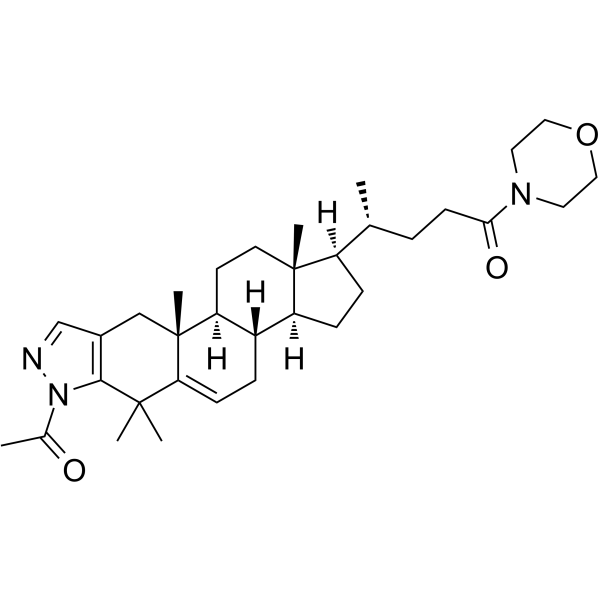
QH536 is a degrader of HMG-CoA reductase (HMGCR) with an EC50 of 0.22 μM. QH536 induces ubiquitination and degradation of HMGCR via the ubiquitin-proteasome pathway, inhibits cholesterol biosynthesis, reduces cholesterol levels, suppresses hepatic stellate cell proliferation, and decreases the expression of fibrotic and inflammatory genes/proteins without inducing intracellular cholesterol accumulation. QH536 can be used in the research of cardiovascular diseases and non-alcoholic steatohepatitis (NASH).
For research use only. We do not sell to patients.
- CAS No.: 2754254-07-2
- Formula: C33H49N3O3
- Molecular Weight:535.76
-
Storage:
Please store the product under the recommended conditions in the Certificate of Analysis.

To place orders, for customer services and technical support, please contact: MedChemExpress USA
Tel: 609-228-6898 E-mail: [email protected] [email protected]


-
 Biological Activity
-
Chemical Information
- Protocols
- Purity & Documentation
- References
-
 Help & FAQs




Biological Activity
Description
IC50 & Target
[1]|
HMGCR 0.22 μM (EC50) |
In Vitro
QH536 (10 μM; 16 h) does not induce cholesterol accumulation in SV589 human fibroblast cells[1].
QH536 (0.1-10 μM; 16 h) reverses Lovastatin (HY-N0504)-induced HMGCR accumulation and degrades endogenous HMGCR in CHO-K1 cells with an EC50 of 0.13 μM[1].
QH536 (1-10 μM; 4-8 h) degrades HMGCR in CHO-K1 cells via the ubiquitin-proteasome pathway, requiring functional ubiquitination sites on HMGCR[1].
QH536 (0.3-10 μM; 7 days) inhibits cholesterol biosynthesis in CHO-7 cells, leading to growth inhibition that is reversed by exogenous cholesterol[1].
QH536 (0.1-2 μM; 24 h) dose-dependently reduces TGFβ1-induced fibrotic gene (α-SMA, COL1A1, TIMP1, TGFβ1) and protein (α-SMA) expression in LX-2 hepatic stellate cells, with no effect on quiescent cells[1].
MedChemExpress (MCE) has not independently confirmed the accuracy of these methods. They are for reference only.
-
Cell Line:CHO-K1 cells
-
Concentration:0.1-10 μM (with lovastatin); concentration gradient (sterol-depleted medium)
-
Incubation Time:16 h
-
Result:Eliminated lovastatin-induced HMGCR accumulation, reducing from 15.2-fold increase to 0.4-fold relative to vehicle in a dose-dependent manner.
Degraded endogenous HMGCR with an EC50 of 0.13 μM.
-
Cell Line:CHO-K1 cells
-
Concentration:1-10 μM (8 h with/without MG-132); 1-10 μM (4 h with mevalonate and MG-132); 1-10 μM (transfected cells)
-
Incubation Time:8 h (with/without MG-132); 4 h (with mevalonate and MG-132)
-
Result:Had its induced HMGCR degradation completely blocked by the proteasome inhibitor MG-132.
Triggered HMGCR ubiquitination in a dose-dependent manner.
Had its degradation effect completely blocked when HMGCR ubiquitination sites (lysine 89 and 248) were mutated to arginine.
-
Cell Line:LX-2 hepatic stellate cells
-
Concentration:0.1 μM; 0.2 μM; 0.5 μM; 1 μM; 2 μM
-
Incubation Time:24 h
-
Result:Significantly inhibited TGFβ1-induced cholesterol levels and cell proliferation in a dose-dependent manner.
Had no effect on quiescent LX-2 cells (without TGFβ1 stimulation).
- RNA extraction experimental
- BrdU Incorporation Assay
- Somatic Cell Culture
- CFSE Dye Dilution Proliferation Assay
- Dye-dilution cell tracking and proliferation staining
- CCK-8/WST-8 Cell Proliferation Assay
- Protocol for Cell Cycle
- Cell Counting-Based Growth Curve Assay
- Colony Formation (Clonogenic) Assay
- Cell Viability Determination by MTT Colorimetric Assay
- EdU Incorporation Assay (Click Chemistry-Based DNA Synthesis Measurement)
- Ki-67 Immunostaining Proliferation Assay
- PCNA Immunodetection Proliferation Assay
- Protocol for Cell Counting and Cell Density Analysis
- MTT Cell Proliferation Assay


Chemical Information
-
CAS No. 2754254-07-2
-
Molecular Weight 535.76
-
Formula C33H49N3O3
-
SMILES
C[C@@](C1=CC2)(CC(C=NN3C(C)=O)=C3C(C)1C)[C@](CC4)([H])[C@]2([H])[C@@](CC[C@]5([H])[C@H](C)CCC(N6CCOCC6)=O)([H])[C@]45C
-
Shipping
Room temperature in continental US; may vary elsewhere.
-
Storage
Please store the product under the recommended conditions in the Certificate of Analysis.


Purity & Documentation
References

Calculators
Concentration (start) × Volume (start) = Concentration (final) × Volume (final)


QH536 Related Classifications
HY-147195 Related Classifications
 Powered by Bioz
Keywords