



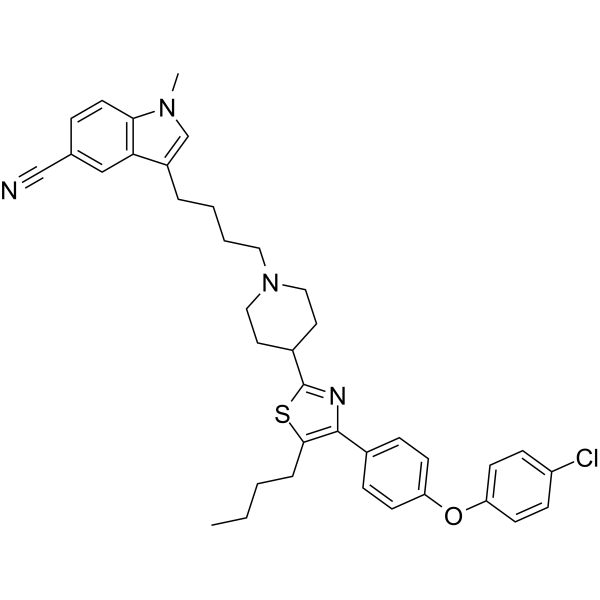
RAGE/SERT-IN-1
RAGE/SERT-IN-1 is a potent and orally active advanced glycation end products (RAGE) and serotonin transporter (SERT) inhibitor with IC50s of 8.26 μM and 31.09 nM, respectively. RAGE/SERT-IN-1 exhibits significant neuroprotective effect against Aβ25-35-induced neuronal damage and alleviates depressive behavior of mice. RAGE/SERT-IN-1 can be used for researching the comorbidity of Alzheimer's disease and depression.
For research use only. We do not sell to patients.
- CAS No.: 2766739-35-7
- Formula: C38H41ClN4OS
- Molecular Weight:637.28
-
Storage:
Please store the product under the recommended conditions in the Certificate of Analysis.

To place orders, for customer services and technical support, please contact: MedChemExpress USA
Tel: 609-228-6898 E-mail: [email protected] [email protected]


-
 Biological Activity
-
Chemical Information
- Protocols
- Purity & Documentation
- References
-
 Help & FAQs




Biological Activity
Description
IC50 & Target
IC50: 8.26 μM (RAGE), 31.09 nM (SERT)[1]
In Vitro
RAGE/SERT-IN-1 (compound 12) (1-20 μM; 24 hours) does not significantly affect cell viability of SH-SY5Y[1].
MedChemExpress (MCE) has not independently confirmed the accuracy of these methods. They are for reference only.
-
Cell Line:SH-SY5Y[1]
-
Concentration:1, 5, 10 and 20 μM
-
Incubation Time:24 hours
-
Result:Did not affect cell viability at concentrations of 1, 5, and 10 μM, and only a slight decrease in cell viability at the concentration of 20 μM was observed with the viability still above 80%.
In Vivo
RAGE/SERT-IN-1 (100 and 200mg/kg; IP; single dosage) does not cause mice death and not significant change in the ratio of organ-to-body weight at 100 mg/kg[1].
RAGE/SERT-IN-1 (60 mg/kg; PO; single dosage) significantly reduces the immobility time in tail suspension test[1].
RAGE/SERT-IN-1 (60 mg/kg for PO, 10 mg/kg for IV; single dosage) exhibits acceptable pharmacokinetic properties in mice[1].
Pharmacokinetic Parameters of RAGE/SERT-IN-1 in male ICR mice[1].
| PO (60 mg/kg) | IV (10 mg/kg) | |
| T1/2 (h) | 5.55 | 3.46 |
| Cmax (ng/mL) | 4935 | 51745 |
| AUC0-∞ (ng/mL·h) | 24684 | 23653 |
| CL (mL/min/kg) | 7.09 | |
| VSS (L/kg) | 1037 | |
| F (%) | 17.1 |
MedChemExpress (MCE) has not independently confirmed the accuracy of these methods. They are for reference only.
-
Animal Model:Male ICR mice (24-26 g)[1]
-
Dosage:100mg/kg and 200mg/kg
-
Administration:IP; single (observed for 2 weeks)
-
Result:All mice were survived and no significant changed in the ratio of organ-to-body weight at a dose of 100 mg/kg.
-
Animal Model:Male ICR mice[1]
-
Dosage:60 mg/kg
-
Administration:PO; single dosage
-
Result:Significantly reduced the immobility time in tail suspension test.
-
Animal Model:Male ICR mice[1]
-
Dosage:60 mg/kg for PO, 10 mg/kg for IV
-
Administration:PO and IV; single dosage
-
Result:Exhibited acceptable pharmacokinetic properties in mice.


Chemical Information
-
CAS No. 2766739-35-7
-
Molecular Weight 637.28
-
Formula C38H41ClN4OS
-
SMILES
CCCCC1=C(N=C(S1)C2CCN(CC2)CCCCC3=CN(C4=C3C=C(C=C4)C#N)C)C5=CC=C(C=C5)OC6=CC=C(C=C6)Cl
-
Shipping
Room temperature in continental US; may vary elsewhere.
-
Storage
Please store the product under the recommended conditions in the Certificate of Analysis.


Purity & Documentation
References

Calculators
Concentration (start) × Volume (start) = Concentration (final) × Volume (final)


RAGE/SERT-IN-1 Related Classifications
HY-146619 Related Classifications
 Powered by Bioz