



Annexin A5/ANXA5 Protein, Mouse (His, Myc)

Based on 1 Customer Validation
The annexin A5 (ANXA5) protein acts as an anticoagulant, indirectly inhibiting the thromboplastin-specific complex, which is critical in the coagulation cascade. As a monomer, ANXA5 plays a key role in regulating the coagulation pathway, affecting the delicate balance between pro- and anti-coagulant factors. Annexin A5/ANXA5 Protein, Mouse (His, Myc) is the recombinant mouse-derived Annexin A5/ANXA5 protein, expressed by E. coli , with N-10*His, C-Myc labeled tag.
- Species: Mouse
- Source: E. coli
-
Storage:Stored at -20°C for 2 years from date of receipt. After reconstitution, it is stable at 4°C for 1 week or -20°C for longer (with carrier protein). It is recommended to freeze aliquots at -20°C or -80°C for extended storage.


To place orders, for customer services and technical support, please contact: MedChemExpress USA
Tel: 609-228-6898 E-mail: [email protected] [email protected]


-
 Biological Activity
-
Technical Parameters
-
Product Properties
- Documentation
- Help & FAQs




Biological Activity
Description
The annexin A5 (ANXA5) protein acts as an anticoagulant, indirectly inhibiting the thromboplastin-specific complex, which is critical in the coagulation cascade. As a monomer, ANXA5 plays a key role in regulating the coagulation pathway, affecting the delicate balance between pro- and anti-coagulant factors. Annexin A5/ANXA5 Protein, Mouse (His, Myc) is the recombinant mouse-derived Annexin A5/ANXA5 protein, expressed by E. coli , with N-10*His, C-Myc labeled tag.
Background
Annexin A5 (ANXA5) protein serves as an anticoagulant, acting as an indirect inhibitor of the thromboplastin-specific complex crucial in the blood coagulation cascade. Structurally, it exists as a monomer, and in its functional capacity, ANXA5 plays a pivotal role in regulating key components of the coagulation pathway, thereby influencing the delicate balance between procoagulant and anticoagulant factors. Additionally, ANXA5 exhibits binding interactions with ATRX and EIF5B, suggesting its involvement in diverse cellular processes beyond its role in coagulation. These multifaceted attributes underscore the significance of ANXA5 in cellular regulation and its potential implications in both hemostasis and broader cellular functions.
MCE Validation Data
-
Purity - SDS-PAGE
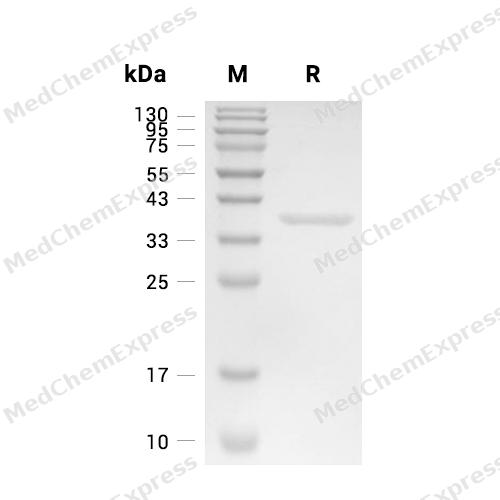
Purity - SDS-PAGE


Technical Parameters
-
Species Mouse
-
Source E. coli
-
Tag N-10*His;C-Myc
-
Accession
P48036 (A2-D319)
-
Gene ID11747
-
Molecular Construction
-
N-term
-
10*His
-
ANXA5 (A2-D319)
Accession # P48036 -
Myc
-
C-term
-
-
Protein Length
Full Length
-
Synonyms
ANXA5; RPRGL3; Prev. ANX5; Thromboplastin Inhibitor; Prev. ENX2; Anchorin CII; CPB-I; Lipocortin V; PAP-I; VAC-Alpha; Placental Anticoagulant Protein I; Annexin-5; Vascular Anticoagulant-Alpha; PP4; Calphobindin I; Epididymis Secretory Protein Li 7; Endon
-
AA Sequence
ATRGTVTDFPGFDGRADAEVLRKAMKGLGTDEDSILNLLTSRSNAQRQEIAQEFKTLFGRDLVDDLKSELTGKFEKLIVAMMKPSRLYDAYELKHALKGAGTDEKVLTEIIASRTPEELSAIKQVYEEEYGSNLEDDVVGDTSGYYQRMLVVLLQANRDPDTAIDDAQVELDAQALFQAGELKWGTDEEKFITIFGTRSVSHLRRVFDKYMTISGFQIEETIDRETSGNLEQLLLAVVKSIRSIPAYLAETLYYAMKGAGTDDHTLIRVVVSRSEIDLFNIRKEFRKNFATSLYSMIKGDTSGDYKKALLLLCGGEDD
-
Molecular Weight
Approximately 38-41 kDa, based on SDS-PAGE under reducing conditions.
-
Purity
≥ 95%, as determined by reducing SDS-PAGE.


Product Properties
Lyophilized powder.
1.Lyophilized from a 0.22 μm filtered solution of 20 mM Tris-HCl, 0.5 M NaCl, 6% trehalose, pH 8.0.
2.Lyophilized from a 0.22 μm filtered solution of 20 mM Tris-HCl, 500 mM NaCl, pH 8.0, 6% trehalose
Please refer to the lot-specific COA for specific buffer information.
Note: For SPR assay, please replace the buffer. Primary amine components (e.g., Tris, imidazole) can affect protein-coupled chips.
<1 EU/μg, determined by LAL method.
It is not recommended to reconstitute to a concentration less than 100 μg/mL in ddH2O.
Stored at -20°C for 2 years from date of receipt. After reconstitution, it is stable at 4°C for 1 week or -20°C for longer (with carrier protein). It is recommended to freeze aliquots at -20°C or -80°C for extended storage.
Room temperature in continental US; may vary elsewhere.


Documentation
-
Data Sheet (237 KB)
-
SDS (254 KB)
- English - EN (254 KB)
- Français - FR (254 KB)
- Deutsch - DE (254 KB)
- Norwegian - NO (254 KB)
- Español - ES (254 KB)
- Swedish - SV (254 KB)
- Italian - IT (254 KB)
- Korean - KR (254 KB)
- Portuguese - PT (254 KB)
-
Handling Instructions (2659 KB)

Calculators
Concentration (start) × Volume (start) = Concentration (final) × Volume (final)


 Powered by Bioz

