



Apolipoprotein M/APOM Protein, Human (166a.a, HEK293, His)

Based on 1 Customer Validation
Apolipoprotein M Protein, Human (166a.a, HEK293, His) expresses in HEK293, does not contain signal peptide sequence with a His tag at the N-terminus. Apolipoprotein M (APOM) is an apolipoprotein and member of the lipocalin protein family. It is found associated with high density lipoproteins and to a lesser extent with low density lipoproteins and triglyceride-rich lipoproteins.
- Species: Human
- Source: HEK293
-
Storage:Stored at -20°C for 2 years from date of receipt. After reconstitution, it is stable at 4°C for 1 week or -20°C for longer (with carrier protein). It is recommended to freeze aliquots at -20°C or -80°C for extended storage.


To place orders, for customer services and technical support, please contact: MedChemExpress USA
Tel: 609-228-6898 E-mail: [email protected] [email protected]


-
 Biological Activity
-
Technical Parameters
-
Product Properties
- Documentation
- Help & FAQs




Biological Activity
Description
Apolipoprotein M Protein, Human (166a.a, HEK293, His) expresses in HEK293, does not contain signal peptide sequence with a His tag at the N-terminus. Apolipoprotein M (APOM) is an apolipoprotein and member of the lipocalin protein family. It is found associated with high density lipoproteins and to a lesser extent with low density lipoproteins and triglyceride-rich lipoproteins.
Background
Apolipoprotein M (APOM) is an apolipoprotein and member of the lipocalin protein family. It is found associated with high density lipoproteins and to a lesser extent with low density lipoproteins and triglyceride-rich lipoproteins. The encoded protein is secreted through the plasma membrane but remains membrane-bound, where it is involved in lipid transport. Two transcript variants encoding two different isoforms have been found for this gene, but only one of them has been fully characterized.
Verified Bioactivity
Measured by its ability to bind all-trans-retinoic acid. The concentration of all-trans-retinoic acid required to quench 50% of Trp fluorescence in Recombinant Human Apolipoprotein M/ApoM is approximately 21.899-27.536 μM.
MCE Validation Data
-
Purity - SDS-PAGE
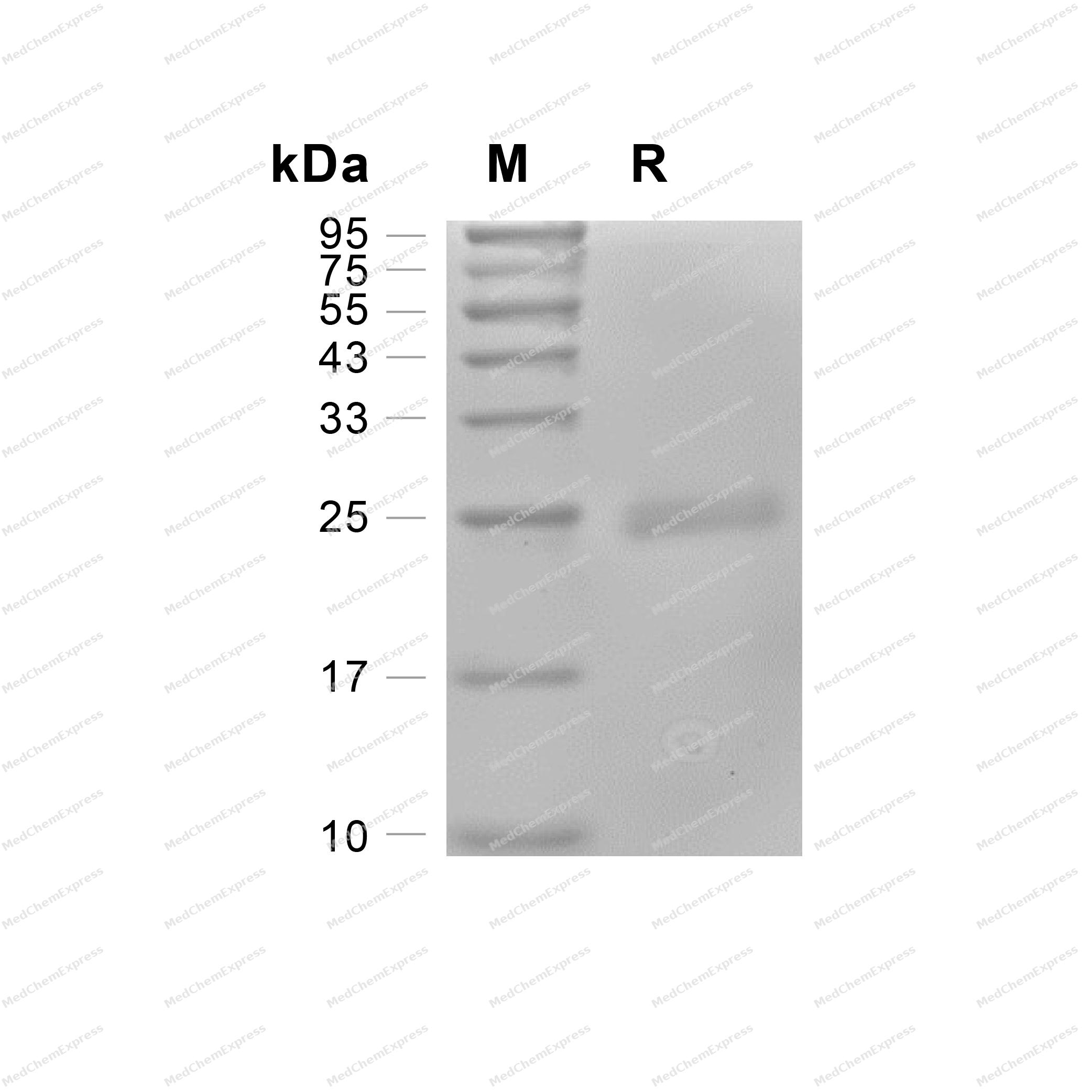
Purity - SDS-PAGE


Technical Parameters
-
Species Human
-
Source HEK293
-
Tag C-6*His
-
Accession
O95445-1 (C23-N188)
-
Gene ID55937
-
Molecular Construction
-
N-term
-
APOM (C23-N188)
Accession # O95445-1 -
6*His
-
C-term
-
-
Protein Length
Full Length of Isoform-1
-
Synonyms
APOM; Alternative Name: G3a, NG20; Apolipoprotein M; NG20-Like Protein; Apo-M; HSPC336; NG20; ApoM; G3a; G3A; Protein G3a
-
AA Sequence
CPEHSQLTTLGVDGKEFPEVHLGQWYFIAGAAPTKEELATFDPVDNIVFNMAAGSAPMQLHLRATIRMKDGLCVPRKWIYHLTEGSTDLRTEGRPDMKTELFSSSCPGGIMLNETGQGYQRFLLYNRSPHPPEKCVEEFKSLTSCLDSKAFLLTPRNQEACELSNN
-
Predicted Molecular Mass
18.6 kDa
-
Molecular Weight
Approximately 25 kDa, based on SDS-PAGE under reducing conditions.
-
Glycosylation
Yes
-
Purity
≥ 90%, as determined by reducing SDS-PAGE.


Product Properties
Lyophilized powder.
Lyophilized from a 0.22 μm filtered solution of PBS, pH 7.4.
<1 EU/μg, determined by LAL method.
It is not recommended to reconstitute to a concentration less than 100 μg/mL in ddH2O. For long term storage it is recommended to add a carrier protein (0.1% BSA, 5% HSA, 10% FBS or 5% Trehalose).
Stored at -20°C for 2 years from date of receipt. After reconstitution, it is stable at 4°C for 1 week or -20°C for longer (with carrier protein). It is recommended to freeze aliquots at -20°C or -80°C for extended storage.
Room temperature in continental US; may vary elsewhere.


Documentation
-
Data Sheet (236 KB)
-
SDS (251 KB)
- English - EN (251 KB)
- Français - FR (251 KB)
- Deutsch - DE (251 KB)
- Norwegian - NO (251 KB)
- Español - ES (251 KB)
- Swedish - SV (251 KB)
- Italian - IT (251 KB)
- Korean - KR (251 KB)
- Portuguese - PT (251 KB)
-
Handling Instructions (2659 KB)

Calculators
Concentration (start) × Volume (start) = Concentration (final) × Volume (final)


 Powered by Bioz

