



BCAS2 Protein, Human (His, T7)

Based on 1 Customer Validation
BCAS2 Protein, Human (His, T7) plays crucial roles in pre-mRNA splicing and androgen receptor transcription. BCAS2 helps repair radiation-induced DSBs efficiently in both human PCa cells and Drosophila.
- Species: Human
- Source: E. coli
-
Storage:Stored at -20°C for 2 years from date of receipt. After reconstitution, it is stable at 4°C for 1 week or -20°C for longer (with carrier protein). It is recommended to freeze aliquots at -20°C or -80°C for extended storage.


To place orders, for customer services and technical support, please contact: MedChemExpress USA
Tel: 609-228-6898 E-mail: [email protected] [email protected]


-
 Biological Activity
-
Technical Parameters
-
Product Properties
- Documentation
- References
- Help & FAQs




Biological Activity
Description
BCAS2 Protein, Human (His, T7) plays crucial roles in pre-mRNA splicing and androgen receptor transcription. BCAS2 helps repair radiation-induced DSBs efficiently in both human PCa cells and Drosophila[1][2].
Background
BCAS2, a protein enriched in advanced prostate cancer, interacts with NBS1 to enhance DNA double-strand break repair. BCAS2 enhances both NHEJ and HR, possibly by interacting with NBS1, which involved the BCAS2 N-terminus as well as both the NBS1 N- and C-termini. The overexpression of BCAS2 was significantly associated with higher Gleason and pathology grades and shorter survival in patients with PCa[2].
MCE Validation Data
-
Purity - SDS-PAGE
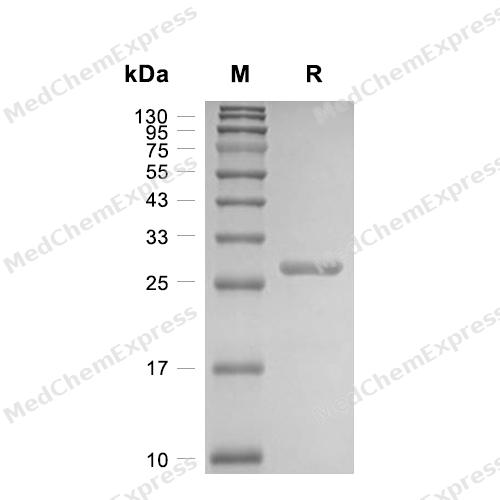
Purity - SDS-PAGE


Technical Parameters
-
Species Human
-
Source E. coli
-
Tag C-6*His;N-T7
-
Accession
O75934 (A2-F225)
-
Molecular Construction
-
N-term
-
T7
-
BCAS2 (A2-F225)
Accession # O75934 -
6*His
-
C-term
-
-
Protein Length
Full Length
-
Synonyms
BCAS2; Breast Carcinoma Amplified Sequence 2; BCAS2 Pre-MRNA Processing Factor; Spliceosome-Associated Protein SPF 27; DAM1; Spliceosome Associated Protein, Amplified In Breast Cancer; Pre-MRNA-Splicing Factor SPF27; Breast Carcinoma-Amplified Sequence 2;
-
AA Sequence
ASMTGGQQMGAGTGLVAGEVVVDALPYFDQGYEAPGVREAAAALVEEETRRYRPTKNYLSYLTAPDYSAFETDIMRNEFERLAARQPIELLSMKRYELPAPSSGQKNDITAWQECVNNSMAQLEHQAVRIENLELMSQHGCNAWKVYNENLVHMIEHAQKELQKLRKHIQDLNWQRKNMQLTAGSKLREMESNWVSLVSKNYEIERTIVQLENEIYQIKQQHGEANKENIRQDF
-
Molecular Weight
Approximately 30 kDa, based on SDS-PAGE under reducing conditions.
-
Purity
≥ 95%, as determined by reducing SDS-PAGE.


Product Properties
Lyophilized powder.
Lyophilized from a 0.22 μm filtered solution of 20 mM Tris-HCl, 200 mM NaCl, 2 mM DTT, pH 8.0 or PBS, pH 7.4, 8% trehalose.
Note: For SPR assay, please replace the buffer. Primary amine components (e.g., Tris, imidazole) can affect protein-coupled chips.
<1 EU/μg, determined by LAL method.
It is not recommended to reconstitute to a concentration less than 100 μg/mL in ddH2O. For long term storage it is recommended to add a carrier protein (0.1% BSA, 5% HSA, 10% FBS or 5% Trehalose).
Stored at -20°C for 2 years from date of receipt. After reconstitution, it is stable at 4°C for 1 week or -20°C for longer (with carrier protein). It is recommended to freeze aliquots at -20°C or -80°C for extended storage.
Room temperature in continental US; may vary elsewhere.


Documentation
-
Data Sheet (263 KB)
-
SDS (251 KB)
- English - EN (251 KB)
- Français - FR (251 KB)
- Deutsch - DE (251 KB)
- Norwegian - NO (251 KB)
- Español - ES (251 KB)
- Swedish - SV (251 KB)
- Italian - IT (251 KB)
- Korean - KR (251 KB)
- Portuguese - PT (251 KB)
-
Handling Instructions (2659 KB)


References
[1]. Li-Po Wang, et al. BCAS2, a protein enriched in advanced prostate cancer, interacts with NBS1 to enhance DNA double-strand break repair. Br J Cancer. 2020 Dec;123(12):1796-1807. [Content Brief]
[2]. Ángel Salmerón-Hernández, et al. BCAS2 Enhances Carcinogenic Effects of Estrogen Receptor Alpha in Breast Cancer Cells. Int J Mol Sci. 2019 Feb 22;20(4):966. [Content Brief]

Calculators
Concentration (start) × Volume (start) = Concentration (final) × Volume (final)


 Powered by Bioz

