



BirA Protein, E. coli (His-MBP)

Based on 1 Customer Validation
BirA Protein, E. coli (His-MBP) is the recombinant E. coli-derived BirA protein, expressed by E. coli , with N-His, N-MBP labeled tag.
- Species: E.coli
- Source: E. coli
-
Storage:Stored at -20°C for 2 years from date of receipt. After reconstitution, it is stable at 4°C for 1 week or -20°C for longer (with carrier protein). It is recommended to freeze aliquots at -20°C or -80°C for extended storage.


To place orders, for customer services and technical support, please contact: MedChemExpress USA
Tel: 609-228-6898 E-mail: [email protected] [email protected]


-
 Biological Activity
-
Technical Parameters
-
Product Properties
- Documentation
- Help & FAQs




Biological Activity
Description
BirA Protein, E. coli (His-MBP) is the recombinant E. coli-derived BirA protein, expressed by E. coli , with N-His, N-MBP labeled tag.
Background
WBP2 protein functions as a transcriptional coactivator for estrogen and progesterone receptors (ESR1 and PGR) upon hormone activation, binding to ESR1-responsive promoters in the presence of estrogen. It is essential for the coactivation function of YAP1 on PGR activity and synergizes with WBP2 in enhancing PGR activity. Additionally, WBP2 modulates the expression of post-synaptic scaffolding proteins through the regulation of ESR1, ESR2, and PGR. WBP2 interacts with the WW domain of YAP1, WWP1, and WWP2, and also forms interactions with NEDD4. Moreover, it associates with ESR1 and UBE3A, contributing to its role as a transcriptional coactivator in hormone-responsive pathways.
Verified Bioactivity
Measured by its ability to generate pyrophosphate from the biotinylation reaction. The pyrophosphate is subsequently hydrolyzed using Recombinant Yeast Inorganic Pyrophosphatase/PPA1 (HY-P79310) that incubated at room temperature for 15 min. The specific activity is >100 pmol/min/μg.
MCE Validation Data
-
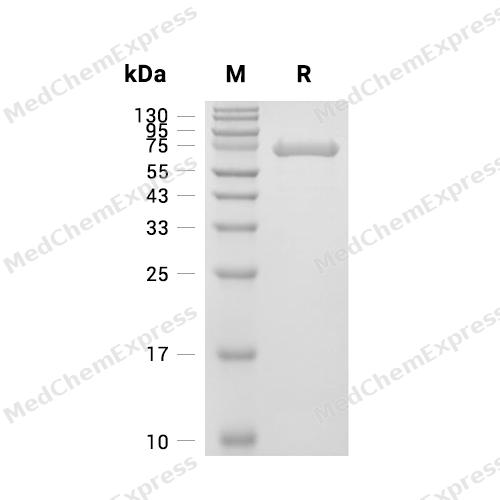
Purity - SDS-PAGE
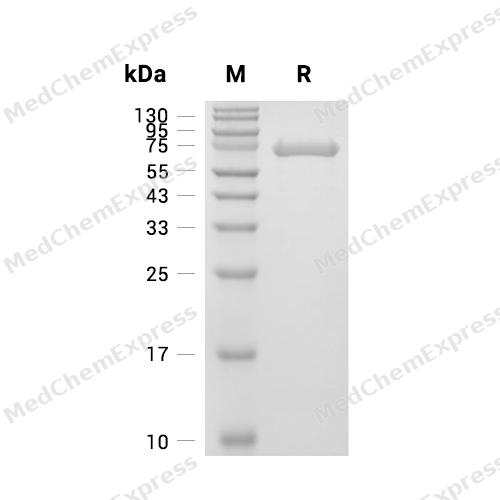
Purity - SDS-PAGE

Assay Procedure
Materials
Assay buffer: 25 mM Tris, 150 mM NaCl, pH 7.5
BirA Protein, E. coli (His-MBP) (HY-P75475)
PPA1 Protein, S. cerevisiae (His) (HY-P79310)
OX40/TNFRSF4 Protein, Human (HEK293, Fc) (HY-P70813)
Magnesium chloride: Prepare 1 M MgCl2 in deionized water
Biotin: Prepare 10 mM biotin in DMSO
Adenosine triphosphate (ATP): Prepare 400 mM ATP in deionized water
Malachite green phosphate detection kit
Procedure
1. Preparation of phosphate standard solution: Dilute 5 mM phosphate standard stock solution to a 50 μM phosphate working solution. Take 10 μL of 5 mM phosphate standard stock solution and add 990 μL of deionized water to prepare the standard dilution solution, yielding 1 mL of 50 μM phosphate working solution.
2. Standard Curve Preparation: Prepare 200 μL aliquots of phosphate standards at 0, 1, 2.5, 5, 10, 20, 30, 40, and 50 μM according to the kit instructions. Include a curve blank containing 200 μL assay buffer.
3. Prepare 1 mL reaction mixture containing 2 mM ATP, 20 mM MgCl2, 800 μM Biotin, 280 μg/mL Human OX40, and 8 μg/mL Yeast PPA1 using assay buffer.
4. Dilute E. coli BirA to 40 μg/mL using assay buffer.
5. Add 100 μL of 40 μg/mL E. coli BirA to a 96-well transparent plate. Include 100 μL assay buffer as a blank control. Perform triplicate wells for each concentration.
6. Add 100 μL of reaction mixture to wells without the standard curve and incubate for 15 min.
7. Color development reagent preparation: Based on sample volume, prepare the color development reagent by mixing 1000 μL Malachite Green Reagent A and 500 μL Malachite Green Reagent B in a 2:1 ratio.
8. Phosphate concentration detection
a. Pipette 200 μL of each phosphate standard and sample concentration sequentially into the sample wells of a 96-well plate, including a curve blank containing 200 μL assay buffer.
b. Add 70 μL of color developer to each well. Gently mix by pipetting and incubate at room temperature for 10 min.
c. Calculate phosphate concentration based on the standard curve and sample dilution factor. Read OD at 630 nm in endpoint mode.
10. Calculate Specific Activity:
Specific Activity (pmol/min/μg) = | Phosphate released* (nmol) x (1000 pmol/nmol) |
| Incubation time (min) x amount of enzyme (μg) |
*Derived from the phosphate standard curve using linear fitting and adjusted for Control.


Technical Parameters
-
Species E.coli
-
Source E. coli
-
Tag N-6*His;N-MBP
-
Accession
P06709 (M1-K321)
-
Gene ID948469 [NCBI]
-
Molecular Construction
-
N-term
-
6*His-MBP
-
BirA (M1-K321)
Accession # P06709 -
C-term
-
-
Protein Length
Full Length
-
Synonyms
Biotin-[acetyl-CoA carboxylase] synthetase; Biotin--protein ligase; EC:6.3.4.15; Biotin--[acetyl-CoA-carboxylase] ligase; Biotin operon repressor; Bifunctional ligase/repressor BirA
-
AA Sequence
MKDNTVPLKLIALLANGEFHSGEQLGETLGMSRAAINKHIQTLRDWGVDVFTVPGKGYSLPEPIQLLNAKQILGQLDGGSVAVLPVIDSTNQYLLDRIGELKSGDACIAEYQQAGRGRRGRKWFSPFGANLYLSMFWRLEQGPAAAIGLSLVIGIVMAEVLRKLGADKVRVKWPNDLYLQDRKLAGILVELTGKTGDAAQIVIGAGINMAMRRVEESVVNQGWITLQEAGINLDRNTLAAMLIRELRAALELFEQEGLAPYLSRWEKLDNFINRPVKLIIGDKEIFGISRGIDKQGALLLEQDGIIKPWMGGEISLRSAEK
-
Molecular Weight
Approximately 64-68 kDa, based on SDS-PAGE under reducing conditions.
-
Purity
≥ 95%, as determined by reducing SDS-PAGE.


Product Properties
Lyophilized powder
1.Lyophilized from a 0.22 μm filtered solution of 50 mM Tris, 100 mM NaCl, 10% glycerol, pH 8.0, 5% trehalose, 5% mannitol, 0.01% Tween 80.
2.Lyophilized from a 0.22 μm filtered solution of PBS, pH 7.4, 8% trehalose, 8% mannitol, 0.02% Tween 80.
Please refer to the lot-specific COA for specific buffer information.
Note: For SPR assay, please replace the buffer. Primary amine components (e.g., Tris, imidazole) can affect protein-coupled chips.
<1 EU/μg, determined by LAL method.
It is not recommended to reconstitute to a concentration less than 100 μg/mL in ddH2O.
Stored at -20°C for 2 years from date of receipt. After reconstitution, it is stable at 4°C for 1 week or -20°C for longer (with carrier protein). It is recommended to freeze aliquots at -20°C or -80°C for extended storage.
Room temperature in continental US; may vary elsewhere.


Documentation
-
Data Sheet (237 KB)
-
SDS (252 KB)
- English - EN (252 KB)
- Français - FR (252 KB)
- Deutsch - DE (252 KB)
- Norwegian - NO (252 KB)
- Español - ES (252 KB)
- Swedish - SV (252 KB)
- Italian - IT (252 KB)
- Korean - KR (252 KB)
- Portuguese - PT (252 KB)
-
Handling Instructions (2659 KB)

Calculators
Concentration (start) × Volume (start) = Concentration (final) × Volume (final)


 Powered by Bioz

