



BMPRIB/ALK-6 Protein, Human (sf9, His-GST)

Based on 1 Customer Validation
BMPR1B/ALK-6 protein is a type I member of the bone morphogenetic protein (BMP) receptor family of transmembrane serine/threonine kinases. BMPR1B/ALK-6 is the receptor for BMP-7/OP-1 and GDF-5, positively regulates chondrocyte differentiation through GDF-5 interaction. BMPR1B/ALK-6 also involves in SCUBE3/BMP-2/BMP-4 signals regulation, controlling growth, morphogenesis, and bone and teeth development. ALK-6/GDF-9/BMP-15 signals is essential in prolificacy of goat. The human BMPR1B/ALK-6 protein contains 502 amino acids and a transmembrane domain (127-148 a.a.). BMPRIB/ALK-6 Protein, Human (sf9, His-GST) is produced by HEK293 cells (R149-L502) with N-terminal His- and GST-tag.
- Species: Human
- Source: Sf9 insect cells
-
Storage:Stored at -80°C for 1 year from date of receipt. It is stable at -20°C for 3 months after opening. It is recommended to freeze aliquots at -80°C for extended storage. Avoid repeated freeze-thaw cycles.


To place orders, for customer services and technical support, please contact: MedChemExpress USA
Tel: 609-228-6898 E-mail: [email protected] [email protected]


-
 Biological Activity
-
Technical Parameters
-
Product Properties
- Documentation
- References
- Help & FAQs




Biological Activity
Description
BMPR1B/ALK-6 protein is a type I member of the bone morphogenetic protein (BMP) receptor family of transmembrane serine/threonine kinases[1]. BMPR1B/ALK-6 is the receptor for BMP-7/OP-1 and GDF-5, positively regulates chondrocyte differentiation through GDF-5 interaction[2][3]. BMPR1B/ALK-6 also involves in SCUBE3/BMP-2/BMP-4 signals regulation, controlling growth, morphogenesis, and bone and teeth development[4]. ALK-6/GDF-9/BMP-15 signals is essential in prolificacy of goat[5]. The human BMPR1B/ALK-6 protein contains 502 amino acids and a transmembrane domain (127-148 a.a.). BMPRIB/ALK-6 Protein, Human (sf9, His-GST) is produced by HEK293 cells (R149-L502) with N-terminal His- and GST-tag.
Background
BMPRIB/ALK-6, also known as CDw293 (cluster of differentiation w293), is a member of the bone morphogenetic protein (BMP) receptor family of transmembrane serine/threonine kinases. BMPs are involved in endochondral bone formation and embryogenesis, transducing signals through the formation of heteromeric complexes of 2 types BMP receptors: type I receptors (50-55 kD) and type II receptors (70-80 kD). Type II receptors phosphorylate and activate type I receptors which autophosphorylate, then bind and activate SMAD transcriptional regulators[1]. ALK-6 is the receptor for BMP-7/OP-1 and GDF-5, positively regulates chondrocyte differentiation through GDF-5 interaction[2][3]. ALK-6 signaling is also controlled by SCUBE3, a BMP-2/BMP-4 co-receptor, recruits the BMP receptor complexes into raft microdomains, and positively modulates signaling possibly by augmenting the specific interactions between BMPs and BMP type I receptors[3]. ALK-6 involves in controlling growth, morphogenesis, and bone and teeth development through modulation of BMP signaling, is essential for chondrogenesis in vivo, while BMPR1A/ALK-3 and ALK-6 have overlapping functions during early chondrogenesis[4]. ALK-6/GDF-9/BMP-15 signals play a key role in prolificacy. ALK-6 and GDF-9 are widely expressed in 20 tissues with highest in ovary, while BMP-15 gene was expressed exclusively in ovary and pituitary[5]. The sequences of ALK-6 are highly conserved among different species, and the sequence of human shares a high similarity with rat (98.21%) and mouse (98.21%), respectively.
Verified Bioactivity
The kinase activity of this recombinant protein is testing in progress, we cannot offer a guarantee yet.
MCE Validation Data
-
Purity - SDS-PAGE
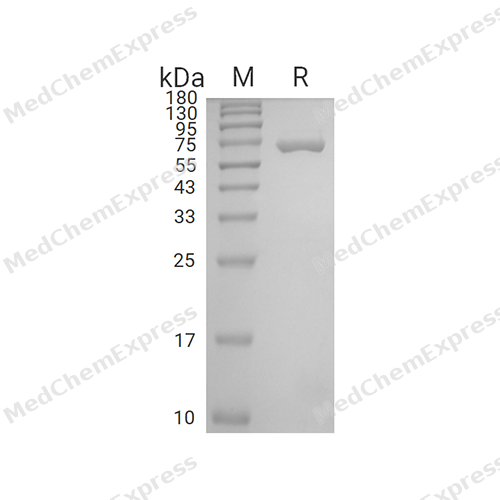
Purity - SDS-PAGE


Technical Parameters
-
Species Human
-
Source Sf9 insect cells
-
Tag N-His;N-GST
-
Accession
O00238 (R149-L502)
-
Molecular Construction
-
N-term
-
His-GST
-
BMPR1B (R149-L502)
Accession # O00238 -
C-term
-
-
Protein Length
Cytoplasmic Domain
-
Synonyms
BMPR1B; Serine/Threonine Receptor Kinase; Bone Morphogenetic Protein Receptor Type 1B; Activin Receptor-Like Kinase 6; CDw293; CDw293 Antigen; ALK6; ALK-6; Bone Morphogenetic Protein Receptor, Type IB; BDA1D; Bone Morphogenetic Protein Receptor Type-1B; AMD3; BMP Type-1B Receptor; AMDD; BMPR-1B; BDA2
-
AA Sequence
RYKRQETRPRYSIGLEQDETYIPPGESLRDLIEQSQSSGSGSGLPLLVQRTIAKQIQMVKQIGKGRYGEVWMGKWRGEKVAVKVFFTTEEASWFRETEIYQTVLMRHENILGFIAADIKGTGSWTQLYLITDYHENGSLYDYLKSTTLDAKSMLKLAYSSVSGLCHLHTEIFSTQGKPAIAHRDLKSKNILVKKNGTCCIADLGLAVKFISDTNEVDIPPNTRVGTKRYMPPEVLDESLNRNHFQSYIMADMYSFGLILWEVARRCVSGGIVEEYQLPYHDLVPSDPSYEDMREIVCIKKLRPSFPNRWSSDECLRQMGKLMTECWAHNPASRLTALRVKKTLAKMSESQDIKL
-
Predicted Molecular Mass
68.3 kDa
-
Molecular Weight
Approximately 65-70 kDa, based on SDS-PAGE under reducing conditions.
-
Purity
≥ 90%, as determined by reducing SDS-PAGE.


Product Properties
Solution.
Supplied as a 0.22 μm filtered solution of 50 mM Tris, 100 mM NaCl, pH 8.5, 20% glycerol, 0.3 mM DTT.
Note: For SPR assay, please replace the buffer. Primary amine components (e.g., Tris, imidazole) can affect protein-coupled chips.
<1 EU/μg, determined by LAL method.
Please use rapid thawing with running water to thaw the protein.
Stored at -80°C for 1 year from date of receipt. It is stable at -20°C for 3 months after opening. It is recommended to freeze aliquots at -80°C for extended storage. Avoid repeated freeze-thaw cycles.
Shipping with dry ice.


Documentation
-
Data Sheet (266 KB)
-
SDS (252 KB)
- English - EN (252 KB)
- Français - FR (252 KB)
- Deutsch - DE (252 KB)
- Norwegian - NO (252 KB)
- Español - ES (252 KB)
- Swedish - SV (252 KB)
- Italian - IT (252 KB)
- Korean - KR (252 KB)
- Portuguese - PT (252 KB)
-
Handling Instructions (2659 KB)


References
[1]. ten Dijke P, et al. Signaling via hetero-oligomeric complexes of type I and type II serine/threonine kinase receptors. Curr Opin Cell Biol. 1996 Apr;8(2):139-45. [Content Brief]
[2]. Xu H, et al. [BMP7 signaling via BMPR1A, BMPR1B inhibits the proliferation of lung large carcinoma NCI-H460 cell]. Zhongguo Fei Ai Za Zhi. 2010 Jul;13(7):659-64. Chinese. [Content Brief]
[3]. Demirhan O, et al. A homozygous BMPR1B mutation causes a new subtype of acromesomelic chondrodysplasia with genital anomalies. J Med Genet. 2005 Apr;42(4):314-7. [Content Brief]
[4]. Lin YC, et al. SCUBE3 loss-of-function causes a recognizable recessive developmental disorder due to defective bone morphogenetic protein signaling. Am J Hum Genet. 2021 Jan 7;108(1):115-133. [Content Brief]
[5]. Yang CX, et al. Cloning and mRNA expression levels of GDF9, BMP15, and BMPR1B genes in prolific and non-prolific goat breeds. Mol Reprod Dev. 2012 Jan;79(1):2. [Content Brief]
[6]. Yoon BS, et al. Bmpr1a and Bmpr1b have overlapping functions and are essential for chondrogenesis in vivo. Proc Natl Acad Sci U S A. 2005 Apr 5;102(14):5062-7. [Content Brief]

Calculators
Concentration (start) × Volume (start) = Concentration (final) × Volume (final)


 Powered by Bioz

