



Carbonic Anhydrase 2 Protein, Human (His)

Based on 1 Customer Validation
Carbonic Anhydrase 2 (CA2) catalyzes the reversible hydration of carbon dioxide. Mutations in CA2 are linked to osteopetrosis and renal tubular acidosis. The gene exhibits biased expression in various tissues, notably in the stomach and colon. Two transcript variants, encoding different isoforms, have been identified. Carbonic Anhydrase 2 Protein, Human (His) is the recombinant human-derived Carbonic Anhydrase 2 protein, expressed by E. coli , with C-6*His labeled tag.
- Species: Human
- Source: E. coli
-
Storage:Stored at -20°C for 2 years from date of receipt. After reconstitution, it is stable at 4°C for 1 week or -20°C for longer (with carrier protein). It is recommended to freeze aliquots at -20°C or -80°C for extended storage.


To place orders, for customer services and technical support, please contact: MedChemExpress USA
Tel: 609-228-6898 E-mail: [email protected] [email protected]


-
 Biological Activity
-
Technical Parameters
-
Product Properties
- Documentation
- Help & FAQs




Biological Activity
Description
Carbonic Anhydrase 2 (CA2) catalyzes the reversible hydration of carbon dioxide. Mutations in CA2 are linked to osteopetrosis and renal tubular acidosis. The gene exhibits biased expression in various tissues, notably in the stomach and colon. Two transcript variants, encoding different isoforms, have been identified. Carbonic Anhydrase 2 Protein, Human (His) is the recombinant human-derived Carbonic Anhydrase 2 protein, expressed by E. coli , with C-6*His labeled tag.
Background
Carbonic Anhydrase 2 Protein is a member of the carbonic anhydrase isozyme family, responsible for catalyzing the reversible hydration of carbon dioxide. Dysregulation of this enzyme is linked to conditions such as osteopetrosis and renal tubular acidosis. Two transcript variants encoding distinct isoforms have been identified. In addition to its fundamental role in carbon dioxide metabolism, the protein exhibits biased expression in various tissues, with notable levels in the stomach and colon, as well as eight other tissues. This tissue-specific expression profile suggests its potential involvement in specialized physiological processes beyond its well-established functions in acid-base balance.
Verified Bioactivity
Measured by its esterase activity incubate at room temperature in kinetic mode for 5 minutes. The specific activity is 1851.84-2881.02 pmol/min/μg.
MCE Validation Data
-
Purity - SDS-PAGE
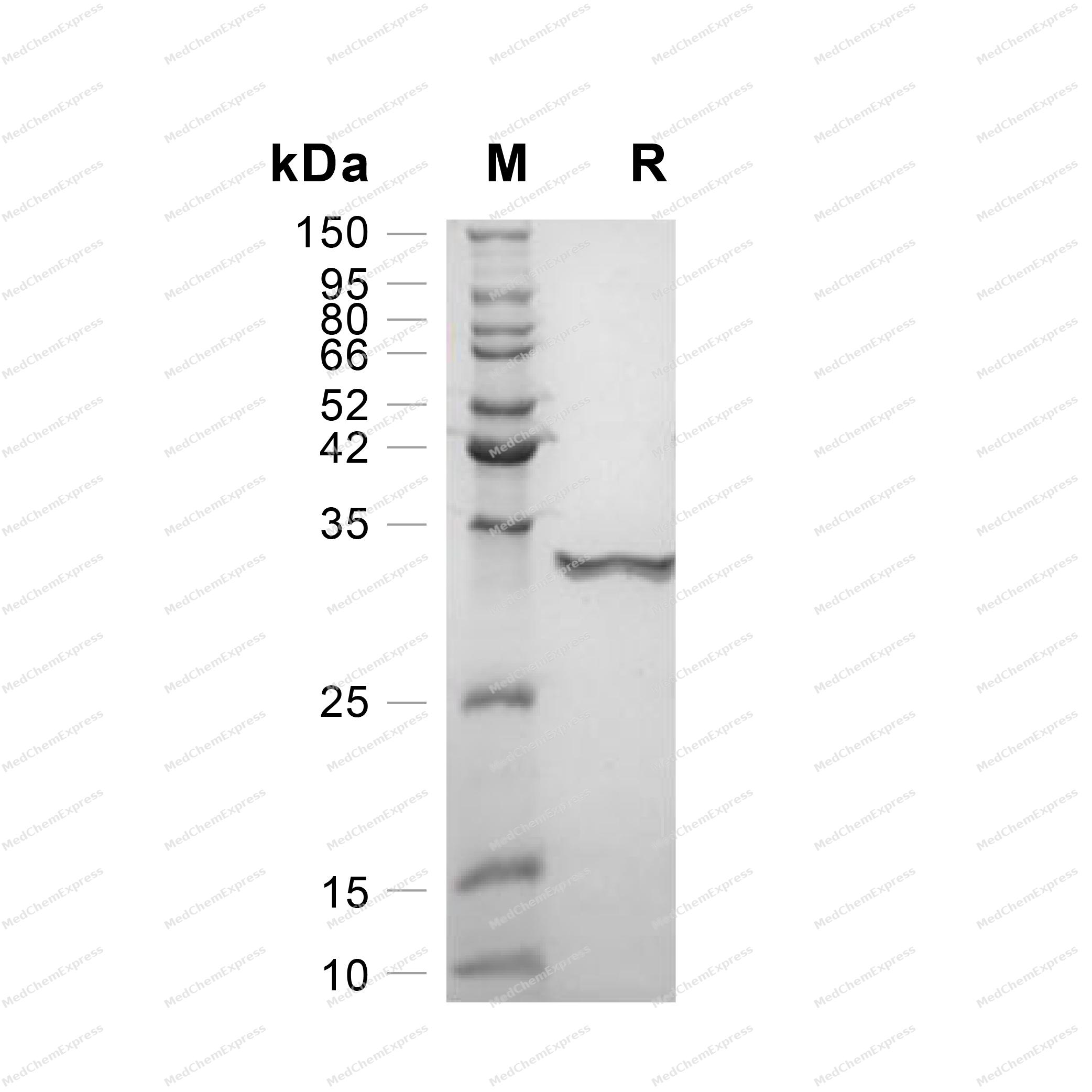
Purity - SDS-PAGE


Technical Parameters
-
Species Human
-
Source E. coli
-
Tag C-6*His
-
Accession
NP_000058.1 (S2-K260)
-
Gene ID760
-
Molecular Construction
-
N-term
-
CA2 (S2-K260)
Accession # NP_000058.1 -
6*His
-
C-term
-
-
Protein Length
Full Length
-
Synonyms
CA2; CAC; Carbonic Anhydrase 2; Epididymis Secretory Protein Li 282; Carbonic Anhydrase II; Epididymis Luminal Protein 76; CA-II; Carbonic Anhydrase B; Carbonate Dehydratase II; Carbonic Dehydratase; Cyanamide Hydratase CA2; Carbonic Anhydrase; CAII; HEL-
-
AA Sequence
SHHWGYGKHNGPEHWHKDFPIAKGERQSPVDIDTHTAKYDPSLKPLSVSYDQATSLRILNNGHAFNVEFDDSQDKAVLKGGPLDGTYRLIQFHFHWGSLDGQGSEHTVDKKKYAAELHLVHWNTKYGDFGKAVQQPDGLAVLGIFLKVGSAKPGLQKVVDVLDSIKTKGKSADFTNFDPRGLLPESLDYWTYPGSLTTPPLLECVTWIVLKEPISVSSEQVLKFRKLNFNGEGEPEELMVDNWRPAQPLKNRQIKASFK
-
Predicted Molecular Mass
30.1 kDa
-
Molecular Weight
Approximately 33 kDa, based on SDS-PAGE under reducing conditions.
-
Purity
≥ 95%, as determined by reducing SDS-PAGE.


Product Properties
Lyophilized powder.
Lyophilized from a 0.22 μm filtered solution of 20 mM Tris, 500 mM NaCl, pH 8.0 or 20 mM Tris-HCl, 500 mM NaCl, pH 8.0, 8% trehalose, 8% mannitol and 0.02% Tween80.
Note: For SPR assay, please replace the buffer. Primary amine components (e.g., Tris, imidazole) can affect protein-coupled chips.
<1 EU/μg, determined by LAL method.
It is not recommended to reconstitute to a concentration less than 100 μg/mL in ddH2O. For long term storage it is recommended to add a carrier protein (0.1% BSA, 5% HSA, 10% FBS or 5% Trehalose).
Stored at -20°C for 2 years from date of receipt. After reconstitution, it is stable at 4°C for 1 week or -20°C for longer (with carrier protein). It is recommended to freeze aliquots at -20°C or -80°C for extended storage.
Room temperature in continental US; may vary elsewhere.


Documentation
-
Data Sheet (237 KB)
-
SDS (252 KB)
- English - EN (252 KB)
- Français - FR (252 KB)
- Deutsch - DE (252 KB)
- Norwegian - NO (252 KB)
- Español - ES (252 KB)
- Swedish - SV (252 KB)
- Italian - IT (252 KB)
- Korean - KR (252 KB)
- Portuguese - PT (252 KB)
-
Handling Instructions (2659 KB)

Calculators
Concentration (start) × Volume (start) = Concentration (final) × Volume (final)


 Powered by Bioz

