



Carboxypeptidase A2/CPA2 Protein, Rat (HEK293, His)

Based on 1 Customer Validation
Carboxypeptidase A2/CPA2 protein is a member of the key peptidase M14 family, which plays an important role in peptide hydrolysis and contributes to the regulation of biological pathways. CPA2 may share conserved features with related proteins. Carboxypeptidase A2/CPA2 Protein, Rat (HEK293, His) is the recombinant rat-derived Carboxypeptidase A2/CPA2 protein, expressed by HEK293 , with C-His labeled tag.
- Species: Rat
- Source: HEK293
-
Storage:Stored at -20°C for 2 years from date of receipt. After reconstitution, it is stable at 4°C for 1 week or -20°C for longer (with carrier protein). It is recommended to freeze aliquots at -20°C or -80°C for extended storage.


To place orders, for customer services and technical support, please contact: MedChemExpress USA
Tel: 609-228-6898 E-mail: [email protected] [email protected]


-
 Biological Activity
-
Technical Parameters
-
Product Properties
- Documentation
- Help & FAQs




Biological Activity
Description
Carboxypeptidase A2/CPA2 protein is a member of the key peptidase M14 family, which plays an important role in peptide hydrolysis and contributes to the regulation of biological pathways. CPA2 may share conserved features with related proteins. Carboxypeptidase A2/CPA2 Protein, Rat (HEK293, His) is the recombinant rat-derived Carboxypeptidase A2/CPA2 protein, expressed by HEK293 , with C-His labeled tag.
Background
The Carboxypeptidase A2/CPA2 Protein is a pivotal member of the peptidase M14 family, signifying its essential role as a peptidase enzyme. As part of this enzyme family, CPA2 likely shares conserved structural and functional features with related proteins, implicating its involvement in the hydrolysis of peptide bonds. Its membership in the peptidase M14 family underscores its significance in cellular processes related to the cleavage of peptides and the regulation of various biological pathways. The study of CPA2 provides insights into its specific enzymatic functions within the context of the peptidase M14 family, offering potential applications in therapeutic interventions and a deeper understanding of its broader impact on cellular processes involved in peptide metabolism. Further exploration of CPA2's role promises to enhance our comprehension of its contributions to normal physiology and pathological conditions.
Verified Bioactivity
Measured by its ability to cleave the 200 μM colorimetric peptide substrate Ac-Phe-Thiaphe-OH, in the presence of 200 μM 5,5’Dithio-bis (2-nitrobenzoic acid) (DTNB) that incubate at room temperature for 5 minutes. The specific activity is 4697.712 pmol/min/µg. (Activation description: The proenzyme needs to be activated by Trypsin for an activated form.)
MCE Validation Data
-
Purity - SDS-PAGE
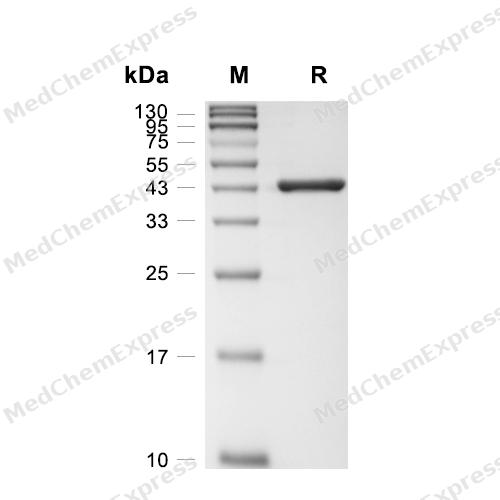
Purity - SDS-PAGE


Technical Parameters
-
Species Rat
-
Source HEK293
-
Tag C-10*His
-
Accession
NP_001013101.2 (Q17-Y417)
-
Molecular Construction
-
N-term
-
CPA2 (Q17-Y417)
Accession # NP_001013101.2 -
His
-
C-term
-
-
Protein Length
Full Length
-
Synonyms
CPA2; Carboxypeptidase A2 Isoform 4; Carboxypeptidase A2; Carboxypeptidase A2 Isoform 1; Carboxypeptidase A2 (Pancreatic); Carboxypeptidase A2 Isoform 5
-
AA Sequence
QETFVGDQVLEIIPSHEEQIRTLLQLEAEEHLELDFWKSPTIPGETVHVRVPFASIQAVKVFLESQGIDYSIMIEDVQVLLDQEREEMLFNQQRERGGNFNFEAYHTLEEIYQEMDNLVAENPGLVSKVNIGSSFENRPMNVLKFSTGGDKPAIWLDAGIHAREWVTQATALWTANKIASDYGTDPAITSLLNTLDIFLLPVTNPDGYVFSQTTNRMWRKTRSKRSGSGCVGVDPNRNWDANFGGPGASSSPCSDSYHGPKPNSEVEVKSIVDFIKSHGKVKAFITLHSYSQLLMFPYGYKCTKPDDFNELDEVAQKAAQALKRLHGTSYKVGPICSVIYQASGGSIDWAYDLGIKYSFAFELRDTGFYGFLLPAKQILPTAEETWLGLKTIMEHVRDHPY
-
Molecular Weight
Approximately 45 kDa
-
Purity
≥ 95%, as determined by reducing SDS-PAGE.


Product Properties
Lyophilized powder.
Lyophilized from a 0.22 μm filtered solution of PBS, pH 7.4.
<1 EU/μg, determined by LAL method.
It is not recommended to reconstitute to a concentration less than 100 μg/mL in ddH2O. For long term storage it is recommended to add a carrier protein (0.1% BSA, 5% HSA, 10% FBS or 5% Trehalose).
Stored at -20°C for 2 years from date of receipt. After reconstitution, it is stable at 4°C for 1 week or -20°C for longer (with carrier protein). It is recommended to freeze aliquots at -20°C or -80°C for extended storage.
Room temperature in continental US; may vary elsewhere.


Documentation
-
Data Sheet (262 KB)
-
SDS (251 KB)
- English - EN (251 KB)
- Français - FR (251 KB)
- Deutsch - DE (251 KB)
- Norwegian - NO (251 KB)
- Español - ES (251 KB)
- Swedish - SV (251 KB)
- Italian - IT (251 KB)
- Korean - KR (251 KB)
- Portuguese - PT (251 KB)
-
Handling Instructions (2659 KB)

Calculators
Concentration (start) × Volume (start) = Concentration (final) × Volume (final)


 Powered by Bioz

