



CCN2/CTGF Protein, Rhesus macaque (HEK293, His)
Based on 1 Customer Validation
CCN2 is a mitogen secreted by vascular endothelial cells and a mechanosensor of mesenchymal cell differentiation that secretes stromal cell proteins. CCN2 can sense appropriate mechanical stress and downregulate its expression accordingly. CCN2 is a classic epithelial-to-mesenchymal transition (EMT) and fibrosis marker. CCN2/CTGF Protein, Rhesus macaque (HEK293, His) is the recombinant Rhesus Macaque-derived CCN2/CTGF protein, expressed by HEK293 , with C-His labeled tag.
- Species: Rhesus Macaque
- Source: HEK293
-
Storage:Stored at -20°C for 2 years from date of receipt. After reconstitution, it is stable at 4°C for 1 week or -20°C for longer (with carrier protein). It is recommended to freeze aliquots at -20°C or -80°C for extended storage.


To place orders, for customer services and technical support, please contact: MedChemExpress USA
Tel: 609-228-6898 E-mail: [email protected] [email protected]


-
 Biological Activity
-
Technical Parameters
-
Product Properties
- Documentation
- Help & FAQs




Biological Activity
Description
CCN2 is a mitogen secreted by vascular endothelial cells and a mechanosensor of mesenchymal cell differentiation that secretes stromal cell proteins. CCN2 can sense appropriate mechanical stress and downregulate its expression accordingly. CCN2 is a classic epithelial-to-mesenchymal transition (EMT) and fibrosis marker. CCN2/CTGF Protein, Rhesus macaque (HEK293, His) is the recombinant Rhesus Macaque-derived CCN2/CTGF protein, expressed by HEK293 , with C-His labeled tag.
Background
Cellular communication network factor 2 (CCN2) is a mitogen secreted by vascular endothelial cells and a cysteine-rich secreted matrix cell protein. CCN2 is involved in chondrocyte proliferation and differentiation, cell adhesion of multiple cell types, and in mesenchymal cells such as chondrocytes, osteoblasts, and fibroblasts under multiple types of mechanical stress, such as tensile stress, compressive stress, and highly expressed under shear stress). Furthermore, CCN2 expression is regulated by activation of various mechanosensory signaling pathways, such as mechanosensing ion channels, integrin-focal adhesion-actin dynamics, Rho GTPase family members, Hippo-YAP signaling, and G protein-coupled receptors. body. Certain polymorphisms in the CCN2 gene are associated with a higher incidence of systemic sclerosis. In the field of airway fibrotic asthma, CCN2 and fibronectin (FN) are classic epithelial-to-mesenchymal transition (EMT) and fibrosis markers. CCN2 and FN are upregulated in A549 cells in response to AREG stimulation. EGFR/JNK/AP-1 activation by AREG stimulation further mediates TGF-β-induced EMT in human lung epithelial cells. CCN2 is also associated with platelet-derived growth factor. Sunitinib (HY-10255A) induces autophagy through the TOLLIP (Toll-interacting protein)-mediated endosome-related pathway, leading to cardiomyocyte apoptosis and cardiac dysfunction. This maladaptive autophagy selectively degrades the cardiomyocyte survival mediator CCN2. Thus, sunitinib-induced cardiac dysfunction in vivo can be mimicked by the ability of adeno-associated virus serotype 9 (AAV9) to specifically knock down Ccn2.
Verified Bioactivity
Immobilized Rhesus macaque CTGF His at 1 μg/mL (100 μL/well) can bind Monoclonal Anti-Human CTGF Antibody Human IgG1 with a linear range of 0.1-2 ng/mL.
MCE Validation Data
-
Purity - SDS-PAGE
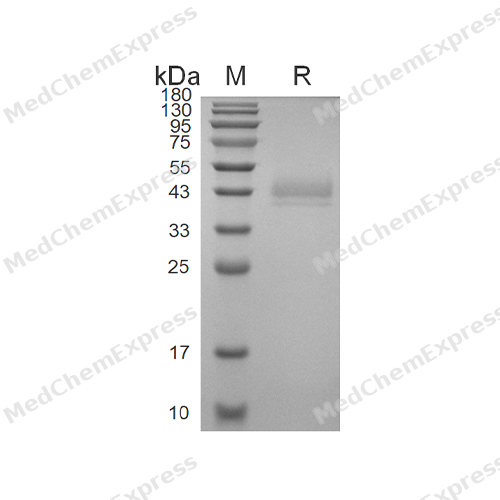
Purity - SDS-PAGE


Technical Parameters
-
Species Rhesus Macaque
-
Source HEK293
-
Tag C-10*His
-
Accession
H9FQD5 (Q27-A349)
-
Molecular Construction
-
N-term
-
CCN2 (Q27-A349)
Accession # H9FQD5 -
10*His
-
C-term
-
-
Protein Length
Full Length of Mature Protein
-
Synonyms
CCN2; CCN Family Member 2; Prev. CTGF; IBP-8; IGFBP8; SEMDLSL; Connective Tissue Growth Factor; IGFBP-8; Hypertrophic Chondrocyte-Specific Protein 24; NOV2; Insulin-Like Growth Factor-Binding Protein 8; KMD; IGF-Binding Protein 8; Cellular Communication N
-
AA Sequence
QNCSGPCRCPAEQAPRCPAGVSLVLDGCGCCRVCAKQLGELCTERDPCDPHKGLFCDFGSPANRKIGVCTAKDGAPCIFGGTVYRSGESFQSSCKYQCTCLDGAVGCMPLCSMDVRLPSPDCPFPRRVKLPGKCCEEWVCDEPKDQTVVGPALAAYRLEDTFGPDPTMIRANCLVQTTEWSACSKTCGMGISTRVTNDNASCRLEKQSRLCMVRPCEADLEENIKKGKKCIRTPKISKPIKFELSGCTSVKTYRAKFCGVCTDGRCCTPHRTTTLPVEFKCPDGEVMKKNMMFIKTCACHYNCPGDNDIFESLYYRKMYGDMA
-
Predicted Molecular Mass
36.8 kDa
-
Molecular Weight
Approximately 40-45 kDa, based on SDS-PAGE under reducing conditions, due to the glycosylation.
-
Purity
≥ 90%, as determined by reducing SDS-PAGE.


Product Properties
Lyophilized powder.
Lyophilized from a 0.22 μm filtered solution of 20 mM Tris-HCl, 0.5 M NaCl, 6% trehalose, pH 8.0.
Note: For SPR assay, please replace the buffer. Primary amine components (e.g., Tris, imidazole) can affect protein-coupled chips.
<1 EU/μg, determined by LAL method.
It is not recommended to reconstitute to a concentration less than 100 μg/mL in ddH2O.
Stored at -20°C for 2 years from date of receipt. After reconstitution, it is stable at 4°C for 1 week or -20°C for longer (with carrier protein). It is recommended to freeze aliquots at -20°C or -80°C for extended storage.
Room temperature in continental US; may vary elsewhere.


Documentation
-
Data Sheet (238 KB)
-
SDS (254 KB)
- English - EN (254 KB)
- Français - FR (254 KB)
- Deutsch - DE (254 KB)
- Norwegian - NO (254 KB)
- Español - ES (254 KB)
- Swedish - SV (254 KB)
- Italian - IT (254 KB)
- Korean - KR (254 KB)
- Portuguese - PT (254 KB)
-
Handling Instructions (2659 KB)

Calculators
Concentration (start) × Volume (start) = Concentration (final) × Volume (final)


 Powered by Bioz

