



CD52 Protein, Mouse (HEK293, Fc)

Based on 1 Customer Validation
CD52 protein carries and orients carbohydrates, suggesting involvement in molecular transport and arrangement.Its multifaceted role includes a specific function that is not fully understood.Further exploration into CD52's mechanisms and contributions can shed light on its broader significance.Understanding its targeted role provides valuable insights into its functions and implications.CD52 Protein, Mouse (HEK293, Fc) is the recombinant mouse-derived CD52 protein, expressed by HEK293 , with C-hFc labeled tag.
- Species: Mouse
- Source: HEK293
-
Storage:Stored at -20°C for 2 years from date of receipt. After reconstitution, it is stable at 4°C for 1 week or -20°C for longer (with carrier protein). It is recommended to freeze aliquots at -20°C or -80°C for extended storage.


To place orders, for customer services and technical support, please contact: MedChemExpress USA
Tel: 609-228-6898 E-mail: [email protected] [email protected]


-
 Biological Activity
-
Technical Parameters
-
Product Properties
- Documentation
- Help & FAQs




Biological Activity
Description
CD52 protein carries and orients carbohydrates, suggesting involvement in molecular transport and arrangement.Its multifaceted role includes a specific function that is not fully understood.Further exploration into CD52's mechanisms and contributions can shed light on its broader significance.Understanding its targeted role provides valuable insights into its functions and implications.CD52 Protein, Mouse (HEK293, Fc) is the recombinant mouse-derived CD52 protein, expressed by HEK293 , with C-hFc labeled tag.
Background
The CD52 protein appears to have a multifaceted role, involving both the carrying and orienting of carbohydrates, indicating potential functions in molecular transport and arrangement. Beyond these general activities, CD52 may also harbor a more specific role, the details of which are yet to be fully understood. The versatility suggested by CD52's dual functions prompts further exploration into its precise mechanisms and contributions, shedding light on its broader significance in cellular and molecular contexts. Unraveling the specifics of CD52's more targeted role could provide valuable insights, advancing our understanding of its intricate functions and potential implications.
Verified Bioactivity
Measured by its binding ability in a functional ELISA. When Recombinant Human Siglec-10 is immobilized at 2.5 µg/mL (100 µL/well) can bind Recombinant Mouse CD52 Protein. The ED50 for this effect is 1.71 μg/mL.
MCE Validation Data
-
Purity - SDS-PAGE
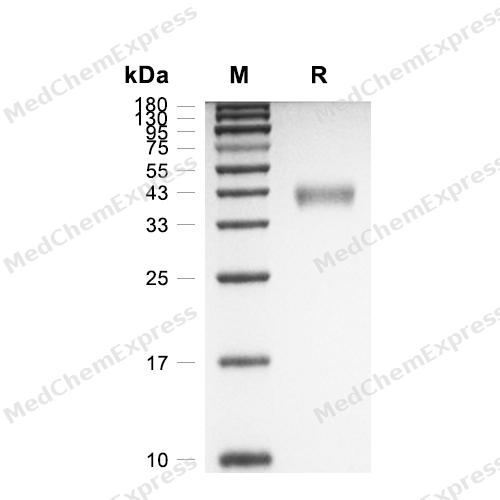
Purity - SDS-PAGE
-
Bioactivity - ELISA
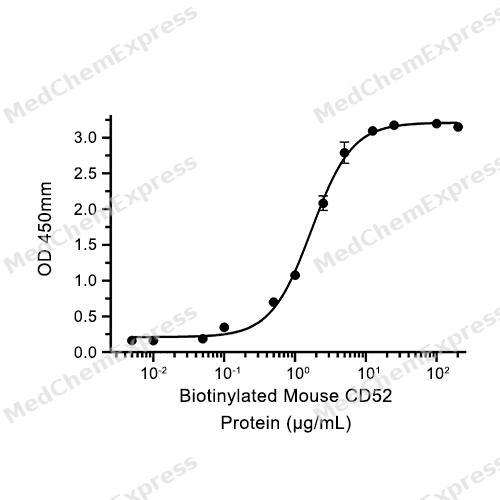
Bioactivity - ELISA


Technical Parameters
-
Species Mouse
-
Source HEK293
-
Tag C-hFc
-
Accession
Q64389 (G24-K46)
-
Molecular Construction
-
N-term
-
CD52 (M1-K46)
Accession # Q64389 -
hFc
-
C-term
-
-
Protein Length
Full Length of Mature Protein
-
Synonyms
CD52; Cambridge Pathology 1 Antigen; Prev. CDW52; CDW52 Antigen (CAMPATH-1 Antigen); HE5; CD52 Antigen; CAMPATH-1 Antigen; CD52 Protein; EDDM5; HEL-S-171mP; Human Epididymis-Specific Protein 5; CDw52; CD52 Antigen (CAMPATH-1 Antigen); He5; Epididymal Secr
-
AA Sequence
GQATTAASGTNKNSTSTKKTPLK
-
Molecular Weight
Approximately 35-45 kDa, based on SDS-PAGE under reducing conditions, due to the glycosylation.
-
Glycosylation
Yes
-
Purity
≥ 95%, as determined by reducing SDS-PAGE.


Product Properties
Lyophilized powder.
Lyophilized from a 0.22 μm filtered solution of PBS, pH 7.4.
<1 EU/μg, determined by LAL method.
It is not recommended to reconstitute to a concentration less than 100 μg/mL in ddH2O. For long term storage it is recommended to add a carrier protein (0.1% BSA, 5% HSA, 10% FBS or 5% Trehalose).
Stored at -20°C for 2 years from date of receipt. After reconstitution, it is stable at 4°C for 1 week or -20°C for longer (with carrier protein). It is recommended to freeze aliquots at -20°C or -80°C for extended storage.
Room temperature in continental US; may vary elsewhere.


Documentation
-
Data Sheet (235 KB)
-
SDS (251 KB)
- English - EN (251 KB)
- Français - FR (251 KB)
- Deutsch - DE (251 KB)
- Norwegian - NO (251 KB)
- Español - ES (251 KB)
- Swedish - SV (251 KB)
- Italian - IT (251 KB)
- Korean - KR (251 KB)
- Portuguese - PT (251 KB)
-
Handling Instructions (2659 KB)

Calculators
Concentration (start) × Volume (start) = Concentration (final) × Volume (final)


 Powered by Bioz

