



CSRP1 Protein, Mouse (His)

Based on 1 Customer Validation
CSRP1 protein may contribute to neuronal development through its interactions with ASCC1, ASCC2, and TRIP4. These connections suggest a regulatory role for CSRP1 in molecular events involved in neuronal growth and differentiation. Understanding the dynamics of CSRP1 interactions with these proteins could enhance our knowledge of neuronal development and facilitate targeted interventions in neurological contexts. CSRP1 Protein, Mouse (His) is the recombinant mouse-derived CSRP1 protein, expressed by E. coli , with C-His labeled tag.
- Species: Mouse
- Source: E. coli
-
Storage:Stored at -20°C for 2 years from date of receipt. After reconstitution, it is stable at 4°C for 1 week or -20°C for longer (with carrier protein). It is recommended to freeze aliquots at -20°C or -80°C for extended storage.


To place orders, for customer services and technical support, please contact: MedChemExpress USA
Tel: 609-228-6898 E-mail: [email protected] [email protected]


-
 Biological Activity
-
Technical Parameters
-
Product Properties
- Documentation
- Help & FAQs




Biological Activity
Description
CSRP1 protein may contribute to neuronal development through its interactions with ASCC1, ASCC2, and TRIP4. These connections suggest a regulatory role for CSRP1 in molecular events involved in neuronal growth and differentiation. Understanding the dynamics of CSRP1 interactions with these proteins could enhance our knowledge of neuronal development and facilitate targeted interventions in neurological contexts. CSRP1 Protein, Mouse (His) is the recombinant mouse-derived CSRP1 protein, expressed by E. coli , with C-His labeled tag.
Background
The CSRP1 protein emerges as a potential contributor to neuronal development, hinting at its involvement in the intricate processes that govern the formation and maturation of neurons. Notably, it engages in interactions with ASCC1, ASCC2, and TRIP4, suggesting a network of connections that may be crucial in orchestrating molecular events relevant to neuronal development. The interplay between CSRP1 and these associated proteins implies a regulatory role, opening avenues for further exploration into the specific mechanisms by which CSRP1 influences neuronal growth and differentiation. Unraveling the intricate dynamics of the CSRP1 interactions with ASCC1, ASCC2, and TRIP4 holds promise for advancing our understanding of the molecular landscape governing neuronal development, potentially paving the way for targeted interventions in neurological contexts.
MCE Validation Data
-
Purity - SDS-PAGE
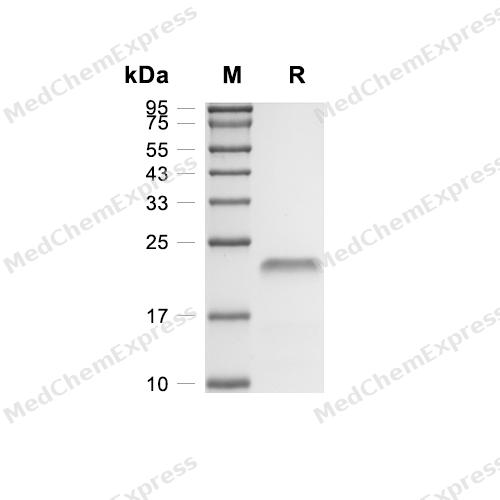
Purity - SDS-PAGE


Technical Parameters
-
Species Mouse
-
Source E. coli
-
Tag C-His
-
Accession
P97315 (M1-E193)
-
Molecular Construction
-
N-term
-
CSRP1 (M1-E193)
Accession # P97315 -
His
-
C-term
-
-
Protein Length
Full Length
-
Synonyms
CSRP1; HEL-141; Prev. CYRP; CRP; CSRP; Epididymis Secretory Sperm Binding Protein; Cysteine And Glycine-Rich Protein 1; Epididymis Secretory Protein Li 286; Cysteine-Rich Protein 1; LIM-Domain Protein; D1S181E; HEL-S-286; Epididymis Luminal Protein 141; C
-
AA Sequence
MPNWGGGKKCGVCQKTVYFAEEVQCEGNSFHKSCFLCMVCKKNLDSTTVAVHGEEIYCKSCYGKKYGPKGYGYGQGAGTLSTDKGESLGIKHEEAPGHRPTTNPNASKFAQKIGGSERCPRCSQAVYAAEKVIGAGKSWHKSCFRCAKCGKGLESTTLADKDGEIYCKGCYAKNFGPKGFGFGQGAGALVHSE
-
Molecular Weight
Approximately 23 kDa, based on SDS-PAGE under reducing conditions.
-
Purity
≥ 95%, as determined by reducing SDS-PAGE.


Product Properties
Lyophilized powder.
Lyophilized from a 0.22 μm filtered solution of PBS, pH 7.4.
<1 EU/μg, determined by LAL method.
It is not recommended to reconstitute to a concentration less than 100 μg/mL in ddH2O. For long term storage it is recommended to add a carrier protein (0.1% BSA, 5% HSA, 10% FBS or 5% Trehalose).
Stored at -20°C for 2 years from date of receipt. After reconstitution, it is stable at 4°C for 1 week or -20°C for longer (with carrier protein). It is recommended to freeze aliquots at -20°C or -80°C for extended storage.
Room temperature in continental US; may vary elsewhere.


Documentation
-
Data Sheet (236 KB)
-
SDS (251 KB)
- English - EN (251 KB)
- Français - FR (251 KB)
- Deutsch - DE (251 KB)
- Norwegian - NO (251 KB)
- Español - ES (251 KB)
- Swedish - SV (251 KB)
- Italian - IT (251 KB)
- Korean - KR (251 KB)
- Portuguese - PT (251 KB)
-
Handling Instructions (2659 KB)

Calculators
Concentration (start) × Volume (start) = Concentration (final) × Volume (final)


 Powered by Bioz

