



CXCL14/BRAK Protein, Rat (N-His)

Based on 1 Customer Validation
BRAK14 is a CXC chemokine constitutively expressed at the mRNA level in certain normal tissues. CXCL14/BRAK Protein, Rat (N-His) is the recombinant rat-derived CXCL14/BRAK protein, expressed by E. coli , with N-6*His labeled tag.
- Species: Rat
- Source: E. coli
-
Storage:Stored at -20°C for 2 years from date of receipt. After reconstitution, it is stable at 4°C for 1 week or -20°C for longer (with carrier protein). It is recommended to freeze aliquots at -20°C or -80°C for extended storage.


To place orders, for customer services and technical support, please contact: MedChemExpress USA
Tel: 609-228-6898 E-mail: [email protected] [email protected]


-
 Biological Activity
-
Technical Parameters
-
Product Properties
- Documentation
- References
- Help & FAQs




Biological Activity
Description
BRAK14 is a CXC chemokine constitutively expressed at the mRNA level in certain normal tissues. CXCL14/BRAK Protein, Rat (N-His) is the recombinant rat-derived CXCL14/BRAK protein, expressed by E. coli , with N-6*His labeled tag.
Background
CXCL14/BRAK belongs to the cytokine gene family which encodes secreted proteins involved in immunoregulatory and inflammatory processes. CXCL14/BRAK encoded the protein which is structurally related to the CXC (Cys-X-Cys) subfamily of cytokines. Members of this subfamily are characterized by two cysteines separated by a single amino acid. CXCL14/BRAK displays chemotactic activity for monocytes but not for lymphocytes, dendritic cells, neutrophils or macrophages. CXCL14/BRAK is involved in the homeostasis of monocyte-derived macrophages rather than in inflammation[1][2][3][4][5].
Verified Bioactivity
The biological activity determined by a chemotaxis bioassay using THP-1 Human monocytic leukemia cells. The ED50 for this effect is1.043 ng/mL, corresponding to a specific activity is 9.59×10⁵ units/mg.
MCE Validation Data
-
Purity - SDS-PAGE
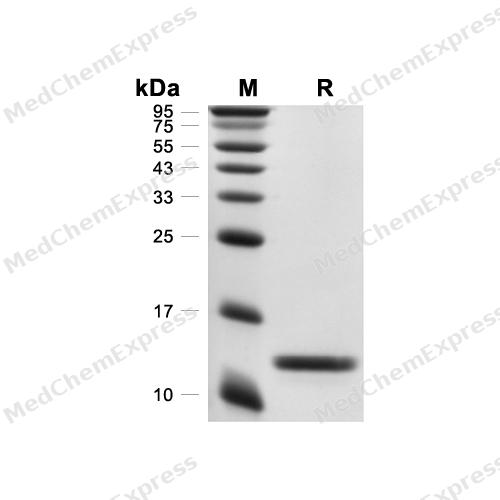
Purity - SDS-PAGE
-
Bioactivity - Cell-Based Assay
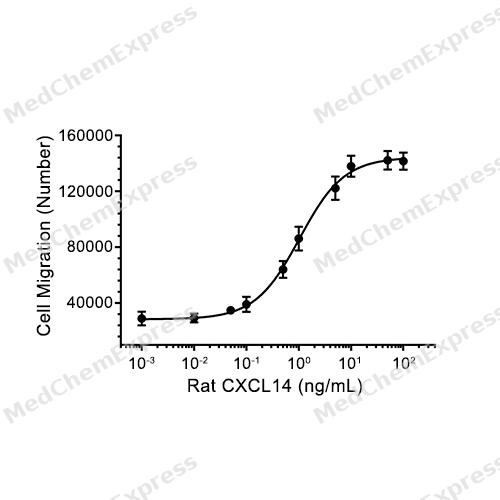
Bioactivity - Cell-Based Assay


Technical Parameters
-
Species Rat
-
Source E. coli
-
Tag N-6*His
-
Accession
Q8K453 (S23-E99)
-
Molecular Construction
-
N-term
-
6*His
-
Cxcl14 (S23-E99)
Accession # Q8K453 -
C-term
-
-
Protein Length
Full Length of Mature Protein
-
Synonyms
CXCL14; Kec; Prev. SCYB14; Small Inducible Cytokine Subfamily B (Cys-X-Cys), Member 14 (BRAK); NJAC; Chemokine (C-X-C Motif) Ligand 14; Small-Inducible Cytokine B14; Breast And Kidney; C-X-C Motif Chemokine 14; MIP-2G; Chemokine BRAK; MIP2G; Bolekine; CXC
-
AA Sequence
SKCKCSRKGPKIRYSDVKKLEMKPKYPHCEEKMVIITTKSMSRYRGQEHCLHPKLQSTKRFIKWYNAWNEKRRVYEE
-
Predicted Molecular Mass
9.5 kDa
-
Molecular Weight
Approximately 12 kDa, based on SDS-PAGE under reducing conditions.
-
Purity
≥ 95%, as determined by reducing SDS-PAGE.


Product Properties
Lyophilized powder.
Lyophilized from a 0.22 μm filtered solution of 50 mM Tris-HCl, 300 mM NaCl, pH 7.4.
Note: For SPR assay, please replace the buffer. Primary amine components (e.g., Tris, imidazole) can affect protein-coupled chips.
<1 EU/μg, determined by LAL method.
It is not recommended to reconstitute to a concentration less than 100 μg/mL in ddH2O. For long term storage it is recommended to add a carrier protein (0.1% BSA, 5% HSA, 10% FBS or 5% Trehalose).
Stored at -20°C for 2 years from date of receipt. After reconstitution, it is stable at 4°C for 1 week or -20°C for longer (with carrier protein). It is recommended to freeze aliquots at -20°C or -80°C for extended storage.
Room temperature in continental US; may vary elsewhere.


Documentation
-
Data Sheet (263 KB)
-
SDS (252 KB)
- English - EN (252 KB)
- Français - FR (252 KB)
- Deutsch - DE (252 KB)
- Norwegian - NO (252 KB)
- Español - ES (252 KB)
- Swedish - SV (252 KB)
- Italian - IT (252 KB)
- Korean - KR (252 KB)
- Portuguese - PT (252 KB)
-
Handling Instructions (2659 KB)


References
[1]. Chang TM, et al. CXCL14 promotes metastasis of non-small cell lung cancer through ACKR2-depended signaling pathway. Int J Biol Sci. 2023 Feb 27;19(5):1455-1470. [Content Brief]
[2]. Du L, et al. Elevated CXCL14 in Induced Sputum Was Associated with Eosinophilic Inflammation and Airway Obstruction in Patients with Asthma. Int Arch Allergy Immunol. 2022;183(11):1216-1225. [Content Brief]
[3]. Kumar A, et al. CXCL14 Promotes a Robust Brain Tumor-Associated Immune Response in Glioma. Clin Cancer Res. 2022 Jul 1;28(13):2898-2910. [Content Brief]
[4]. Liu D, et al. Integrated analysis of 14 lymphoma datasets revealed high expression of CXCL14 promotes cell migration in mantle cell lymphoma. Aging (Albany NY). 2022 Apr 22;14(8):3446-3463. [Content Brief]
[5]. Guo J, et al. Dysregulation of CXCL14 promotes malignant phenotypes of esophageal squamous carcinoma cells via regulating SRC and EGFR signaling. Biochem Biophys Res Commun. 2022 Jun 18;609:75-83. [Content Brief]

Calculators
Concentration (start) × Volume (start) = Concentration (final) × Volume (final)


 Powered by Bioz

