



Cyclophilin F/PPIF Protein, Human (HEK293, His)

Based on 1 Customer Validation
Cyclophilin F/PPIF protein is a peptidyl prolyl cis-trans isomerase (PPIase) that catalyzes the isomerization of proline imide peptide bonds and may contribute to protein folding. It critically regulates the mitochondrial permeability transition pore (mPTP), affecting cell apoptosis or necrosis. Cyclophilin F/PPIF Protein, Human (HEK293, His) is the recombinant human-derived Cyclophilin F/PPIF protein, expressed by HEK293 , with C-6*His labeled tag.
- Species: Human
- Source: HEK293
-
Storage:Stored at -20°C for 2 years from date of receipt. After reconstitution, it is stable at 4°C for 1 week or -20°C for longer (with carrier protein). It is recommended to freeze aliquots at -20°C or -80°C for extended storage.


To place orders, for customer services and technical support, please contact: MedChemExpress USA
Tel: 609-228-6898 E-mail: [email protected] [email protected]


-
 Biological Activity
-
Technical Parameters
-
Product Properties
- Documentation
- Help & FAQs




Biological Activity
Description
Cyclophilin F/PPIF protein is a peptidyl prolyl cis-trans isomerase (PPIase) that catalyzes the isomerization of proline imide peptide bonds and may contribute to protein folding. It critically regulates the mitochondrial permeability transition pore (mPTP), affecting cell apoptosis or necrosis. Cyclophilin F/PPIF Protein, Human (HEK293, His) is the recombinant human-derived Cyclophilin F/PPIF protein, expressed by HEK293 , with C-6*His labeled tag.
Background
Cyclophilin F/PPIF Protein functions as a peptidyl-prolyl cis-trans isomerase (PPIase), playing a vital role in catalyzing the cis-trans isomerization of proline imidic peptide bonds in oligopeptides, thereby potentially facilitating protein folding. Beyond its involvement in protein folding, Cyclophilin F/PPIF is a key player in the regulation of the mitochondrial permeability transition pore (mPTP), where its association with the mPTP is suggested to mask a binding site for inhibiting inorganic phosphate (Pi), ultimately promoting the open probability of the mPTP and leading to apoptosis or necrosis; however, the requirement for PPIase activity in this process is a matter of debate. Additionally, in collaboration with mitochondrial p53/TP53, Cyclophilin F/PPIF contributes to the activation of oxidative stress-induced necrosis. It further participates in modulating mitochondrial membrane F(1)F(0) ATP synthase activity and regulating mitochondrial matrix adenine nucleotide levels. Exhibiting anti-apoptotic activity independently of the mPTP, Cyclophilin F/PPIF, in cooperation with BCL2, effectively inhibits cytochrome c-dependent apoptosis, highlighting its multifaceted roles in mitochondrial function and cell survival mechanisms.
Verified Bioactivity
Measured by its ability to convert the 0.3 mM substrate of Suc-AAPF-pNA, from Cis to Trans formation. The specific activity is 1004.301 nmol/min/mg.
MCE Validation Data
-
Purity - SDS-PAGE
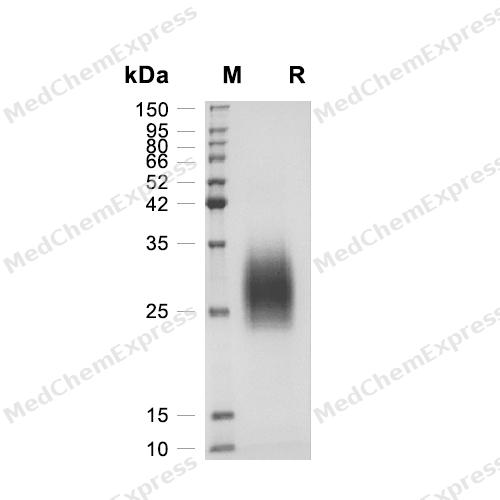
Purity - SDS-PAGE


Technical Parameters
-
Species Human
-
Source HEK293
-
Tag C-6*His
-
Accession
P30405 (C30-S207)
-
Gene ID10105
-
Molecular Construction
-
N-term
-
PPIF (C30-S207)
Accession # P30405 -
6*His
-
C-term
-
-
Protein Length
Full Length of Mature Protein
-
Synonyms
PPIF; HCyP3; Peptidylprolyl Isomerase F; CyP-M; CypD; CYP3; Cyclophilin D; Peptidyl-Prolyl Cis-Trans Isomerase, Mitochondrial; Cyp-D; Peptidylprolyl Isomerase F (Cyclophilin F); Peptidyl-Prolyl Cis-Trans Isomerase F, Mitochondrial; Peptidyl-Prolyl Cis-Tra
-
AA Sequence
CSKGSGDPSSSSSSGNPLVYLDVDANGKPLGRVVLELKADVVPKTAENFRALCTGEKGFGYKGSTFHRVIPSFMCQAGDFTNHNGTGGKSIYGSRFPDENFTLKHVGPGVLSMANAGPNTNGSQFFICTIKTDWLDGKHVVFGHVKEGMDVVKKIESFGSKSGRTSKKIVITDCGQLS
-
Predicted Molecular Mass
19.7 kDa
-
Molecular Weight
Approximately 24-34 kDa, based on SDS-PAGE under reducing conditions.
-
Glycosylation
Yes
-
Purity
≥ 95%, as determined by reducing SDS-PAGE.


Product Properties
Lyophilized powder.
Lyophilized from a 0.22 μm filtered solution of PBS, pH 7.4.
<1 EU/μg, determined by LAL method.
It is not recommended to reconstitute to a concentration less than 100 μg/mL in ddH2O. For long term storage it is recommended to add a carrier protein (0.1% BSA, 5% HSA, 10% FBS or 5% Trehalose).
Stored at -20°C for 2 years from date of receipt. After reconstitution, it is stable at 4°C for 1 week or -20°C for longer (with carrier protein). It is recommended to freeze aliquots at -20°C or -80°C for extended storage.
Room temperature in continental US; may vary elsewhere.


Documentation
-
Data Sheet (237 KB)
-
SDS (254 KB)
- English - EN (254 KB)
- Français - FR (254 KB)
- Deutsch - DE (254 KB)
- Norwegian - NO (254 KB)
- Español - ES (254 KB)
- Swedish - SV (254 KB)
- Italian - IT (254 KB)
- Korean - KR (254 KB)
- Portuguese - PT (254 KB)
-
Handling Instructions (2659 KB)

Calculators
Concentration (start) × Volume (start) = Concentration (final) × Volume (final)


 Powered by Bioz

