



Cystatin C/CST3 Protein, Human (HEK293)

Based on 1 Customer Validation
Cystatin C/CST3 protein can significantly inhibit cysteine proteases and locally regulate their enzymatic activity. It captures and binds free plasma hemoglobin, preventing kidney damage and supporting hepatic heme iron recycling. Cystatin C/CST3 Protein, Human (HEK293) is the recombinant human-derived Cystatin C/CST3 protein, expressed by HEK293 , with tag free.
- Species: Human
- Source: HEK293
-
Storage:Stored at -20°C for 2 years from date of receipt. After reconstitution, it is stable at 4°C for 1 week or -20°C for longer (with carrier protein). It is recommended to freeze aliquots at -20°C or -80°C for extended storage.


To place orders, for customer services and technical support, please contact: MedChemExpress USA
Tel: 609-228-6898 E-mail: [email protected] [email protected]


-
 Biological Activity
-
Technical Parameters
-
Product Properties
- Documentation
- Help & FAQs




Biological Activity
Description
Cystatin C/CST3 protein can significantly inhibit cysteine proteases and locally regulate their enzymatic activity. It captures and binds free plasma hemoglobin, preventing kidney damage and supporting hepatic heme iron recycling. Cystatin C/CST3 Protein, Human (HEK293) is the recombinant human-derived Cystatin C/CST3 protein, expressed by HEK293 , with tag free.
Background
The Cystatin C/CST3 protein serves a crucial physiological role as an inhibitor of cysteine proteinases, acting as a local regulator of their enzyme activity. It is known to capture and bind free plasma hemoglobin, preventing kidney damage and enabling the hepatic recycling of heme iron. In cases of hemolysis, where hemoglobin can accumulate in the kidneys and be secreted in urine, Cystatin C/CST3 plays a vital role in clearing the complexes formed between hemoglobin and Haptoglobin. Additionally, Cystatin C/CST3 acts as an antioxidant, exhibits antibacterial activity, and contributes to modulating various aspects of the acute phase response. The protein's homodimeric structure further enhances its functionality and effectiveness as an enzyme inhibitor.
Verified Bioactivity
Measured by its ability to inhibit papain cleavage of a fluorogenic peptide substrate Z-FR-AMC. The IC50 value is 2.151 nM. (Activation description: The proenzyme needs to be activated in reducing buffer for an activated form.)
MCE Validation Data
-
Purity - SDS-PAGE
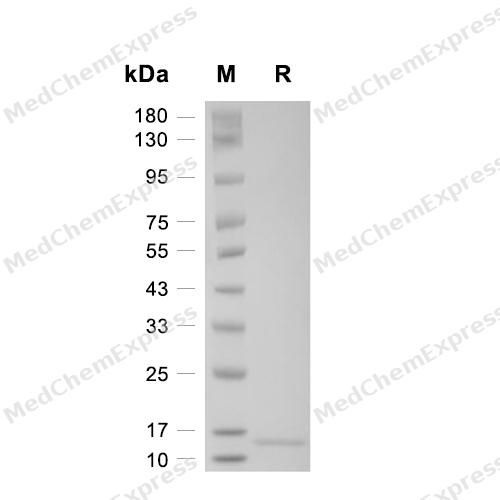
Purity - SDS-PAGE


Technical Parameters
-
Species Human
-
Source HEK293
-
Tag Tag Free
-
Accession
P01034 (S27-A146)
-
Molecular Construction
-
N-term
-
CST3 (S27-A146)
Accession # P01034 -
C-term
-
-
Protein Length
Full Length of Mature Protein
-
Synonyms
CST3; Cystatin C (Amyloid Angiopathy And Cerebral Hemorrhage); Cystatin C; BA218C14.4 (Cystatin C); Epididymis Secretory Protein Li 2; Cystatin 3; Neuroendocrine Basic Polypeptide; Cystatin-3; Post-Gamma-Globulin; HEL-S-2; Gamma-Trace; ADLDWA; Cystatin-C;
-
AA Sequence
SSPGKPPRLVGGPMDASVEEEGVRRALDFAVGEYNKASNDMYHSRALQVVRARKQIVAGVNYFLDVELGRTTCTKTQPNLDNCPFHDQPHLKRKAFCSFQIYAVPWQGTMTLSKSTCQDA
-
Molecular Weight
Approximately 15 kDa, based on SDS-PAGE under reducing conditions.
-
Purity
≥ 95%, as determined by reducing SDS-PAGE.


Product Properties
Lyophilized powder
1.Lyophilized from a 0.22 μm filtered solution of 20 mM PB, 50 mM NaCl, 5% trehalose, 5% mannitol, 0.02% Tween 80, pH 6.8.
2.Lyophilized from a 0.22 μm filtered solution of 10 mM PB, 200 mM NaCl, pH 6.5, 8% trehalose.
Please refer to the lot-specific COA for specific buffer information.
<1 EU/μg, determined by LAL method.
It is not recommended to reconstitute to a concentration less than 100 μg/mL in ddH2O. For long term storage it is recommended to add a carrier protein (0.1% BSA, 5% HSA, 10% FBS or 5% Trehalose).
Stored at -20°C for 2 years from date of receipt. After reconstitution, it is stable at 4°C for 1 week or -20°C for longer (with carrier protein). It is recommended to freeze aliquots at -20°C or -80°C for extended storage.
Room temperature in continental US; may vary elsewhere.


Documentation
-
Data Sheet (236 KB)
-
SDS (251 KB)
- English - EN (251 KB)
- Français - FR (251 KB)
- Deutsch - DE (251 KB)
- Norwegian - NO (251 KB)
- Español - ES (251 KB)
- Swedish - SV (251 KB)
- Italian - IT (251 KB)
- Korean - KR (251 KB)
- Portuguese - PT (251 KB)
-
Handling Instructions (2659 KB)

Calculators
Concentration (start) × Volume (start) = Concentration (final) × Volume (final)


 Powered by Bioz

