



EBP50/SLC9A3R1 Protein, Human (HEK293, His)

Based on 1 Customer Validation
EBP50 is a scaffolding protein that connects plasma membrane proteins to the actin cytoskeleton, regulates its surface expression and forms homo- or heterodimers with NHERF2. It regulates the activity and localization of SLC9A3 and is critical for the recycling of ADRB2. EBP50 (SLC9A3R1) Protein,Human(HEK293,His) is the recombinant human-derived EBP50 (SLC9A3R1), expressed by HEK293, with C-6*His labeled tag. The total length of EBP50 (SLC9A3R1) Protein,Human(HEK293,His) is 358 a.a..
- Species: Human
- Source: HEK293
-
Storage:Stored at -20°C for 2 years from date of receipt. After reconstitution, it is stable at 4°C for 1 week or -20°C for longer (with carrier protein). It is recommended to freeze aliquots at -20°C or -80°C for extended storage.


To place orders, for customer services and technical support, please contact: MedChemExpress USA
Tel: 609-228-6898 E-mail: [email protected] [email protected]


-
 Biological Activity
-
Technical Parameters
-
Product Properties
- Documentation
- Help & FAQs




Biological Activity
Description
EBP50 is a scaffolding protein that connects plasma membrane proteins to the actin cytoskeleton, regulates its surface expression and forms homo- or heterodimers with NHERF2. It regulates the activity and localization of SLC9A3 and is critical for the recycling of ADRB2. EBP50 (SLC9A3R1) Protein,Human(HEK293,His) is the recombinant human-derived EBP50 (SLC9A3R1), expressed by HEK293, with C-6*His labeled tag. The total length of EBP50 (SLC9A3R1) Protein,Human(HEK293,His) is 358 a.a..
Background
EBP50 serves as a scaffold protein, facilitating the connection between plasma membrane proteins and members of the ezrin/moesin/radixin family, thereby linking them to the actin cytoskeleton and regulating their surface expression. Essential for the recycling of internalized ADRB2, EBP50 plays a crucial role in the regulation of SLC9A3 activity and subcellular localization. It is indispensable for cAMP-mediated phosphorylation and inhibition of SLC9A3 and may contribute to Wnt signaling and the targeting of HTR4 to microvilli. Furthermore, EBP50 is involved in phosphate reabsorption in renal proximal tubules, sperm capacitation, and the regulation of chloride and bicarbonate homeostasis in spermatozoa. It forms homodimers and heterodimers with NHERF2 and interacts with a diverse array of proteins, including ezrin, radixin, moesin, PDGFRA, PDGFRB, ADRB2, NOS2, CFTR, ARHGAP17, EPI64, RACK1, OPRK1, GNAQ, CTNNB1, PLCB3, and PDZK1. Additionally, EBP50 participates in complexes with CLCN3, PAG1, CFTR, SLC4A7, ATP6V1B1, TRPC4, HTR4, PODXL, SLC26A3, MCC, SLC34A1, SLC26A6, and ACE2, highlighting its diverse roles in cellular processes and signaling pathways.
MCE Validation Data
-
Purity - SDS-PAGE
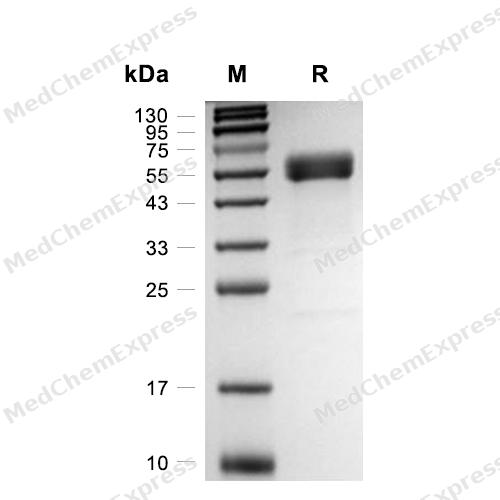
Purity - SDS-PAGE


Technical Parameters
-
Species Human
-
Source HEK293
-
Tag C-6*His
-
Accession
O14745-1 (M1-L358)
-
Gene ID9368
-
Protein Length
Full Length of Isoform-1
-
Synonyms
NHERF1; Solute Carrier Family 9 Isoform A3 Regulatory Factor 1; Prev. SLC9A3R1; Na(+)/H(+) Exchange Regulatory Cofactor 1; NHERF-1; SLC9A3 Regulator 1; NHERF; Solute Carrier Family 9 (Sodium/Hydrogen Exchanger), Isoform 3 Regulatory Factor 1; EBP50; Solut
-
AA Sequence
MSADAAAGAPLPRLCCLEKGPNGYGFHLHGEKGKLGQYIRLVEPGSPAEKAGLLAGDRLVEVNGENVEKETHQQVVSRIRAALNAVRLLVVDPETDEQLQKLGVQVREELLRAQEAPGQAEPPAAAEVQGAGNENEPREADKSHPEQRELRPRLCTMKKGPSGYGFNLHSDKSKPGQFIRSVDPDSPAEASGLRAQDRIVEVNGVCMEGKQHGDVVSAIRAGGDETKLLVVDRETDEFFKKCRVIPSQEHLNGPLPVPFTNGEIQKENSREALAEAALESPRPALVRSASSDTSEELNSQDSPPKQDSTAPSSTSSSDPILDFNISLAMAKERAHQKRSSKRAPQMDWSKKNELFSNL
-
Predicted Molecular Mass
38.9 kDa
-
Molecular Weight
Approximately 48-60 kDa, based on SDS-PAGE under reducing conditions.
-
Purity
≥ 95%, as determined by reducing SDS-PAGE.


Product Properties
Lyophilized powder.
Lyophilized from a 0.22 μm filtered solution of PBS, pH 7.4.
<1 EU/μg, determined by LAL method.
It is not recommended to reconstitute to a concentration less than 100 μg/mL in ddH2O. For long term storage it is recommended to add a carrier protein (0.1% BSA, 5% HSA, 10% FBS or 5% Trehalose).
Stored at -20°C for 2 years from date of receipt. After reconstitution, it is stable at 4°C for 1 week or -20°C for longer (with carrier protein). It is recommended to freeze aliquots at -20°C or -80°C for extended storage.
Room temperature in continental US; may vary elsewhere.


Documentation
-
Data Sheet (238 KB)
-
SDS (251 KB)
- English - EN (251 KB)
- Français - FR (251 KB)
- Deutsch - DE (251 KB)
- Norwegian - NO (251 KB)
- Español - ES (251 KB)
- Swedish - SV (251 KB)
- Italian - IT (251 KB)
- Korean - KR (251 KB)
- Portuguese - PT (251 KB)
-
Handling Instructions (2659 KB)

Calculators
Concentration (start) × Volume (start) = Concentration (final) × Volume (final)


 Powered by Bioz

