



EGFR Protein, Rhesus Macaque (HEK293, His)

Based on 1 Customer Validation
The EGFR protein is a receptor tyrosine kinase that can bind to a variety of ligands, such as EGF, TGFA, AREG, epigen, BTC, epiregulin, and HBEGF, to initiate signaling cascades that mediate cellular responses. This involves receptor dimerization, autophosphorylation and recruitment of adapter proteins such as GRB2, activating downstream pathways such as RAS-RAF-MEK-ERK, PI3-kinase-AKT, PLCgamma-PKC and STAT. EGFR Protein, Rhesus Macaque (HEK293, His) is the recombinant Rhesus Macaque-derived EGFR protein, expressed by HEK293 , with C-10*His labeled tag.
- Species: Rhesus Macaque
- Source: HEK293
-
Storage:Stored at -20°C for 2 years from date of receipt. After reconstitution, it is stable at 4°C for 1 week or -20°C for longer (with carrier protein). It is recommended to freeze aliquots at -20°C or -80°C for extended storage.


To place orders, for customer services and technical support, please contact: MedChemExpress USA
Tel: 609-228-6898 E-mail: [email protected] [email protected]


-
 Biological Activity
-
Technical Parameters
-
Product Properties
- Documentation
- Help & FAQs




Biological Activity
Description
The EGFR protein is a receptor tyrosine kinase that can bind to a variety of ligands, such as EGF, TGFA, AREG, epigen, BTC, epiregulin, and HBEGF, to initiate signaling cascades that mediate cellular responses. This involves receptor dimerization, autophosphorylation and recruitment of adapter proteins such as GRB2, activating downstream pathways such as RAS-RAF-MEK-ERK, PI3-kinase-AKT, PLCgamma-PKC and STAT. EGFR Protein, Rhesus Macaque (HEK293, His) is the recombinant Rhesus Macaque-derived EGFR protein, expressed by HEK293 , with C-10*His labeled tag.
Background
The EGFR protein, a receptor tyrosine kinase, binds ligands of the EGF family, including EGF, TGFA/TGF-alpha, AREG, epigen/EPGN, BTC/betacellulin, epiregulin/EREG, and HBEGF/heparin-binding EGF. This interaction initiates cascades that convert extracellular signals into cellular responses, involving receptor homo- and/or heterodimerization and autophosphorylation on key cytoplasmic residues. The phosphorylated receptor recruits adapter proteins like GRB2, activating downstream signaling cascades, including RAS-RAF-MEK-ERK, PI3 kinase-AKT, PLCgamma-PKC, and STATs modules. Additionally, EGFR may trigger the NF-kappa-B signaling cascade and directly phosphorylate proteins like RGS16, activating its GTPase activity, potentially linking EGF receptor signaling to G protein-coupled receptor signaling. Furthermore, EGFR phosphorylates MUC1, enhancing its interaction with SRC and CTNNB1/beta-catenin. It positively regulates cell migration through interaction with CCDC88A/GIV, retaining EGFR at the cell membrane post-ligand stimulation, thereby promoting EGFR signaling and triggering cell migration. Beyond its canonical functions, EGFR contributes to enhancing learning and memory performance and plays a role in mammalian pain signaling, with isoform 2 potentially acting as an antagonist to EGF action.
Verified Bioactivity
1.This product does not contain protein kinase domain.
2.Immobilized Rhesus Macaque EGFR, at 1 μg/mL (100 μL/well) can bind Anti- EGFR Antibody. The ED50 is 8.347 ng/mL, corresponding to a specific activity is 1.2×10⁵ U/mg
MCE Validation Data
-
Purity - SDS-PAGE
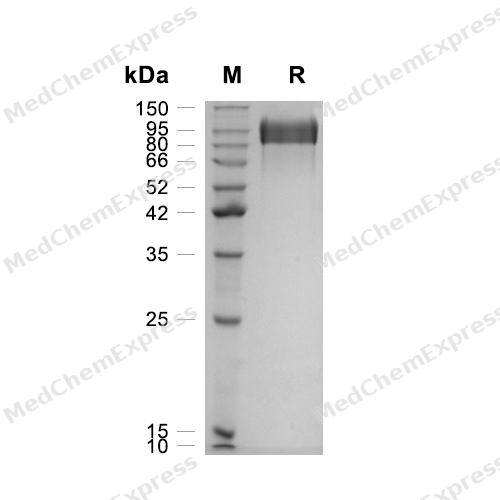
Purity - SDS-PAGE
-
Bioactivity - ELISA
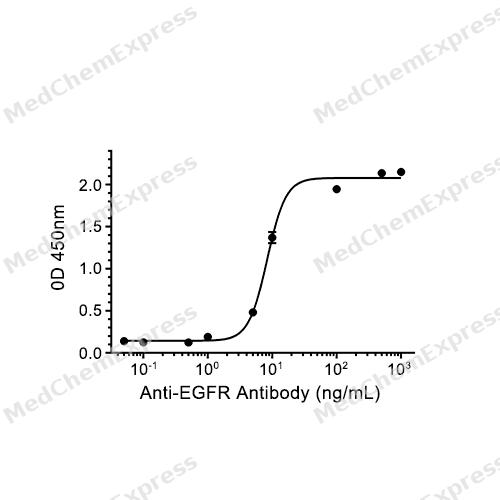
Bioactivity - ELISA


Technical Parameters
-
Species Rhesus Macaque
-
Source HEK293
-
Tag C-10*His
-
Accession
XP_001107305.1 (L25-S645)
-
Molecular Construction
-
N-term
-
EGFR (L25-S645)
Accession # XP_001107305.1 -
10*His
-
C-term
-
-
Protein Length
Partial
-
Synonyms
EGFR; Epidermal Growth Factor Receptor Variant EX12_14del; Prev. ERBB; Cell Proliferation-Inducing Protein 61; ERBB1; Cell Growth Inhibiting Protein 40; ERRP; Receptor Protein-Tyrosine Kinase; Receptor Tyrosine-Protein Kinase ErbB-1; Alternative Protein E
-
AA Sequence
LEEKKVCQGTSNKLTQLGTFEDHFLSLQRMFNNCEVVLGNLEITYVQRNYDLSFLKTIQEVAGYVLIALNTVERIPLENLQIIRGNMYYENSYALAVLSNYDANKTGLKELPMRNLQEILHGAVRFSNNPALCNVESIQWRDIVSSEFLSNMSMDFQNHLGSCQKCDPSCPNGSCWGAGEENCQKLTKIICAQQCSGRCRGKSPSDCCHNQCAAGCTGPRESDCLVCRKFRDEATCKDTCPPLMLYNPTTYQMDVNPEGKYSFGATCVKKCPRNYVVTDHGSCVRACGADSYEMEEDGVRKCKKCEGPCRKVCNGIGIGEFKDTLSINATNIKHFKNCTSISGDLHILPVAFRGDSFTHTPPLDPQELDILKTVKEITGFLLIQAWPENRTDLHAFENLEIIRGRTKQHGQFSLAVVSLNITSLGLRSLKEISDGDVIISGNKNLCYANTINWKKLFGTSSQKTKIISNRGENSCKATGQVCHALCSPEGCWGPEPRDCVSCQNVSRGRECVDKCNVLEGEPREFVENSECIQCHPECLPQVMNITCTGRGPDNCIQCAHYIDGPHCVKTCPAGVMGENNTLVWKYADAGHVCHLCHPNCTYGCTGPGLEGCARNGPKIPS
-
Molecular Weight
Approximately 85-100 kDa, based on SDS-PAGE under reducing conditions, due to the glycosylation.
-
Glycosylation
Yes
-
Purity
≥ 95%, as determined by reducing SDS-PAGE.


Product Properties
Lyophilized powder.
Lyophilized from a 0.22 μm filtered solution of 20 mM PB, 150 mM NaCl, pH 7.4.
<1 EU/μg, determined by LAL method.
It is not recommended to reconstitute to a concentration less than 100 μg/mL in ddH2O.
Stored at -20°C for 2 years from date of receipt. After reconstitution, it is stable at 4°C for 1 week or -20°C for longer (with carrier protein). It is recommended to freeze aliquots at -20°C or -80°C for extended storage.
Room temperature in continental US; may vary elsewhere.


Documentation
-
Data Sheet (240 KB)
-
SDS (254 KB)
- English - EN (254 KB)
- Français - FR (254 KB)
- Deutsch - DE (254 KB)
- Norwegian - NO (254 KB)
- Español - ES (254 KB)
- Swedish - SV (254 KB)
- Italian - IT (254 KB)
- Korean - KR (254 KB)
- Portuguese - PT (254 KB)
-
Handling Instructions (2659 KB)

Calculators
Concentration (start) × Volume (start) = Concentration (final) × Volume (final)


 Powered by Bioz

