



EpCAM/TROP1 Protein, Human (HEK293, His)
Based on 4 publication(s) in Google Scholar
The EpCAM/TROP1 protein serves as an important homogeneous interacting molecule that promotes direct contact between intestinal epithelial cells (IEC) and intraepithelial lymphocytes (IEL) in the mucosal epithelium. This feature helps establish an immune barrier against mucosal infections. EpCAM/TROP1 Protein, Human (HEK293, His) is the recombinant human-derived EpCAM/TROP1 protein, expressed by HEK293 , with C-6*His labeled tag.
- Species: Human
- Source: HEK293
-
Storage:Stored at -20°C for 2 years from date of receipt. After reconstitution, it is stable at 4°C for 1 week or -20°C for longer (with carrier protein). It is recommended to freeze aliquots at -20°C or -80°C for extended storage.


To place orders, for customer services and technical support, please contact: MedChemExpress USA
Tel: 609-228-6898 E-mail: [email protected] [email protected]


-
 Biological Activity
-
Technical Parameters
-
Product Properties
- Documentation
- Help & FAQs




Biological Activity
Description
The EpCAM/TROP1 protein serves as an important homogeneous interacting molecule that promotes direct contact between intestinal epithelial cells (IEC) and intraepithelial lymphocytes (IEL) in the mucosal epithelium. This feature helps establish an immune barrier against mucosal infections. EpCAM/TROP1 Protein, Human (HEK293, His) is the recombinant human-derived EpCAM/TROP1 protein, expressed by HEK293 , with C-6*His labeled tag.
Background
The EpCAM/TROP1 Protein emerges as a pivotal entity, potentially functioning as a physical homophilic interaction molecule that fosters direct contact between intestinal epithelial cells (IECs) and intraepithelial lymphocytes (IELs) at the mucosal epithelium, thereby contributing to the establishment of an immunological barrier as the primary defense against mucosal infections. Beyond its role in mucosal immunity, this protein plays a significant part in the proliferation and differentiation of embryonic stem cells. It further exhibits regulatory influence by up-regulating the expression of FABP5, MYC, and cyclins A and E, implicating EpCAM/TROP1 in the modulation of key cellular processes. Its monomeric nature and interaction with phosphorylated CLDN7 underscore the intricate molecular interactions involved, providing insights into the diverse functions of this protein in cellular physiology.
Verified Bioactivity
Measured by the ability of the immobilized protein to support the adhesion of the L929 cells mouse fibroblast cell line. The ED50 for this effect is 0.7677 μg/mL, corresponding to a specific activity is 1.3×10³ units/mg.
MCE Validation Data
-
Purity - SDS-PAGE
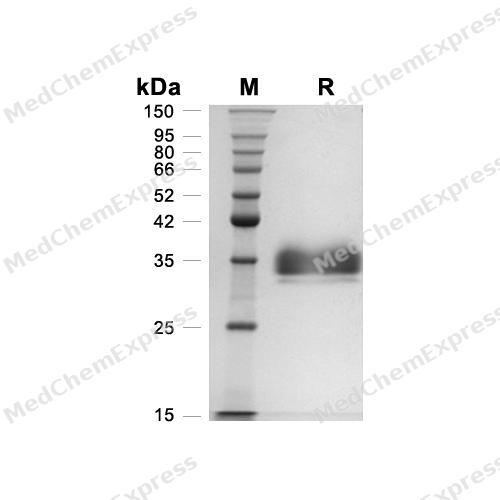
Purity - SDS-PAGE
-
Bioactivity - Cell-Based Assay
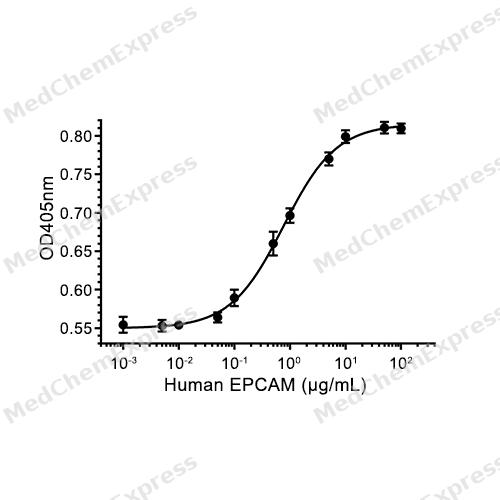
Bioactivity - Cell-Based Assay


Publications (4)
-
Journal Impact Factor
-
Most Recent
-
ACS Nano
Electric Field-Resistant Bubble-Enhanced Wash-Free Profiling of Extracellular Vesicle Surface Markers. [Abstract]2025 Mar 4;19(8):8093-8107. PMID: 39985473 -
-
Biosens Bioelectron
Simultaneous detection of cancerous exosomal miRNA-21 and PD-L1 with a sensitive dual-cycling nanoprobe. [Abstract]2022 Nov 15:216:114636. PMID: 35986985 -
Anal Chim Acta
Isothermal nucleic acid amplification-based magnetic aptasensor for sensitive detection and in situ imaging of Trop-2 in triple-negative breast cancer. [Abstract]2025 Dec 22:1380:344734. PMID: 41241473


Technical Parameters
-
Species Human
-
Source HEK293
-
Tag C-6*His
-
Accession
AAH14785.1 (Q24-K265)
-
Molecular Construction
-
N-term
-
EpCAM (Q24-K265)
Accession # AAH14785.1 -
6*His
-
C-term
-
-
Protein Length
Extracellular Domain
-
Synonyms
EPCAM; HEA125; Prev. TACSTD1; CO-17A; Prev. MIC18; EGP314; Prev. M4S1; EGP34; Tumor-Associated Calcium Signal Transducer 1; CD326; TROP1; MOC31; KSA; 17-1A; GA733-2; Ly74; Ber-Ep4; MH99; Ep-CAM; Membrane Component, Chromosome 4, Surface Marker (35kD Glyco
-
AA Sequence
QEECVCENYKLAVNCFVNNNRQCQCTSVGAQNTVICSKLAAKCLVMKAEMNGSKLGRRAKPEGALQNNDGLYDPDCDESGLFKAKQCNGTSTCWCVNTAGVRRTDKDTEITCSERVRTYWIIIELKHKAREKPYDSKSLRTALQKEITTRYQLDPKFITSILYENNVITIDLVQNSSQKTQNDVDIADVAYYFEKDVKGESLFHSKKMDLTVNGEQLDLDPGQTLIYYVDEKAPEFSMQGLK
-
Molecular Weight
Approximately 31-45 kDa, based on SDS-PAGE under reducing conditions, due to the glycosylation.
-
Glycosylation
Yes
-
Purity
≥ 95%, as determined by reducing SDS-PAGE.


Product Properties
Lyophilized powder.
Lyophilized from a 0.2 μm filtered solution of 20 mM PB, 150 mM NaCl, pH 7.2-7.4.
<1 EU/μg, determined by LAL method.
It is not recommended to reconstitute to a concentration less than 100 μg/mL in ddH2O. For long term storage it is recommended to add a carrier protein (0.1% BSA, 5% HSA, 10% FBS or 5% Trehalose).
Stored at -20°C for 2 years from date of receipt. After reconstitution, it is stable at 4°C for 1 week or -20°C for longer (with carrier protein). It is recommended to freeze aliquots at -20°C or -80°C for extended storage.
Room temperature in continental US; may vary elsewhere.


Documentation
-
Data Sheet (237 KB)
-
SDS (254 KB)
- English - EN (254 KB)
- Français - FR (254 KB)
- Deutsch - DE (254 KB)
- Norwegian - NO (254 KB)
- Español - ES (254 KB)
- Swedish - SV (254 KB)
- Italian - IT (254 KB)
- Korean - KR (254 KB)
- Portuguese - PT (254 KB)
-
Handling Instructions (2659 KB)

Calculators
Concentration (start) × Volume (start) = Concentration (final) × Volume (final)


 Powered by Bioz

