



FAM3D Protein, Mouse (HEK293, His)

Based on 1 Customer Validation
FAM3D protein is part of the FAM3 family and plays an important role in cell signaling as a transmembrane ligand in the ephrin family.FAM3D interacts with its Eph receptor, initiates bidirectional signaling, regulates multiple cellular processes in development, and is involved in tissue boundary formation, axon guidance, angiogenesis, and synaptic plasticity.FAM3D Protein, Mouse (HEK293, His) is the recombinant mouse-derived FAM3D protein, expressed by HEK293 , with C-10*His labeled tag.
- Species: Mouse
- Source: HEK293
-
Storage:Stored at -20°C for 2 years from date of receipt. After reconstitution, it is stable at 4°C for 1 week or -20°C for longer (with carrier protein). It is recommended to freeze aliquots at -20°C or -80°C for extended storage.


To place orders, for customer services and technical support, please contact: MedChemExpress USA
Tel: 609-228-6898 E-mail: [email protected] [email protected]


-
 Biological Activity
-
Technical Parameters
-
Product Properties
- Documentation
- Help & FAQs




Biological Activity
Description
FAM3D protein is part of the FAM3 family and plays an important role in cell signaling as a transmembrane ligand in the ephrin family.FAM3D interacts with its Eph receptor, initiates bidirectional signaling, regulates multiple cellular processes in development, and is involved in tissue boundary formation, axon guidance, angiogenesis, and synaptic plasticity.FAM3D Protein, Mouse (HEK293, His) is the recombinant mouse-derived FAM3D protein, expressed by HEK293 , with C-10*His labeled tag.
Background
FAM3D Protein belongs to the FAM3 family. It is a member of the ephrin family, which consists of proteins that play crucial roles in cellular signaling and communication. FAM3D specifically functions as a transmembrane ligand, interacting with its corresponding Eph receptor to initiate bidirectional signaling events that regulate a wide range of cellular processes. This protein is involved in various developmental processes such as tissue boundary formation, axon guidance, angiogenesis, and synaptic plasticity. Furthermore, FAM3D has been implicated in several pathological conditions, including cancer, cardiovascular diseases, and neurological disorders, thereby making it a potential target for therapeutic intervention.
MCE Validation Data
-
Purity - SDS-PAGE
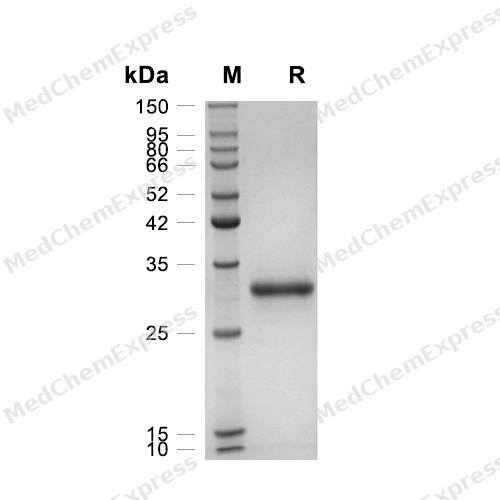
Purity - SDS-PAGE


Technical Parameters
-
Species Mouse
-
Source HEK293
-
Tag C-10*His
-
Accession
P97805 (Y26-M223)
-
Molecular Construction
-
N-term
-
FAM3D (Y26-M223)
Accession # P97805 -
10*His
-
C-term
-
-
Protein Length
Full Length of Mature Protein
-
Synonyms
FAM3D; Oncoprotein-Induced Transcript 1; FAM3 Metabolism Regulating Signaling Molecule D; Protein FAM3D; OIT1; Family With Sequence Similarity 3, Member D; EF7; Cytokine-Like Protein EF-7; Family With Sequence Similarity 3 Member D
-
AA Sequence
YTSFSRKTIRLPRWLGITPKDIQTPKSKCGLSKICPNNFFAFKISSGAANVVGPSMCFEDEIIMSPVRNNVGRGLNVALVNGSTGQVMKKDSFDMYSGDPQLLLNFLTEIPDSTLVLVASYDDPGTKMNDKIKTLFSNLGSSYAKQLGFRDSWVFVGAKDLKSKSPYEQFLKNNPETNKYDGWPELLELEGCVPRKVM
-
Predicted Molecular Mass
23.4 kDa
-
Molecular Weight
Approximately 31 kDa, based on SDS-PAGE under reducing conditions, due to the glycosylation.
-
Glycosylation
Yes
-
Purity
≥ 90%, as determined by reducing SDS-PAGE.


Product Properties
Lyophilized powder.
Lyophilized from sterile PBS, pH 7.4 . Normally 5 % - 8 % trehalose, mannitol and 0.01% Tween 80 are added as protectants before lyophilization.
<1 EU/μg, determined by LAL method.
It is not recommended to reconstitute to a concentration less than 100 μg/mL in ddH2O.
Stored at -20°C for 2 years from date of receipt. After reconstitution, it is stable at 4°C for 1 week or -20°C for longer (with carrier protein). It is recommended to freeze aliquots at -20°C or -80°C for extended storage.
Room temperature in continental US; may vary elsewhere.


Documentation
-
Data Sheet (236 KB)
-
SDS (252 KB)
- English - EN (252 KB)
- Français - FR (252 KB)
- Deutsch - DE (252 KB)
- Norwegian - NO (252 KB)
- Español - ES (252 KB)
- Swedish - SV (252 KB)
- Italian - IT (252 KB)
- Korean - KR (252 KB)
- Portuguese - PT (252 KB)
-
Handling Instructions (2659 KB)

Calculators
Concentration (start) × Volume (start) = Concentration (final) × Volume (final)


 Powered by Bioz

