



Fc gamma RIIIA/CD16a Protein, Rat (HEK293, His)

Based on 1 Customer Validation
Fc γ RIIIA/CD16a is a receptor for the invariant Fc fragment of immunoglobulin γ (IgG). Fc γ RIIIA/CD16a regulates NK cell survival and proliferation and prevents NK cell progenitor cell apoptosis. Fc γ RIIIA/CD16a plays a role in mediating the anti-tumor activity of therapeutic antibodies by triggering TNFA-dependent ADCC, which promotes the entry of the virus into bone marrow cells during secondary infection and subsequent viral replication through antibody-dependent enhancement (ADE). Fc gamma RIIIA/CD16a Protein, Rat (HEK293, His) is the recombinant rat-derived Fc gamma RIIIA/CD16a, expressed by HEK293, with C-His labeled tag.
- Species: Rat
- Source: HEK293
-
Storage:Stored at -20°C for 2 years from date of receipt. After reconstitution, it is stable at 4°C for 1 week or -20°C for longer (with carrier protein). It is recommended to freeze aliquots at -20°C or -80°C for extended storage.


To place orders, for customer services and technical support, please contact: MedChemExpress USA
Tel: 609-228-6898 E-mail: [email protected] [email protected]


-
 Biological Activity
-
Technical Parameters
-
Product Properties
- Documentation
- References
- Help & FAQs




Biological Activity
Description
Fc γ RIIIA/CD16a is a receptor for the invariant Fc fragment of immunoglobulin γ (IgG). Fc γ RIIIA/CD16a regulates NK cell survival and proliferation and prevents NK cell progenitor cell apoptosis. Fc γ RIIIA/CD16a plays a role in mediating the anti-tumor activity of therapeutic antibodies by triggering TNFA-dependent ADCC, which promotes the entry of the virus into bone marrow cells during secondary infection and subsequent viral replication through antibody-dependent enhancement (ADE). Fc gamma RIIIA/CD16a Protein, Rat (HEK293, His) is the recombinant rat-derived Fc gamma RIIIA/CD16a, expressed by HEK293, with C-His labeled tag.
Background
The Fc γ RIIIA/CD16a protein is a receptor for the invariant Fc fragment of immunoglobulin γ (IgG) and is optimally activated upon binding to the aggregation antigen-igg complex displayed on the cell surface, initiating antibody-dependent cytotoxicity (ADCC). Fc γ RIIIA/CD16a mediates IgG effects on natural killer (NK) cells, binding to antigen-igg complexes produced during infection, triggering NK cell-dependent cytokine production and degranulation. Fc γ RIIIA/CD16a plays a crucial role in the generation of memory-like adaptive NK cells, regulating NK cell survival and proliferation, and preventing NK cell progenitor cell apoptosis. Fc γ RIIIA/CD16a plays a role in mediating the antitumor activity of therapeutic antibodies, triggering TNFA-dependent ADCC in IgG-coated tumor cells and enhancing ADCC in response to focused IgG. Fc γ RIIIA/CD16a is involved in pathogenesis through an antibody-dependent enhancement (ADE) mechanism that promotes the entry of the virus into bone marrow cells during secondary infection and subsequent viral replication[1][2][3].
Verified Bioactivity
Measured by its binding ability in a functional ELISA. Immobilized Rat CD16a protein at 10 μg/mL (100 μL/well) can bind Human IgG1. The ED50 for this effect is 93.49 ng/mL.
MCE Validation Data
-
Purity - SDS-PAGE
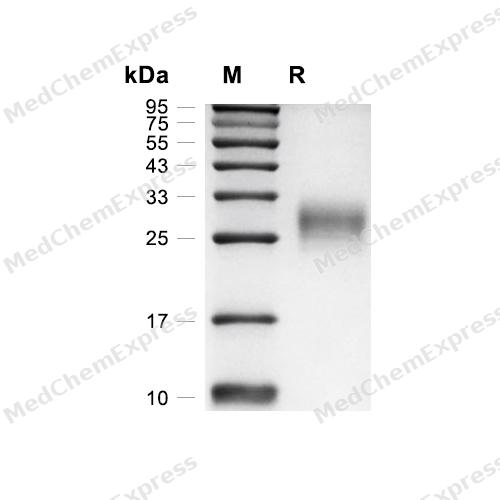
Purity - SDS-PAGE


Technical Parameters
-
Species Rat
-
Source HEK293
-
Tag C-His
-
Accession
XP_008767961.1 (L22-P200)
-
Gene ID304966
-
Protein Length
Partial
-
Synonyms
FCGR3A; CD16; Prev. FCGR3; Fc Fragment Of IgG, Low Affinity IIIa, Receptor For (CD16); Prev. FCG3; Fc Of IgG Low Affinity IIIa Receptor Isoform 2; FcgammaRIIIa; Fc Of IgG Low Affinity IIIa Receptor Isoform 1; FcGRIIIA; Immunoglobulin G Fc Receptor III; CD
-
AA Sequence
LQKAVVILDPEWVRVLEEDCVILRCQGTFSPEDNSTKWFHNKSLISHQDANYVIQSARVKDSGMYRCQTAFSALSDPVQLDVHADWLLLQTTKRLFQEGDPIRLRCHSWRNTPVFKVTYLQNGKGKKYFHRNSELSISKATHADSGSYFCRGIIGRNNISSASLQISIGDPTSPSSFLP
-
Predicted Molecular Mass
20.3 kDa
-
Molecular Weight
Approximately 27-32 kDa, based on SDS-PAGE under reducing conditions, due to the glycosylation.
-
Purity
≥ 95%, as determined by reducing SDS-PAGE.


Product Properties
Lyophilized powder.
Lyophilized from a 0.22 μm filtered solution of PBS, pH 7.4.
<1 EU/μg, determined by LAL method.
It is not recommended to reconstitute to a concentration less than 100 μg/mL in ddH2O. For long term storage it is recommended to add a carrier protein (0.1% BSA, 5% HSA, 10% FBS or 5% Trehalose).
Stored at -20°C for 2 years from date of receipt. After reconstitution, it is stable at 4°C for 1 week or -20°C for longer (with carrier protein). It is recommended to freeze aliquots at -20°C or -80°C for extended storage.
Room temperature in continental US; may vary elsewhere.


Documentation
-
Data Sheet (264 KB)
-
SDS (254 KB)
- English - EN (254 KB)
- Français - FR (254 KB)
- Deutsch - DE (254 KB)
- Norwegian - NO (254 KB)
- Español - ES (254 KB)
- Swedish - SV (254 KB)
- Italian - IT (254 KB)
- Korean - KR (254 KB)
- Portuguese - PT (254 KB)
-
Handling Instructions (2659 KB)


References
[1]. Mao C, et al. Cross-species higher sensitivities of FcγRIIIA/FcγRIV to afucosylated IgG for enhanced ADCC. Antib Ther. 2021 Aug 19;4(3):159-170. [Content Brief]
[2]. Vivier E, et al. Structure and function of the CD16:zeta:gamma complex expressed on human natural-killer cells. Int J Cancer Suppl. 1992;7:11-4. [Content Brief]
[3]. Musolino A, et al. Role of Fcγ receptors in HER2-targeted breast cancer therapy. J Immunother Cancer. 2022 Jan;10(1):e003171. doi: 10.1136/jitc-2021-003171. [Content Brief]

Calculators
Concentration (start) × Volume (start) = Concentration (final) × Volume (final)


 Powered by Bioz

