



Gastrin-71 Protein, Mouse (HEK293, Fc)

Based on 1 Customer Validation
Gastrin-71 protein acts as a potent stimulator of various physiological processes. It activates the gastric mucosa, promotes the production and secretion of hydrochloric acid, and induces the release of digestive enzymes from the pancreas. Gastrin-71 Protein, Mouse (HEK293, Fc) is the recombinant mouse-derived Gastrin-71 protein, expressed by HEK293 , with C-hFc labeled tag.
- Species: Mouse
- Source: HEK293
-
Storage:Stored at -20°C for 2 years from date of receipt. After reconstitution, it is stable at 4°C for 1 week or -20°C for longer (with carrier protein). It is recommended to freeze aliquots at -20°C or -80°C for extended storage.


To place orders, for customer services and technical support, please contact: MedChemExpress USA
Tel: 609-228-6898 E-mail: [email protected] [email protected]


-
 Biological Activity
-
Technical Parameters
-
Product Properties
- Documentation
- Help & FAQs




Biological Activity
Description
Gastrin-71 protein acts as a potent stimulator of various physiological processes. It activates the gastric mucosa, promotes the production and secretion of hydrochloric acid, and induces the release of digestive enzymes from the pancreas. Gastrin-71 Protein, Mouse (HEK293, Fc) is the recombinant mouse-derived Gastrin-71 protein, expressed by HEK293 , with C-hFc labeled tag.
Background
Gastrin-71 is a peptide hormone belonging to the gastrin family, playing a vital role in the regulation of gastrointestinal functions. Known for its stimulatory effects, gastrin prompts the stomach mucosa to produce and secrete hydrochloric acid, essential for the digestion of food. Additionally, it influences the pancreas, triggering the secretion of digestive enzymes crucial for nutrient breakdown. Gastrin-71 further contributes to gastrointestinal dynamics by stimulating smooth muscle contraction, enhancing blood circulation, and increasing water secretion in both the stomach and intestine. These multifaceted actions highlight the importance of Gastrin-71 in orchestrating various physiological processes crucial for efficient digestion and nutrient absorption.
Verified Bioactivity
Measured in a cell proliferation assay using HT-29 human coloncancer cells.The ED50 for this effect is 1.093 ng/mL, corresponding to a specificactivity is 9.15×10⁵ Unit/mg.
MCE Validation Data
-
Purity - SDS-PAGE
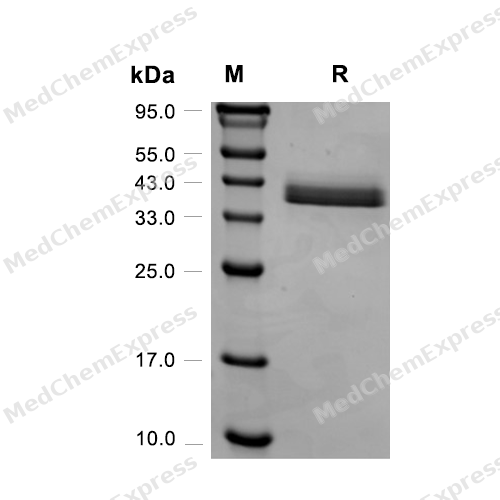
Purity - SDS-PAGE
-
Bioactivity - Cell-Based Assay
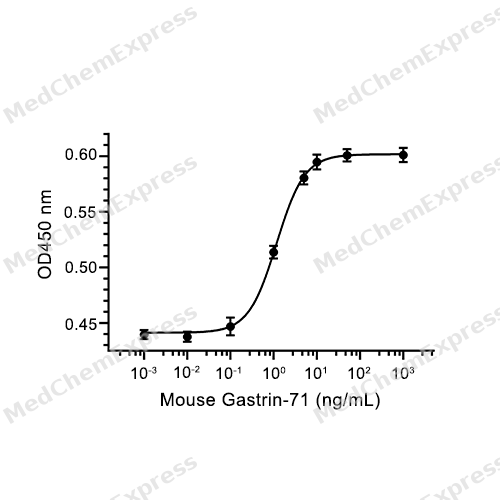
Bioactivity - Cell-Based Assay


Technical Parameters
-
Species Mouse
-
Source HEK293
-
Tag C-hFc
-
Accession
P48757 (S22-F92)
-
Molecular Construction
-
N-term
-
Gastrin-71 (S22-F92)
Accession # P48757 -
hFc
-
C-term
-
-
Protein Length
Full Length of Mature Protein
-
Synonyms
GAST; Prev. GAS; Gastrin; Preprogastrin; Gastrin-71; Gastrin component
-
AA Sequence
SWKPRSQLQDASSGPGTNEDLEQRQFNKLGSASHHRRQLGPQGPQHFIADLSKKQRPRMEEEEEAYGWMDF
-
Predicted Molecular Mass
34.3 kDa
-
Molecular Weight
Approximately 38-43 kDa, based on SDS-PAGE under reducing conditions.
-
Purity
≥ 95%, as determined by reducing SDS-PAGE.


Product Properties
Lyophilized powder.
Lyophilized from a 0.22 μm filtered solution of PBS, 200 mM arginine, pH 7.4.
<1 EU/μg, determined by LAL method.
It is not recommended to reconstitute to a concentration less than 100 μg/mL in ddH2O. For long term storage it is recommended to add a carrier protein (0.1% BSA, 5% HSA, 10% FBS or 5% Trehalose).
Stored at -20°C for 2 years from date of receipt. After reconstitution, it is stable at 4°C for 1 week or -20°C for longer (with carrier protein). It is recommended to freeze aliquots at -20°C or -80°C for extended storage.
Room temperature in continental US; may vary elsewhere.


Documentation
-
Data Sheet (235 KB)
-
SDS (251 KB)
- English - EN (251 KB)
- Français - FR (251 KB)
- Deutsch - DE (251 KB)
- Norwegian - NO (251 KB)
- Español - ES (251 KB)
- Swedish - SV (251 KB)
- Italian - IT (251 KB)
- Korean - KR (251 KB)
- Portuguese - PT (251 KB)
-
Handling Instructions (2659 KB)

Calculators
Concentration (start) × Volume (start) = Concentration (final) × Volume (final)


 Powered by Bioz

