



GLA/alpha-Galactosidase A Protein, Mouse (HEK293, His)
Based on 1 Customer Validation
GLA/alpha-Galactosidase A Protein is responsible for the breakdown of alpha-galactoside in the lysosome. GLA/alpha-Galactosidase A Protein participates in the negative regulation of nitric oxide biosynthesis and nitric oxide synthase activity. A deficiency of GLA/alpha-Galactosidase A Protein causes Fabry disease. GLA/alpha-Galactosidase A Protein, Mouse (HEK293, His) is the recombinant mouse-derived GLA/alpha-Galactosidase A protein, expressed by HEK293 , with C-His labeled tag.
- Species: Mouse
- Source: HEK293
-
Storage:Stored at -20°C for 2 years from date of receipt. After reconstitution, it is stable at 4°C for 1 week or -20°C for longer (with carrier protein). It is recommended to freeze aliquots at -20°C or -80°C for extended storage.


To place orders, for customer services and technical support, please contact: MedChemExpress USA
Tel: 609-228-6898 E-mail: [email protected] [email protected]


-
 Biological Activity
-
Technical Parameters
-
Product Properties
- Documentation
- Help & FAQs




Biological Activity
Description
GLA/alpha-Galactosidase A Protein is responsible for the breakdown of alpha-galactoside in the lysosome. GLA/alpha-Galactosidase A Protein participates in the negative regulation of nitric oxide biosynthesis and nitric oxide synthase activity. A deficiency of GLA/alpha-Galactosidase A Protein causes Fabry disease. GLA/alpha-Galactosidase A Protein, Mouse (HEK293, His) is the recombinant mouse-derived GLA/alpha-Galactosidase A protein, expressed by HEK293 , with C-His labeled tag.
Background
Alpha-galactosidase A is responsible for the breakdown of alpha-galactoside in lysosomes and is homologous to human galactosidase (GLA). GLA is involved in the negative regulation of nitric oxide biosynthesis and nitric oxide synthase activity. GLA acts upstream or internally in the catabolic process of glycosylceramide. Mice deficient in alpha-galactosidase A exhibit age-dependent and distinct sensory system deficits. This is a lysosome storage disorder characterized by the accumulation of alpha-galactosylated substrates in tissues. Alpha-galactosidase A is an active target of clinical research: there are currently two treatment options for Fabry disease, recombinant enzyme replacement therapy and drug companion therapy. Tlr-dependent alpha-Gal-A negative regulation is the mechanistic link between pathogen recognition and autolipid antigen induction in NKT cells[1][2][3][4].
Verified Bioactivity
Measured by its ability to hydrolyze 4-methylumbelliferyl-alpha-D-galactopyranoside. The specific activity is 833.54 pmoL/min/µg, as measured under the described conditions.
MCE Validation Data
-
Purity - SDS-PAGE
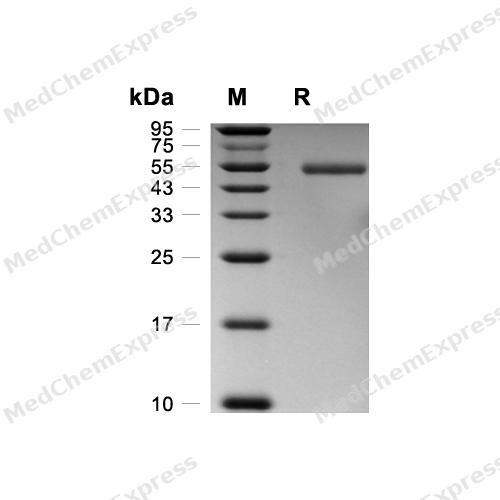
Purity - SDS-PAGE


Technical Parameters
-
Species Mouse
-
Source HEK293
-
Tag C-His
-
Accession
Q8BGZ6 (L34-R421)
-
Molecular Construction
-
N-term
-
GLA (L34-R421)
Accession # Q8BGZ6 -
His
-
C-term
-
-
Protein Length
Full Length of Mature Protein
-
Synonyms
GLA; Alpha-D-Galactoside Galactohydrolase 1; Galactosidase Alpha; Alpha-D-Galactoside Galactohydrolase; GALA; Galactosidase, Alpha; Galactosylgalactosylglucosylceramidase GLA; Alpha-Galactosidase; Alpha-D-Galactosidase A; Agalsidase Alfa; Alpha-Galactosid
-
AA Sequence
LDNGLARTPTMGWLHWERFMCNLDCQEEPDACISEQLFMQMAELMVSDGWRDAGYDYLCIDDCWMAPERDSKGRLQADPQRFPSGIKHLANYVHSKGLKLGIYADVGNKTCAGFPGSFGSYDIDAQTFADWGVDLLKFDGCHCDSVVSLENGYKYMALALNRTGRSIVYSCEWPLYLRPFHKPNYTDIQYYCNHWRNFDDVYDSWESIKNILSWTVVYQKEIVEVAGPGSWNDPDMLVIGNFGLSWDQQVTQMALWAIMAAPLLMSNDLRQISSQAKALLQNKDVIAINQDPLGKQGYCFRKENHIEVWERPLSNLAWAVAVRNLQEIGGPCPYTIQISSLGRGLACNPGCIITQLLPEKVHLGFYEWTLTLKTRVNPSGTVLFRLER
-
Molecular Weight
Approximately 46-52 kDa, based on SDS-PAGE under reducing conditions, due to the glycosylation.
-
Purity
≥ 95%, as determined by reducing SDS-PAGE.


Product Properties
Lyophilized powder.
Lyophilized from a 0.22 μm filtered solution of PBS, pH 7.4.
<1 EU/μg, determined by LAL method.
It is not recommended to reconstitute to a concentration less than 100 μg/mL in ddH2O. For long term storage it is recommended to add a carrier protein (0.1% BSA, 5% HSA, 10% FBS or 5% Trehalose).
Stored at -20°C for 2 years from date of receipt. After reconstitution, it is stable at 4°C for 1 week or -20°C for longer (with carrier protein). It is recommended to freeze aliquots at -20°C or -80°C for extended storage.
Room temperature in continental US; may vary elsewhere.


Documentation
-
Data Sheet (238 KB)
-
SDS (254 KB)
- English - EN (254 KB)
- Français - FR (254 KB)
- Deutsch - DE (254 KB)
- Norwegian - NO (254 KB)
- Español - ES (254 KB)
- Swedish - SV (254 KB)
- Italian - IT (254 KB)
- Korean - KR (254 KB)
- Portuguese - PT (254 KB)
-
Handling Instructions (2659 KB)

Calculators
Concentration (start) × Volume (start) = Concentration (final) × Volume (final)


 Powered by Bioz

