



GRO-alpha/CXCL1 Protein, Mouse
Based on 1 publication(s) in Google Scholar
CXCL1 (Chemokine (C-X-C motif) ligand 1), also known as GRO alpha, NAP-3 or MGSA, belongs to the sub-family of CXC chemokine. CXCL1 is involved in the development of many inflammatory diseases, including the induction of angiogenesis and recruitment of neutrophils. CXCL1 is produced by many cell types, and activates CXCR2 and, at high levels, CXCR1. GRO-alpha/CXCL1 Protein, Mouse is produced in E. coli, and consists of 72 amino acids (A25-N96).
- Species: Mouse
- Source: E. coli
-
Storage:Stored at -20°C for 2 years from date of receipt. After reconstitution, it is stable at 4°C for 1 week or -20°C for longer (with carrier protein). It is recommended to freeze aliquots at -20°C or -80°C for extended storage.


To place orders, for customer services and technical support, please contact: MedChemExpress USA
Tel: 609-228-6898 E-mail: [email protected] [email protected]


-
 Biological Activity
-
Technical Parameters
-
Product Properties
- Documentation
- References
- Help & FAQs


-

HY-P7258
MIP-2/CXCL2 Protein, Mouse -
HY-P7764
MCP-1/CCL2 Protein, Mouse -
HY-P7073
IL-1 beta Protein, Mouse -
HY-135748
Polyinosinic-polycytidylic acid sodium -
HY-14648
Dexamethasone -
HY-B0445
NAD+ -
HY-P7072
IL-1 alpha Protein, Mouse -
HY-P72791
LIX/CXCL5 Protein, Mouse -
HY-P71889
CCL4 Protein, Mouse -
HY-P70664
Irisin Protein, Human/Mouse/Rat (HEK293, His) -
HY-P7063
IL-6 Protein, Mouse -
HY-P7071
IFN-gamma Protein, Mouse


Biological Activity
Description
CXCL1 (Chemokine (C-X-C motif) ligand 1), also known as GRO alpha, NAP-3 or MGSA, belongs to the sub-family of CXC chemokine. CXCL1 is involved in the development of many inflammatory diseases, including the induction of angiogenesis and recruitment of neutrophils. CXCL1 is produced by many cell types, and activates CXCR2 and, at high levels, CXCR1[1]. GRO-alpha/CXCL1 Protein, Mouse is produced in E. coli, and consists of 72 amino acids (A25-N96).
Background
CXCL1, also known as GRO-α, is a polypeptide that is initially isolated from human melanoma cells. CXCL1 acts as a key chemoattractant for neutrophils by binding specifically to its corresponding G-protein-coupled receptor CXCR2. CXCL1 modulates angiogenesis, tumorigenesis, and wound healing. In general, CXCL1 levels are extremely low under normal physiological conditions and greatly increased during inflammatory conditions[2][3].
The amino acid sequence of human CXCL1 protein has low homology between mouse and rat CXCL1 protein.
After translation, the synthesized CXCL1 precursor is 107aa long. A signal peptide is removed from its N-terminus, which shortens the precursor to 73aa. Two other amino acids can also be removed from the C-terminus. In addition, two disulfide bridges are formed from all four cysteine residues in CXCL1. The disulfide bridges give the appropriate structure to CXCL1, which determines the properties of this chemokine. After secretion, CXCL1 undergoes further proteolytic processing, which regulates the activity of this chemokine. From the N-terminus, three, four or five amino acids are removed, which produce CXCL1(4-73), CXCL1(5-73), and CXCL1(6-73), respectively. This increases CXCL1 activity 30 times, as measured by its ability to induce the chemotaxis of treated cells. To date, three CXCL1 receptors have been discovered-CXCR1, CXCR2 and atypical chemokine receptor 1 (ACKR1). Through NF-κB activation, CXCL1 expression is increased by cytokines such as IL-1β, TNF-α and IL-17. CXCL1 can associate into bioactive dimers and primarily signals through CXCR2/IL-8 RB[1].
After CXCL1 expression is induced by carcinogens, it participates in inflammatory responses by recruiting neutrophils. This leads to chronic inflammation. In addition to increasing proliferation, CXCL1 also induces cancer cell migration, particularly EMT. Produced by lymphatic endothelial cells (LECs), CXCL1 enables tumor cell migration into the lymphatic vessels during lymphangiogenesis, leading to lymph node metastasis. CXCL1 is a chemotactic factor for neutrophils. Additionally, it causes the mobilization of these cells from the bone marrow. CXCL1 can also induce recruitment of regulatory T cells (Treg) and MSCs into the tumor niche. Another no-less-important property of CXCL1 is its ability to induce angiogenesis[1].
In Vitro
Recombinant mouse CXCL1 (0.25-250 ng/mL; incubated for 4-6 days) has no effect on CD3 stimulated T cell proliferation[4].
In Vivo
Recombinant mouse CXCL1 (300 pg; once) is intravenously injected into SCD mice. The results shows that CXCL1 induces acute vaso-occlusive crisis[5].
Recombinant mouse CXCL1 is injected intra-plantar in the right hindpaws of normal mice 100 ng/15 μL. Intraplantar injection of mouse recombinant CXCL1 induces mechanical allodynia in naive mice, without thermal sensitization[6].
Verified Bioactivity
1.Full biological activity determined by a chemotaxis bioassay using human peripheral blood neutrophils is in a concentration range of 10-100 ng/mL.
2.Measured in a cell proliferation assay using HUVEC. The ED50 for this effect is 0.5-1 ng/mL.
3.Measured by its ability to chemoattract BaF3 mouse pro-B cells transfected with human CXCR2. The ED50 for this effect is 3.722-3.979 ng/mL, corresponding to a specific activity is 2.513×10⁵-2.687×10⁵ U/mg.
MCE Validation Data
-
Purity - SDS-PAGE
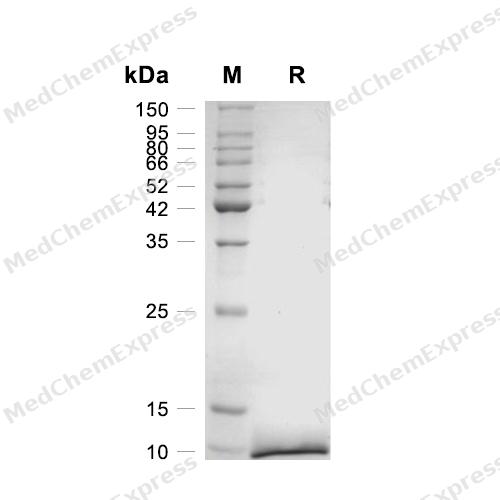
Purity - SDS-PAGE
-
Bioactivity - Cell-Based Assay
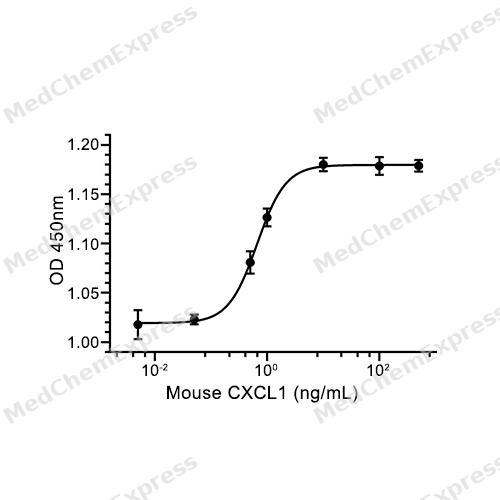
Bioactivity - Cell-Based Assay


Publications (1)
-
Journal Impact Factor
-
Most Recent
-
Acta Pharmacol Sin
CXCR2 modulates chronic pain comorbid depression in mice by regulating adult neurogenesis in the ventral dentate gyrus. [Abstract]2025 Jun;46(6):1567-1579. PMID: 39972170
GRO-alpha/CXCL1 Protein, Mouse purchased from MedChemExpress. Usage Cited in: Acta Pharmacol Sin. 2025 Jun;46(6):1567-1579. [Abstract]
GRO-alpha/CXCL1 Protein, Mouse (3 mg/mL; 400 nL; micro-syringe pump into the ventral DG; for 15 consecutive days during the period from day 5 to day 19) increased mRNA levels of Dcx in the ventral DG after the SNI surgery mice.

GRO-alpha/CXCL1 Protein, Mouse purchased from MedChemExpress. Usage Cited in: Acta Pharmacol Sin. 2025 Jun;46(6):1567-1579. [Abstract]
GRO-alpha/CXCL1 Protein, Mouse (3 mg/mL; 400 nL; micro-syringe pump into the ventral DG; for 15 consecutive days during the period from day 5 to day 19) increased protein levels of Dcx in the ventral DG after the SNI surgery mice.

GRO-alpha/CXCL1 Protein, Mouse purchased from MedChemExpress. Usage Cited in: Acta Pharmacol Sin. 2025 Jun;46(6):1567-1579. [Abstract]
GRO-alpha/CXCL1 Protein, Mouse (3 mg/mL; 400 nL; micro-syringe pump into the ventral DG; for 15 consecutive days during the period from day 5 to day 19) promoted both proliferation and neuronal differentiation of NSCs by increasing the number of Ki67+ cells and BrdU+DCX+ cells in the ventral DG of SNI mice.

GRO-alpha/CXCL1 Protein, Mouse purchased from MedChemExpress. Usage Cited in: Acta Pharmacol Sin. 2025 Jun;46(6):1567-1579. [Abstract]
GRO-alpha/CXCL1 Protein, Mouse (3 mg/mL; 400 nL; micro-syringe pump into the ventral DG; for 15 consecutive days during the period from day 5 to day 19) increased the mRNA expression of Wnt3a and β-catenin in the ventral DG of SNI mice.

GRO-alpha/CXCL1 Protein, Mouse purchased from MedChemExpress. Usage Cited in: Acta Pharmacol Sin. 2025 Jun;46(6):1567-1579. [Abstract]
GRO-alpha/CXCL1 Protein, Mouse (3 mg/mL; 400 nL; micro-syringe pump into the ventral DG; for 15 consecutive days during the period from day 5 to day 19) increased the protein expression of Wnt3a and β-catenin in the ventral DG of SNI mice.


Technical Parameters
-
Species Mouse
-
Source E. coli
-
Tag Tag Free
-
Accession
P12850 (A25-K96)
-
Molecular Construction
-
N-term
-
CXCL1 (A25-K96)
Accession # P12850 -
C-term
-
-
Protein Length
Full Length of Mature Protein
-
Synonyms
CXCL1; Neutrophil-Activating Protein 3; Prev. GRO1; Fibroblast Secretory Protein; Prev. MGSA; C-X-C Motif Chemokine 1; Prev. FSP; GRO-Alpha(1-73); SCYB1; GRO1 Oncogene (Melanoma Growth-Stimulating Activity); NAP-3; Melanoma Growth Stimulatory Activity Alp
-
AA Sequence
APIANELRCQCLQTMAGIHLKNIQSLKVLPSGPHCTQTEVIATLKNGREACLDPEAPLVQKIVQKMLKGVPK
-
Predicted Molecular Mass
7.8 kDa
-
Molecular Weight
Approximately 9 kDa, based on SDS-PAGE under reducing conditions.
-
Purity
≥ 95%, as determined by reducing SDS-PAGE.


Product Properties
Lyophilized powder
1.Lyophilized from a 0.22 μm filtered solution of PBS, pH 7.4.
2.Lyophilized from a 0.22 μm filtered solution of 20 mM PB, 150 mM NaCl, pH 7.4.
3.Lyophilized from a 0.22 μm filtered solution of PBS, pH 7.4, 8% trehalose.
Please refer to the lot-specific COA for specific buffer information.
<1 EU/μg, determined by LAL method.
It is not recommended to reconstitute to a concentration less than 100 μg/mL in ddH2O. For long term storage it is recommended to add a carrier protein (0.1% BSA, 5% HSA, 10% FBS or 5% Trehalose).
Stored at -20°C for 2 years from date of receipt. After reconstitution, it is stable at 4°C for 1 week or -20°C for longer (with carrier protein). It is recommended to freeze aliquots at -20°C or -80°C for extended storage.
Room temperature in continental US; may vary elsewhere.


Documentation
-
Data Sheet (265 KB)
-
SDS (252 KB)
- English - EN (252 KB)
- Français - FR (252 KB)
- Deutsch - DE (252 KB)
- Norwegian - NO (252 KB)
- Español - ES (252 KB)
- Swedish - SV (252 KB)
- Italian - IT (252 KB)
- Korean - KR (252 KB)
- Portuguese - PT (252 KB)
-
Handling Instructions (2659 KB)


References
[1]. Jan Korbecki, et al. CXCL1: Gene, Promoter, Regulation of Expression, mRNA Stability, Regulation of Activity in the Intercellular Space. Int J Mol Sci. 2022 Jan 12;23(2):792. [Content Brief]
[2]. Dhawan P, et al. Role of CXCL1 in tumorigenesis of melanoma. J Leukoc Biol. 2002 Jul;72(1):9-18. [Content Brief]
[3]. Sheng-Mou Hou, et al. CXCL1 contributes to IL-6 expression in osteoarthritis and rheumatoid arthritis synovial fibroblasts by CXCR2, c-Raf, MAPK, and AP-1 pathway. Arthritis Res Ther. 2020 Oct 21;22(1):251. [Content Brief]
[4]. Huey-ming Lo, et al. TNF-α induces CXCL1 chemokine expression and release in human vascular endothelial cells in vitro via two distinct signaling pathways. Acta Pharmacol Sin. 2014 Mar;35(3):339-50. [Content Brief]
[5]. M Kouwenberg, et al. Reduced CXCL1 production by endogenous IL-37 expressing dendritic cells does not affect T cell activation. PLoS One. 2021 May 24;16(5):e0251809. [Content Brief]
[6]. Jung-Eun Jang, et al. CXCL1 and its receptor, CXCR2, mediate murine sickle cell vaso-occlusion during hemolytic transfusion reactions. J Clin Invest. 2011 Apr;121(4):1397-401. [Content Brief]
[7]. Yuan Sun, et al. Opioids enhance CXCL1 expression and function after incision in mice. J Pain. 2014 Aug;15(8):856-66. [Content Brief]

Calculators
Concentration (start) × Volume (start) = Concentration (final) × Volume (final)


 Powered by Bioz

