



MIP-2/CXCL2 Protein, Mouse
Based on 1 publication(s) in Google Scholar
CXCL2, also called Gro-beta or MIP-2, is a pro-inflammatory cytokine with chemotactic activities on neutrophils. CXCL2 is produced by activated monocytes and neutrophils and expressed at sites of inflammation. CXCL2 is involved in many immune responses including wound healing, cancer metastasis, and angiogenesis. MIP-2/CXCL2 Protein, Mouse is produced in E. coli, and consists of 74 amino acids (A27-N100).
- Species: Mouse
- Source: E. coli
-
Storage:Stored at -20°C for 2 years from date of receipt. After reconstitution, it is stable at 4°C for 1 week or -20°C for longer (with carrier protein). It is recommended to freeze aliquots at -20°C or -80°C for extended storage.


To place orders, for customer services and technical support, please contact: MedChemExpress USA
Tel: 609-228-6898 E-mail: [email protected] [email protected]


-
 Biological Activity
-
Technical Parameters
-
Product Properties
- Documentation
- References
- Help & FAQs


-

HY-P7188
GRO-alpha/CXCL1 Protein, Mouse -
HY-P70753
IL-17A Protein, Mouse (HEK293, His) -
HY-135748
Polyinosinic-polycytidylic acid sodium -
HY-17031
SBE-β-CD -
HY-P7227
IP-10/CRG-2/CXCL10 Protein, Mouse -
HY-P7224
IL-8/CXCL8 Protein, Human -
HY-P72791
LIX/CXCL5 Protein, Mouse -
HY-P7044
IL-6 Protein, Human -
HY-P7190
GRO-beta/CXCL2 Protein, Human -
HY-P7073
IL-1 beta Protein, Mouse -
HY-P7153
DCIP-1/CXCL3 Protein, Mouse -
HY-P7285
SDF-1 alpha/CXCL12 Protein, Mouse


Biological Activity
Description
CXCL2, also called Gro-beta or MIP-2, is a pro-inflammatory cytokine with chemotactic activities on neutrophils. CXCL2 is produced by activated monocytes and neutrophils and expressed at sites of inflammation. CXCL2 is involved in many immune responses including wound healing, cancer metastasis, and angiogenesis[1][2]. MIP-2/CXCL2 Protein, Mouse is produced in E. coli, and consists of 74 amino acids (A27-N100).
Background
CXCL2 is a chemokine induced by endotoxin and serves as an extremely potent chemo-attractant for neutrophils, acting as a crucial inflammatory mediator. CXCL2 could be produced by multiple, different cell types, including macrophages and cancer cells. CXCL2 is involved in cancer metastasis, angiogenesis, and wound healing[1][4][5].
The amino acid sequence of human CXCL2 protein has low homology between mouse and rat CXCL2 protein.
CXCL2 is 90% identical in amino acid sequence as a related chemokine, CXCL1. The gene for CXCL2 is located on human chromosome 4 in a cluster of other CXC chemokines. CXCL2 binds to the G-protein coupled receptor CXCR2 (IL-8RB) expressed on macrophages, neutrophils, and epithelial cells and its classical function is to act as chemotactic factors attracting neutrophils to sites of injury[2][3].
In enterocytes, LPS induces CXCL2 expression and promotes migration of neutrophils in a model of platelet-activating factor induced shock and bowel injury. In acute lung injury, CXCR2 ligands, including CXCL1/2/3, have chemotactic effects for polymorphonuclear leukocytes[4]. CXCL2 could provoke a dose-dependent increase of colorectal tumor cell migration in vitro. Further, according to Bachmeier et al., CXCL-1 and −2 silencing could down-regulate several metastasis-promoting genes and inhibit the metastatic potential of breast cancer cells[5].
Verified Bioactivity
1. The ED50 is <1 ng/mL as measured by CHO-K1/Gα15/mCXCR2 cells (human Gα15 and mouse CXCR2 stably expressed in CHO-K1 cells).
2. Measured in a cell proliferation assay using HUVEC human umbilical vein endothelial cells. The ED50 this effect is 24.09 ng/ml, corresponding to a specific activity is 41511 units/mg.
3. Measured by its ability to chemoattract BaF3 mouse pro-B cells transfected with human CXCR2. The ED50 for this effect is 1.0-10.0 ng/mL, corresponding to a specific activity is ≤2.130×10⁵ U/mg.
MCE Validation Data
-
Purity - SDS-PAGE
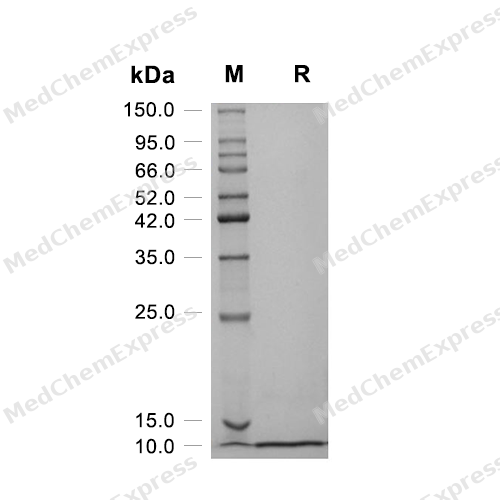
Purity - SDS-PAGE
-
Bioactivity - Cell-Based Assay
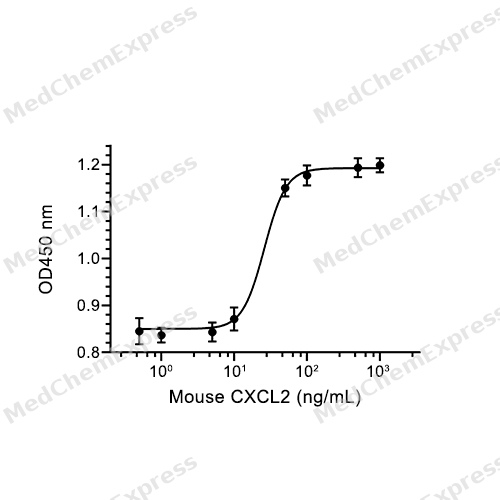
Bioactivity - Cell-Based Assay


Publications (1)
-
Journal Impact Factor
-
Most Recent
-
Cancer Lett
Circulating cytokine profiling and clustering identify biomarker predicting efficacy of ICI in combination with chemotherapy. [Abstract]2025 Oct 28:631:217918. PMID: 40701131


Technical Parameters
-
Species Mouse
-
Source E. coli
-
Tag Tag Free
-
Accession
P10889 (G27-N100)
-
Molecular Construction
-
N-term
-
CXCL2 (G27-N100)
Accession # P10889 -
C-term
-
-
Protein Length
Full Length of Mature Protein
-
Synonyms
CXCL2; Growth-Regulated Protein Beta; Prev. GRO2; GRO2 Oncogene; SCYB2; MIP2-Alpha; CINC-2a; Gro-Beta; MGSA-B; MIP2A; MIP-2a; Melanoma Growth Stimulatory Activity Beta; GROb; MGSA Beta; Macrophage Inflammatory Protein 2-Alpha; MIP2; Chemokine (C-X-C Motif
-
AA Sequence
GAVVASELRCQCLKTLPRVDFKNIQSLSVTPPGPHCAQTEVIATLKGGQKVCLDPEAPLVQKIIQKILNKGKAN
-
Predicted Molecular Mass
7.9 kDa
-
Molecular Weight
Approximately 10 kDa, based on SDS-PAGE under reducing conditions.
-
Purity
≥ 95%, as determined by reducing SDS-PAGE.


Product Properties
Lyophilized powder.
1.Lyophilized from a 0.22 μm filtered solution of PBS.
2.Lyophilized from a 0.22 μm filtered solution of 20 mM PB, 150 mM NaCl, pH 7.4.
Please refer to the lot-specific COA for specific buffer information.
<1 EU/μg, determined by LAL method.
It is not recommended to reconstitute to a concentration less than 100 μg/mL in ddH2O. For long term storage it is recommended to add a carrier protein (0.1% BSA, 5% HSA, 10% FBS or 5% Trehalose).
Stored at -20°C for 2 years from date of receipt. After reconstitution, it is stable at 4°C for 1 week or -20°C for longer (with carrier protein). It is recommended to freeze aliquots at -20°C or -80°C for extended storage.
Room temperature in continental US; may vary elsewhere.


Documentation
-
Data Sheet (264 KB)
-
SDS (252 KB)
- English - EN (252 KB)
- Français - FR (252 KB)
- Deutsch - DE (252 KB)
- Norwegian - NO (252 KB)
- Español - ES (252 KB)
- Swedish - SV (252 KB)
- Italian - IT (252 KB)
- Korean - KR (252 KB)
- Portuguese - PT (252 KB)
-
Handling Instructions (2659 KB)


References
[1]. Laila A Al-Alwan, et al. Differential roles of CXCL2 and CXCL3 and their receptors in regulating normal and asthmatic airway smooth muscle cell migration. J Immunol. 2013 Sep 1;191(5):2731-41. [Content Brief]
[2]. Chaochao Q, et al. Macrophage Inflammatory Protein-2 in High Mobility Group Box 1 Secretion of Macrophage Cells Exposed to Lipopolysaccharide. Cell Physiol Biochem. 2017;42(3):913-928. [Content Brief]
[3]. Louis M Pelus, et al. Peripheral blood stem cell mobilization: the CXCR2 ligand GRObeta rapidly mobilizes hematopoietic stem cells with enhanced engraftment properties. Exp Hematol. 2006 Aug;34(8):1010-20. [Content Brief]
[4]. Aimalie L Hardaway, et al. Marrow adipocyte-derived CXCL1 and CXCL2 contribute to osteolysis in metastatic prostate cancer. Clin Exp Metastasis. 2015 Apr;32(4):353-68. [Content Brief]
[5]. Jeongim Ha, et al. CXCL2 mediates lipopolysaccharide-induced osteoclastogenesis in RANKL-primed precursors. Cytokine. 2011 Jul;55(1):48-55. [Content Brief]
[6]. Yu Lu, et al. Type conversion of secretomes in a 3D TAM2 and HCC cell co-culture system and functional importance of CXCL2 in HCC. Sci Rep. 2016 Apr 27;6:24558. [Content Brief]
[7]. Sagar Paudel, et al. CXCL1 regulates neutrophil homeostasis in pneumonia-derived sepsis caused by Streptococcus pneumoniae serotype 3. Blood. 2019 Mar 21;133(12):1335-1345. [Content Brief]

Calculators
Concentration (start) × Volume (start) = Concentration (final) × Volume (final)


 Powered by Bioz

